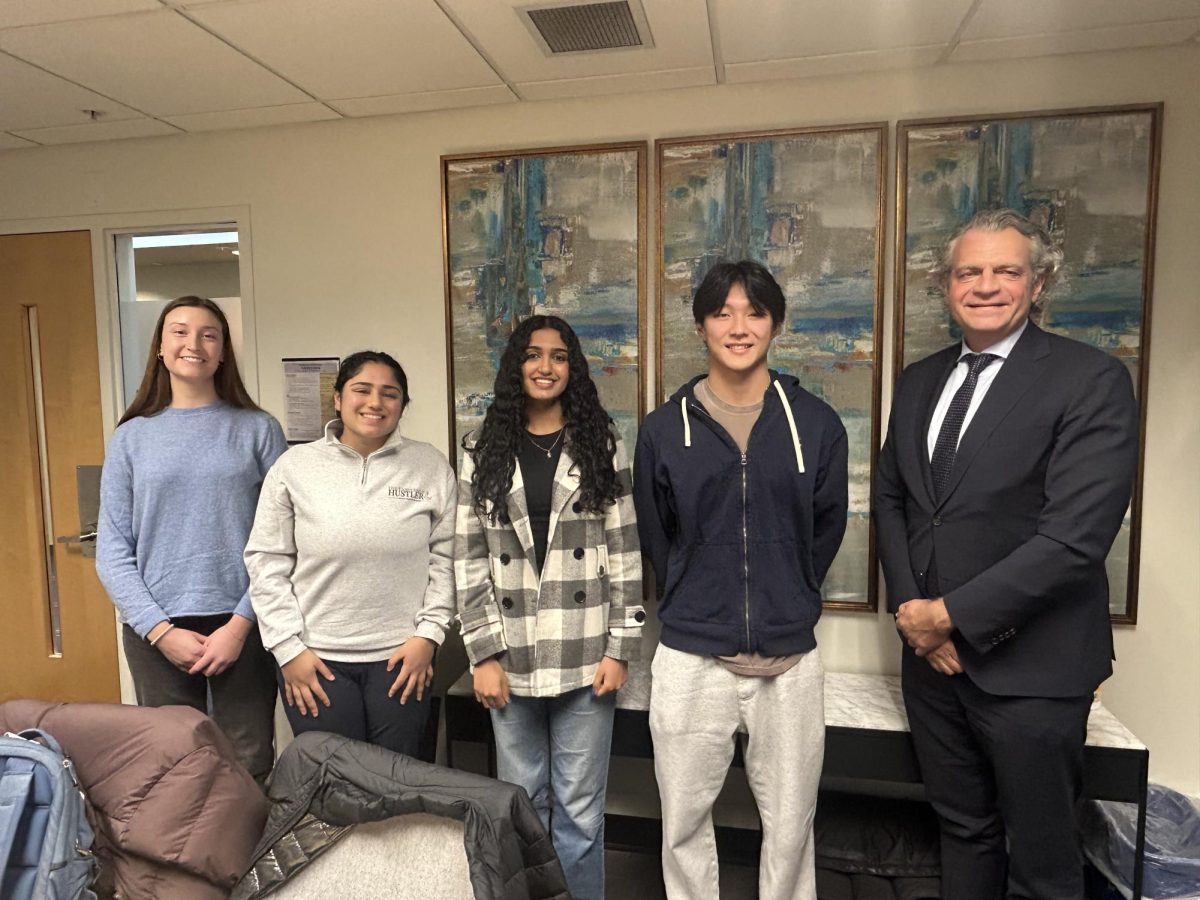


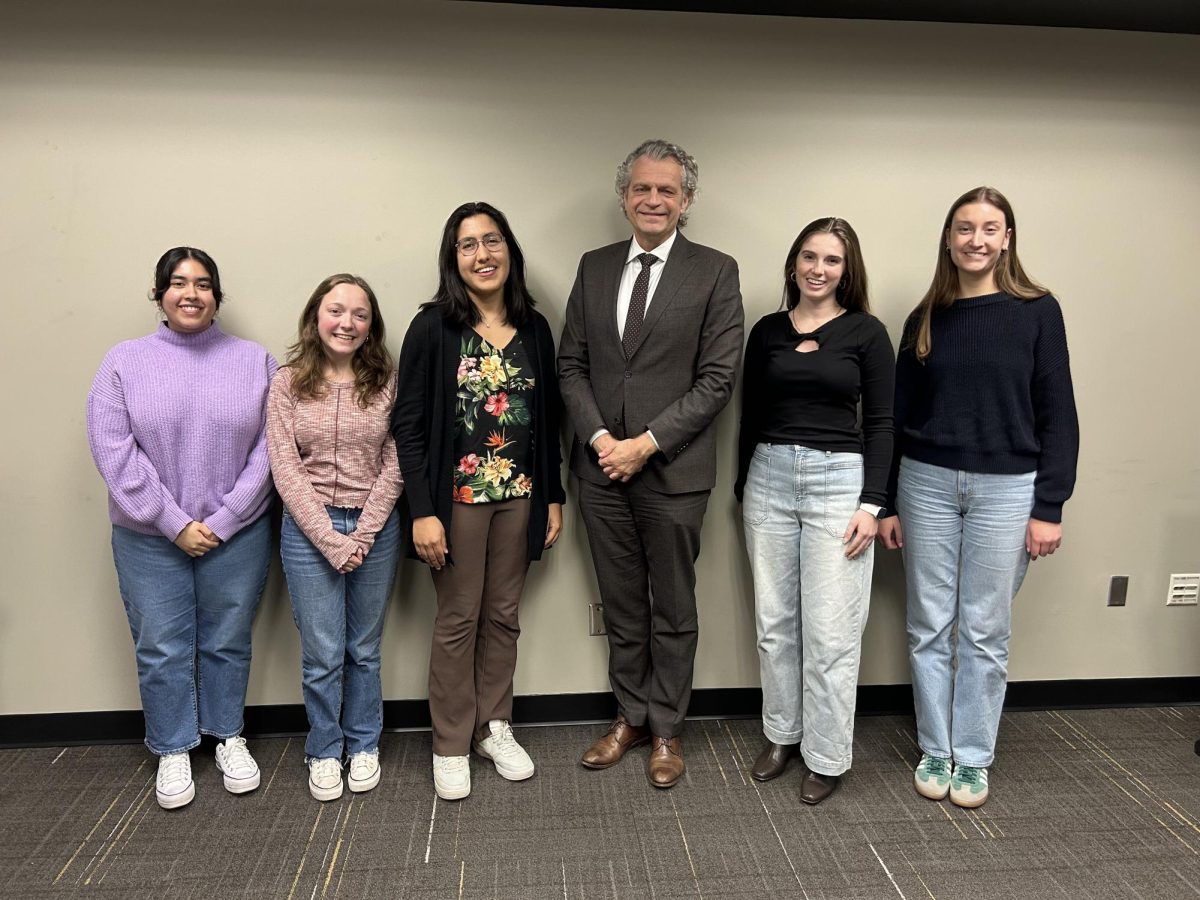
The Hustler spoke with Chancellor Daniel Diermeier for the last debrief of the fall 2025 semester. He discussed ongoing and potential campus expansions, changes to the admissions process, campus safety concerns and current political matters.
He also shared insight into prospective student programming changes, spring 2026 commencement and the 2034 Special Olympic Games, as well as the future of Vanderbilt’s football and women’s basketball teams.
Campus expansion and construction
The Hustler: Vanderbilt announced last month that a new residential college will be constructed on Commons, with construction expected to start this month and finish in time to house students for the 2027 to 2028 school year. What will the new residential college on Commons look like, and what can students expect from it?
Diermeier: We are building a new house there on the residential Commons, and we are slightly increasing the incoming class, and we just can’t accommodate people in the existing houses. Whenever we do this, there’s a detailed plan, but we make sure that there’s as little disruption as possible. So, it shouldn’t be anything unusual; it’s just another thing as part of what we want to do with respect to buildings, and, in particular, with respect to the residential college system.
The study abroad office recently hosted an information session on VU-NYC, Vanderbilt’s new campus in New York City. What has been the student response to the campus so far, and how is the university continuing to build momentum and prepare for the inaugural fall 2026 class?
We are on track to offer this opportunity for students [in the] next academic year. The student interest was off the charts. We had 394 students there. We were really, really heartened by the student interest. It’s a new part of the undergraduate experience at Vanderbilt, and it’s wonderful to see that so many students want to explore that and then see whether this is the right space for them. It’s a different type of educational experience than what we’re doing in Nashville. It’s really designed to take full advantage of what Manhattan and New York City and Chelsea [have] to offer.
International campuses
In terms of campus expansion, does Vanderbilt have plans to expand internationally? We have heard from some faculty that the university is considering plans in London. Are discussions about London actually occurring, or are there other locations the university is looking at?
The active plans right now are New York, West Palm Beach and San Francisco. We are exploring other opportunities. And that doesn’t mean everything we explore we’re going to do. We had looked at a couple of other opportunities that we decided [were] not good ideas. Our focus at first has been domestically. We’re not going to rule out something internationally, but if it’s international, it has to be the right fit. It has to be at the right time, and that means that it would need to create opportunities for faculty or the students that currently they do not have now. That may include an international location, but we’re not at a point where we have any type of kind of active consideration as we do in New York and West Palm Beach or in San Francisco.
You said that you didn’t decide to pursue some avenues you’re exploring. Can you tell us what those were?
No. Whenever we do [make a decision], we try to be very confidential. We have lots of confidential discussions with people, and that includes if we’re deciding that we’re not going to move forward. We keep that confidential until the point where we make a public announcement. [Campuses] where you know [where] those are, those are things that we were comfortable talking about. There are other things that we’re exploring right now or we’re not at this point for various reasons. And then there were other things where we had discussions, but we ensured confidentiality with people. When we decided not to move forward, we wanted to honor that commitment.
Are faculty opinions taken into consideration? Are these locations discussed with faculty before decisions are made?
There’s always ongoing dialogue. When we think about international locations, as you pointed out, we’ve had discussions on that. Now, what’s important is that when these opportunities come up, they tend to come up in a short window. So, you then have to basically have had dialogue for a long time. But then when the opportunity occurs, you need to take advantage of it.
For example, we’ve had multiyear discussions with faculty about increasing or enhancing [the] international footprint of Vanderbilt. There was a faculty report five years ago, [and] there were ongoing discussions, but it’s important to separate broader discussions about what we want to do from a particular project, which very often has to operate in a short time window and with a lot of confidentiality.
So, take the New York example. We had broad discussions [on] a variety of different ways [to] establish some kind of presence in other locations, including New York. But when the opportunity manifested itself, we had to act quickly, because the [General Theological Seminary], who was our partner there, had to make very quick decisions [in] a short timeframe. Under confidentiality, you can’t have five months of discussions. You’ve got to do it or you’re not going to do it. If you don’t do it now, it’s not going to happen. I think that’s these two things need to be separate, broader discussions about opportunities, where we want to go, and then the concrete example where there is an opportunity that then needs to be evaluated with speed and often confidentially.
Admissions
Provost Cybele Raver said that the new residential college on Commons will “allow [Vanderbilt] to extend even more students a Vanderbilt education.” Will Vanderbilt increase its enrollment numbers with the new addition, and what spurred the decision?
Universities that are healthy always will expand. 40 years ago, we didn’t have a neuroscience major. It didn’t exist as a field. But now we do, and now there’s a lot of interest in computer science and [artificial intelligence] related fields. So, we want to make sure that we have educational offerings that keep the curriculum fresh and prepare our students for meaningful and impactful careers. We still have to teach mathematics and history and economics and all of that, we’re adding educational offerings. So, there’s a natural growth. It’s not dramatic, but you always should expect some growth, whether that’s on the graduate side, on the faculty side, on the building side. It’s a good sign for universities because it means that they’re healthy and growing.
This year’s transfer class had a 24% increase, with 446 students being accepted compared to 359 last year. Why has this change occurred, and do you expect the transfer class size to continue increasing?
We had a tremendously strong transfer class this year. I think that’s another sign that things are going very well; students that have started their undergraduate experience at other universities really want to come here. The transfer class was super strong, so we expanded that a little bit as well. That’s kind of a year-to-year decision. What we’re doing [regarding] transfer students, is also a little bit driven by what the education offerings are when something new comes online [and] how it’s going with residential colleges. There’s a whole lot of variables that play into that, and so it gives us a little bit of flexibility. But the most important thing that we took away from this year’s transfer classes [was] significant increased interest in being part of the Vanderbilt community.
Vanderbilt adopted a test optional policy through Fall 2027. Does the university have plans to include standardized testing as part of its admissions process for classes following that?
This was really done at the time during [COVID-19]. It was [because] students just couldn’t reliably take standardized tests, and then we decided we’re just going to do an experiment. So it was necessitated by the experience — the difficulty that students [faced] to even submit test scores. What we decided [was] we’re going to have a period of a few years to see whether we see significant differences among the students that choose to submit test scores or not, and then we’re going to make an evaluation. Things may change, but that’s the design and the rationale.
Endowment
Vanderbilt’s 2025 endowment is $10.9 billion, which is a 9.9% increase from last year. How does this growth impact the university’s priorities in the short and long term?
The endowment is an enormously important part of doing the type of work that we do on campus, especially supporting our students. So, when people think about endowments, they sometimes think about it as one big bank account, but it’s really over 4,000 different accounts all dedicated by donors and philanthropists that want to support the university.
The overwhelming majority of the endowment is dedicated toward financial aid, Opportunity Vanderbilt and other programs. So, if the endowment grows, that allows us to support our students more broadly. It allows us to invest in our faculty and other academic initiatives. So, having a good year like we had last year, the money from the endowment is then used for financial aid, to support faculty research or other academic initiatives.
As Vanderbilt’s endowment continues to rise, do you think there is an opportunity, or an obligation, to change anything, perhaps about tuition, student support or programming?
We evaluate this every year. So, every year we’re making an evaluation about what we want to do with student support, financial aid, tuition levels and initiatives that support students and faculty. That’s part of the overall budgetary process. So, we just started that process, and it’s a process that happens every year when we have a particularly strong year in the endowment. It allows us to just provide more revenue to the university. So that’s a great thing. It gives us more flexibility. Also, money that comes from [the endowment] is usually smoothed out. So, you use three-year averages to account for year-to-year swings. That’s a very, very standard process. And you know, overall, it’s always good if you have more financial resources available. So, any year where the endowment is doing well, that allows us then to look at initiatives even more broadly than before.
Will some of this money be allocated to the planned new domestic campuses or elsewhere? Maybe new campuses?
What we try to do [with the domestic campuses] is to have basically the same structure, the same financial models that we have in the university at this campus. We’re not really thinking about them separately. It’s just like the platform is bigger. That’s another way to think about it. As an analogy, when we added the College of Connected Computing, we’re going to do more, but they don’t have a separate structure or anything like that. So, as we do more and as we’re growing, whether that is by adding another college or another major or another program or another department or another location, we just have to make sure that the resources across the board grow so that we can support that. And we’re very, very diligent and intentional.
Campus Safety
This semester, we’ve received tips about safety on campus, including car break-ins and recently unauthorized attempts to access student dorms. The 2025 Annual Security and Fire Safety Report also revealed that there was an increase in stalking and motor vehicle thefts on campus. In light of this, is the university more concerned about campus safety right now, and if so, what specific steps are being taken in response?
Campus safety and student safety is always a top priority for us, and it is something that we are monitoring very closely, and then we are responding appropriately. A few years, a little bit over a year ago now, we organized a whole variety of administrative functions, including public safety, which is now overseen by vice chancellor Darren Reisberg. We just appointed a new head of police, Tommye Sutton, who is looking already at engaging in a whole variety of initiatives to make sure that our students on campus are safe.
That is an ongoing process because we need to make sure that as we see things changing, data changing and our environment changing, that we’re reacting appropriately. We’re all over this, and we have a new great leader after Chief Washington stepped down, who is taking this on with a lot of energy and with a lot of intentionality.
How is the university measuring whether its response to these safety concerns is actually improving conditions for students?
Obviously looking at incidents, we’re tracking that. We’re also looking at reports. There’s a whole data center that is integrated [and is] the backbone, if you will, [of] what our public safety officers are doing. That’s an important input when we’re thinking about how [to] make sure that campus safety is at the highest level.
Politics and higher education
On Dec. 2, Republican Matt Van Epps ran against Democrat Aftyn Behn in a special election for the 7th Congressional District in Tennessee, where Van Epps won. How might the outcome of this election affect Vanderbilt and its students, if at all?
We have great relationships [with] the members of our congressional delegation, no matter what party they’re in. This, of course, is [a] particularly important election for us because the district includes Vanderbilt. We had [a] wonderful relationship with Mark Green, his predecessor, and we want to do the same thing.
It’s very important to us that we have great relationships with all public officials that have a connection to Vanderbilt — Metro Council, mayor, congressional [representatives,] senators, governors [and the] federal administration. [It’s] an important part of our responsibility to make sure that we have a collaborative and cooperative relationship with the decision makers [and] with public officials. Once they’re elected, we congratulate them, and we wish them the best, and then we want to have a great relationship.
What is the current status of Vanderbilt’s engagement with the higher education compact the Trump administration sent to nine universities, including Vanderbilt? Has the university moved beyond the review and feedback phase, and if so, is there a timeline for a decision?
The way this worked is we were part of a group of universities that were invited by the federal government to comment on the draft for the compact. We decided we would participate in that. There are now three universities that are part of this process that have declared their willingness, if you will. It’s us, Arizona State University and Washington University in St Louis. There is no process at this point. We haven’t gotten questions or anything like that. I would say things are in a phase where the federal government is in the process of figuring out how it wants to get this feedback structured, but there are no deadlines or anything like that.
Undergraduate and graduate students, faculty members and other individuals part of the Vanderbilt community have protested throughout the semester in response to the possibility of Vanderbilt complying with the higher education compact. How do you respond to these concerns?
Whenever we have to make a decision on that, we ask ourselves: How does this connect with our purpose and values? And as you know, dialogue is a very important part of what we do. And as I just mentioned earlier, we have great relationships with all levels of government, from the local government to state government to the federal government. Our point of view is that, when we are invited to participate and provide feedback, our natural inclination is to do so. We’ve done this repeatedly last year in a whole variety of issues, most prominently the endowment tax debate that was going on in Congress as part of the Big Beautiful Bill. What you learn in these interactions — in the case of this, this was a legislative action, a congressional action, where I was in Washington every other week — is that dialogue is useful. And very often, people have a perception of higher education, which is not quite accurate. It’s complicated.
Most people, if you ask them, ‘What’s an endowment?’ They think it’s a bank account. Just to give you an example from that, when we had discussions with members of Congress or staff members, people said, ‘Were you sitting on all of this money? Why aren’t you using that for financial aid more?’ I said, ‘Well, that’s what we’re doing, right?’ The bulk of the endowment is used for financial aid already. But, [the endowment] is not one big thing. It’s 4,000 separate accounts. That was an important conversation because no people understood that, [even] when they are engaged in policy making that would affect Vanderbilt directly. That’s an important part of how they’re now thinking about higher education. And we would do the same thing with respect to the compact. I think the idea that we should not talk to people at all, that’s certainly not something that I think is a wise course of action. And I don’t think our values demand that.
On the contrary, I think our values, our point of view on institutional neutrality, says that on issues that are outside of the core purpose of the university, the university should not take a position. But on issues that are inside the core purpose of the university, the university can take a position and can engage in however it chooses fit. The issues that are discussed and described and covered in the compact draft are clearly within the core purpose of the university. So that’s like questionable admissions and curriculum and those are core purpose areas of the university we want to be engaged with. So, it’s entirely appropriate for us to participate in this conversation, and then people can have a different point of view on that.
How you do it — [whether] you do it this way or that way — that’s fine, but I’m not convinced by the argument that you should not, if you are opposed to something or you support something, that you shouldn’t talk about it. We didn’t like the endowment tax either, and we were actively engaged, because engagement is useful, because engagement and dialogue allow you to understand better where people come from, and you have an opportunity to provide your point of view. That point of view may change where we’re going to end up. There was certainly the lesson from the endowment tax, which made a material difference. Literally tens of millions of dollars are available now to support our faculty or students because the endowment tax, even though we couldn’t completely prevent it from being enacted, is much smaller than the original percentages that were on the table. There was a complicated process of engagement; That is just the way our democracy works. We have to spend a lot of time back and forth trying to advocate our good position. We think that’s appropriate there. And we don’t really understand when people say that this is inappropriate here. It’s not obvious to me that that’s the right answer.
We’ve heard from faculty that C. Cybele Raver has been hosting listening sessions with the various academic colleges regarding the compact. Why is this and what do you hope to achieve from these listening sessions?
We love to hear everyone’s point of view. We’re the dialogue people; we like dialogue. We like to understand where people’s points of views are. We want to understand what their concerns are, and we want to make sure that they understand how we are thinking about it.
One example is many people were confused over how institutional neutrality applies to the compact. We made clear that whether and how we engage with the compact, you can have all sorts of concerns, but institutional neutrality is not one of them, because it’s inside the core. Those were important things because what you learn in these conversations is where people come from, you learn what their understanding of the issue is, you learn something about what the broader point of views are that are represented and then you can also provide your point of view.
So, these things are good things, always, especially in areas where people feel very strongly about it, and where they want to make sure that their voices are heard, so that’s why we did what we did there.
Campus happenings
MOSAIC was canceled this year — are there any other regular admissions events or inclusivity-related programming that will be canceled or altered in the near future?
We revamp and revise what we do during admissions and orientation all the time. So, when we look at particular programs, members of the administration have responsibility to make decisions on that, saying we want to try something new, we may have a better idea of how to do these types of things. That’s how we do things all the time. We want to make sure that things are fresh and not stale. And in this particular case, the people that were both part of admissions but also orientation programs are going to continue to try other things, have different programs, have different approaches. So that’s a standard thing of what we would do every year.
Are there any plans being made for the location of spring 2026 commencement? Is there any chance that the ceremony will be held either on Alumni Lawn to align with tradition or maybe even FirstBank football stadium?
We will certainly always evaluate the location. The reason we went off campus the last two years was because of construction. We didn’t have the opportunity to do it in our football stadium. The football stadium is done though, and looks great.
Alumni Lawn is really not an option for us anymore. It’s a wonderful place to have Founders Walk, which I hope is a memorable experience for everybody, certainly it is for me every time. The problem is that on Alumni Lawn, we just cannot accommodate as many people. I think 30% to 40% of the seats have restrictive views of the stage, and then there is another huge problem that people cannot bring more than one or two family members. So, this is not a good situation. I love Alumni Lawn. I think it is in a phenomenal location. It’s like the heart of campus, and that is where people start their journey, but we do not want our graduates to say that only their brother or their sister can come and one parent. That is not a good idea.
So, that [implies] we need to have a large enough space, which suggests the football stadium or a space of similar size. We did it at Bridgestone once, which was great too. It is a lot of people in a big space. This is an ongoing debate because we would love to have it outside, but then you have the question of rain and thunderstorms.
We are evaluating this right now, and we think last year worked very well, but that does not mean we cannot do something even better. The not-satisfied approach that we do for so many things applies to graduation as well.
Nashville was recently selected to host the 2034 Special Olympic Games along with the Nashville Convention and Visitors Corp. What plans are being made, especially concerning housing, athletic facilities and volunteer programs, to support the Games?
We were big supporters of that, and we wanted to be supportive of that. This is still a little bit away, so there is no concrete planning. It has taken place at this point, so we are still at the early stages of that, but we wanted to be very supportive.
Athletics
Vanderbilt’s football team recently beat the University of Tennessee, making this season the first time the team recorded 10 wins. How does the university plan to build upon this success and maintain momentum going into the next season?
It was a wonderful season, culminating with a wonderful win [against] the University of Tennessee, so we were all excited. The excitement for the football team is something that we have never seen before — off the charts. It is wonderful to see so much student enthusiasm and support. The student section [was] packed, and it is just a wonderful experience to see that the stadium is great, and, of course, the team is successful.
You released a statement advocating for Vanderbilt to earn a spot in the College Football Playoff and for Diego Pavia to win the Heisman Trophy. What pushed you to do that? Is that something you see as part of your normal duties as chancellor?
I am very proud of what we do on campus. I am proud of what we do in athletics. I am proud of what our students do every day in their classroom, what they accomplish as alums, what our faculty do and what our staff are doing. I am happy to advocate for them in whatever format is appropriate. This was on social media — yesterday, [I] was on a big panel in New York talking about the future of higher education. I love telling the Vanderbilt story because the Vanderbilt story is wonderful and worth telling. So, on the question of the playoffs and the Heisman, we totally belong in the playoffs. There’s no doubt in my mind. I think the record speaks for itself. And if we were only being evaluated on strength of schedule and performance, then we would be in. I think that this team deserves to be there. And just like when I criticize the U.S. News and World Report rankings, which are methodologically flawed, I would say that too. When I believe something and I think that this is something that needs to be said, I’m willing to say it. This team belongs in the College Football Playoff, and Diego Pavia should win the Heisman.
Were you aware that that the program was trying to get a 13th game scheduled to give it a potential chance to make the playoffs?
Oh, there was all sorts of fun. Things started on social media, right? Originally [it started] as a kind of crazy idea, and sometimes crazy ideas are worth thinking about. It was such a creative way to think about it. There is something appealing to say, rather than having some kind of obscure committee who uses all sorts of criteria that are sometimes difficult to follow: ‘Let’s settle this on the field of play.’ That was an appealing idea. It’s super complicated to get this done. And of course, at the end of the day, there were multiple hurdles that killed that idea right away. But, I thought it was a great idea.
Clark Lea officially signed a contract extension a few days ago. What does this mean for Vanderbilt football?
Clark Lea has done amazing work. We knew that when we hired Clark five years ago that he had the right level of ambition, the right level of experience and the sense of values and alignment with [what] Vanderbilt wanted to be, to be a great coach for our football team. The success that they have had this year is phenomenal, and I think it is very interesting to see the difference between last year and this year. Last year, of course, we had some phenomenal highlights — none bigger than the win over Alabama, and the goalpost, and carrying the thing to the river and all of that. But a lot of that was about extraordinary achievements, last-minute heroics, huge drama.
This year was methodical. They had a plan. They were clear about what their aspirations were. If you remember, they were ridiculed for that at the time, and then they executed. We are now in a position where we can go into any stadium in the country, and we are disappointed if we are not winning. That is a completely different situation than we had even a couple of years ago. So this is a well-structured, highly ambitious program that is delivering, and we love to support that, and we love to support the leaders that created that program, that set this level of aspiration and that then were able to achieve success in order to advance what they were trying to do.
Can you give us any details of Lea’s extension, maybe elaborating on the resources that you allocated to Lea’s disposal?
Because we are a private university, we do not disclose details of compensation unless required by law. The compensation decisions like the one for Coach Lea will be treated privately.
Women’s Basketball player Mikayla Blakes scored her 1000th point last night, doing it in 42 games (fastest in program history). Our women’s soccer team made the elite 8 — with women’s sports on the rise and historically receiving less resources. How is Vanderbilt continuing to uplift women’s sports in the community?
We love what is going on in basketball, and we love what is going on in soccer. I thought they were dominating in their game, and we were unlucky not to win it. We have invested in women’s volleyball, as you know, at a time when most other academic programs are cutting or reducing their support, especially for women’s sports. We have done just the opposite, and we are very proud of what our teams are accomplishing.
Women’s and men’s basketball have had a fantastic start to the season. Mikayla Blakes has been fantastic. The whole trajectory is wonderful. We are now in a position where we are ranked in the top 25 in both our top men’s and women’s programs. And, assuming we are going to be ranked in baseball, that means we will have the top men’s program and two top women’s programs in college athletics. That is incredible. It reflects our commitment to attracting the best talent — coaching and player-wise — and putting them in an environment where they can realize their full potential. That is what we are seeing right now.
We are getting the excitement and the success on the field, and it is a wonderful time at Vanderbilt. We are winning on and off the field. Off the field, we are creating the College of Connected Computing, where we attracted the best leader we could imagine. We established the Institute of National Security, again attracting the best leader we could imagine. Those achievements are not as visible, but when you see the results on the basketball court, it all comes together.
The important thing is that we are winning on the court and off the court. We talked a bit about transfer students — we are seeing a significant increase in demand on the admissions side. We are attracting great talent on the faculty side. We are firing on all cylinders, but it is especially exciting to see this success so directly and so vividly in what is happening right now for basketball and also soccer.
Five-star recruit Jared Curtis recently announced his commitment flip from the University of Georgia to Vanderbilt, and three-star recruit Owen Cabell also changed his commitment from the University of Alabama to Vanderbilt. What do you think is inspiring these commitment flips, and how do you expect this increased interest to impact Vanderbilt’s football program?
We’re on a roll as a university. And just like leaders such as Paul Nakasone and Matthew Johnson-Roberson, [they] want to be part of the academic side. Players want to be part of that. They see the momentum; they see that this is a program on the rise, and they want to be part of building something and creating something that has not been created before. That is exciting.
People that have high ambitions and that want to realize those ambitions want to be at a place where they can turn their ambitions and their goals and their dreams into reality. Universities succeed when they are a place that attracts the best talent and create an environment where they can succeed. We are seeing this in the labs, we are seeing this on campus, we are seeing it with the students that want to come to Vanderbilt, and now we are seeing it on the athletic fields as well. We are extremely excited about that.
I think the fact that the top quarterback in the country is joining Vanderbilt is astonishing. And again, going back five and a half years ago, and where we were and how far we have come, if we can do this, we can do anything. It is a great reminder to see this in athletics because it is so visible, it is engaging emotionally, but it shows for what can be done if we set our ambitions high and create the environment where they can be realized.
Editor’s Mix
Do you have a favorite season on campus?
I think what makes the campus so beautiful is the sense of nature and the trees. So, naturally spring and fall bring that out in their most magnificent form. I cannot decide between spring and fall.
What is a small detail about Vanderbilt that you personally love?
It is not so niche, but I love the culture that we have. I have been in many universities. The combination [of] wanting to do great things together is really unique, and what is a great joy in my role is that I experience this every day in very different ways. Being surrounded by people that have a common sense of purpose and vision that are excited about doing something new and bold and are not shrinking away from challenges and then are able to figure it out together under sometimes not-so-easy circumstances is enormously gratifying.
What do you hope current students will say or take away from their Vanderbilt experience in the future, maybe 10 years from now?
That they had the time of their lives when they were at Vanderbilt, that it helped them grow academically and as people and that they explored many different things that will last them a lifetime. That they made lifelong friends and that they will always be an active, and engaged and excited member of the Vanderbilt community.





Disappointed in the Hustler • Dec 17, 2025 at 10:09 am CST
yawn. More softballs for der Fuhrer.