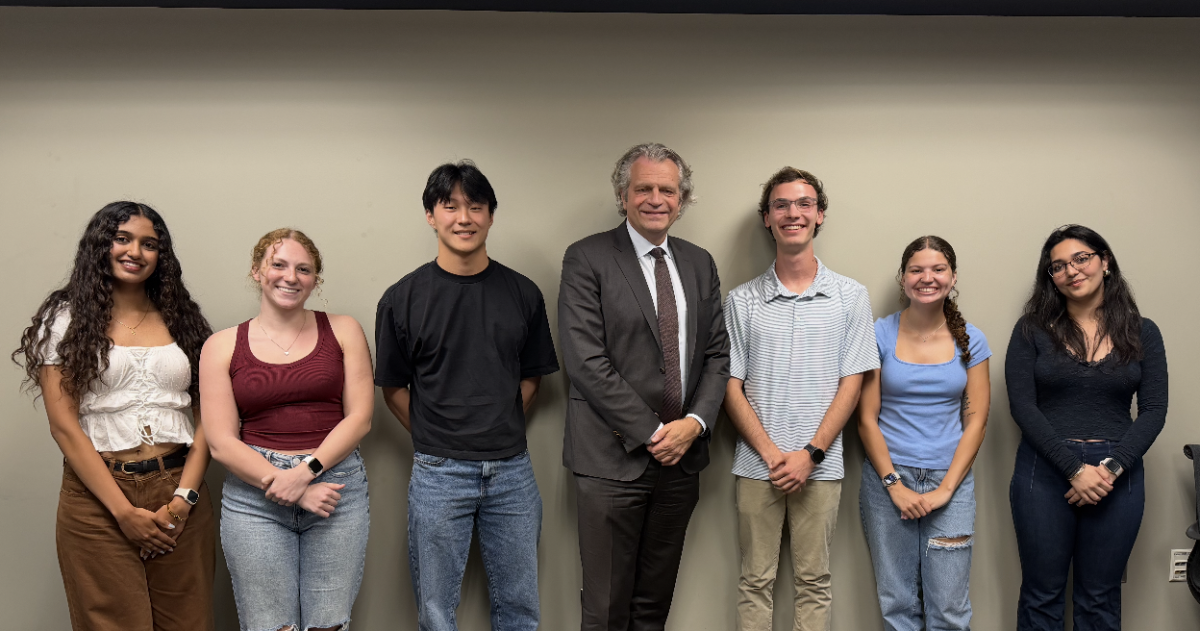


Chancellor Daniel Diermeier sat down with The Hustler for the second debrief of 2026. The chancellor discussed how the university is navigating construction and the rising number of students interested in Vanderbilt, as well as the changing world of college athletics.
Diermeier also touched on the proposed West End innovation district, the Verto transfer admissions program, Vanderbilt Graduate Workers United, free speech on campus and the Rand cookie.
Campus and construction
The Hustler: This semester has seen a fire in North House and a flood in West House. Additionally, several Mayfield residents were relocated following sewage leakage in their showers. How has the university handled the damage as well as the movement of students across campus to other dorms?
Diermeier: So, from time to time, we have a problem with our facilities, and then, you know, student safety is always number one. Whenever that happens, we want to make sure students are safe, and then people get relocated, and then we do the necessary repairs and then once things are safe again, we can have people move back. So, there’s just basically a process that we always follow in those cases.
Has this impacted construction work on the new first-year dorm?
No, I think there is just a massive effort whenever we do large construction projects. But whenever we have construction needs or maintenance needs or anything like that, we have enough staff. And then if we need to bring other people, we just bring them in.
The university currently is working on renovating parts of Commons, the baseball stadium and the area around the Student Life Center, among other projects. Do you see an end in sight for major construction work on campus?
There is a lot going on right now. That’s surely the case, and in part because whenever you do a particular project in the university context, these things run on a yearly cycle. Most of the construction has to be timed for the academic year so that if we want to open, let’s say, a new residential college, it needs to be ready by a particular point in time so when students move in, everything’s ready to go. So that drives, to a certain extent, the construction cycle. Sometimes that means we have to do two to three projects at the same time. Sometimes we can space them appropriately.
The way you want to think about campuses is like, yes, there are constantly some kind of new investments in construction going on, and it’s just because we do new things and we have new fields and faculty’s research projects expand. So Stevenson Center 6, for example, is driven by the need to renovate our lab spaces and to make sure that existing faculty and new faculty have the appropriate lab spaces. So, it’s a need to upgrade facilities because if we don’t do that, you can’t provide a really robust research environment, and the same too with students’ colleges or accommodations.
We’re committed to a residential college model, and this is a 25-year project, and we’re now at a point where we’re ready to complete the final steps on that, which will be absolutely monumental, but then there may be something else in the future. What you want to see is universities growing, and often that requires construction, but not always. So, it’s really an ongoing process.
Right now, I think there’s a lot going on at the same time because we have a whole bunch of projects, some research, some student life, some athletics. They’re all kind of going on at the same time. And we don’t want to stack them because if we stack them, then we have to wait like 10 years to build a research building, and that’s not a good idea. I understand the inconveniences and that it makes it a little bit difficult to find your way around and certain things are more difficult, but the benefit for the university community is really super.
Deliberation on the Specific Plan for Vanderbilt’s proposed innovation district has been deferred by the Metro Planning Commission three times now. What hurdles has Vanderbilt been facing in the rezoning process?
I don’t think they’re hurdles, really. I think it’s more like that we have ongoing discussions, and we just want to make sure we get it right, and so we like the process. Basically, the way you want to think about it is you have your plans, and then you have a conversation, and you want to make some adjustments. So, we’re not worried about this. We think that the conversation so far has been really productive. We think that the support that we’re getting from Metro and from the governor’s office and the planning staff has been very strong, so we’re not worried about this at this point.
How has the university engaged its neighbors in the planning and decision-making process for the innovation district?
There were literally dozens of meetings with the neighbors. So, I mean, like a month of meetings and details, meetings in small groups, individual meetings. And we’re very intentional about making sure that the voice of the community and of the neighbors is really fully represented. If we understand what their concerns are, we can incorporate that into our planning process, to this like literally months of conversations.
What concerns have the university’s neighbors brought up in these discussions, and how does the university plan to address them?
Most importantly, I think people want to see that this enhances the neighborhood, that this is something that makes our neighborhood, our community a windfall. That’s number one. The second thing is then everybody’s always worried about parking, you know, how’s the parking going to work? These are specific details, and then people want to have questions about this road and that road. How is that going to be affected? So, you know, very practical questions about how the development and the development process will affect people’s lives. I think those were the main themes.
Are there conversations with people currently using the land that will be developed into this innovation district about moving elsewhere? What is the university doing to help the people who are already running businesses there?
This will be done in phases. The whole plan is easily a 20-year process. Phase one, there’s a lot of land which is basically parking lots right now, so at this point, phase one would really be concentrated on that. So there’s no need for dislocation or anything like that. And then there’s the question of who owns the land, what are the long-term leases. All that stuff always needs to be thought about, but for phase one, we don’t see any problems along those lines.
Admissions
This year saw a record low 2.8% admissions rate for regular decision students, pulling down its overall admissions rate to 4.7%. To what would you attribute this change?
Well, I think that we have seen a tremendous increase in interest in going to Vanderbilt. I think there are multiple dimensions to this: The first dimension is that we offer a particular type of undergraduate education which is really resonating with people. So, what I would say is the university is an academically rigorous place, but it also pays attention to creating an environment where our students can grow as people, as well, as part of the process. And the aforementioned residential college system is an example of that, the ability for students to engage in student life activities. And then I think it’s also just the culture that we have, which is that we’re a collaborative place. We’re a place where we are one community, where people support and challenge each other. So, I think that’s ‘pillar one’ that is very attractive to people. And we’re not a cut-throat place. So, whenever I spend time with students — and I do this once a month, I have dinner with students in the residential colleges — it’s a very consistent sentiment. That’s why people want to come. And then that’s their reality when they’re on campus, especially in comparison to other universities. Nashville is great. The weather is great. So, there is all this; that’s the nature of the educational offering, and that gets better every year.
Two, the positioning that we have on institutional neutrality, on civil discourse, is very attractive. And we see this from what people, what students write in their essays and also what families and parents are talking about. That is, always, whenever you talk to visiting families, that’s their number one or number two priority, always top of the top of mind. And again, that is in contrast to the experience that people have, or just their sense of what’s going on at other universities, including the obvious. And then the third thing is athletics. I think the success rate of the football team continued with basketball, and people love that. That’s an important added ingredient. I think it’s a great thing for the student community and creates kind of another sense of school spirit.
So, what we’re now seeing that, again, we see this in the conversations, not just from the data. People are now looking at Vanderbilt as a credible alternative to any university in the country.
This admissions process also saw the introduction of the Verto transfer program, allowing students to do one year abroad before attending. What motivated the university to join the other 60+ institutions working with Verto?
We have seen this sudden and tremendous increase in student interest to come to Vanderbilt, and we have a lot more qualified students than we can admit. So, we have been actively exploring pathways to Vanderbilt that are not through the typical first-year admissions process. There are multiple such pathways. There is: you go to another university, and after a year or so, you try to apply for transfer. Or we have a couple of students that go to community college and then transfer over. I was at one of these dinners, and I was sitting next to this person who was the number one graduate in the community colleges in her state and then went over to Vanderbilt. And so, this Verto program is another thing that may work. It’s an experimental thing. We tried it this year, and then we have to evaluate it. We will look for opportunities for students to join Vanderbilt through multiple different pathways. This is a new pathway that we’ve tried. I will have to see how it goes.
Some applicants took to online messaging sites and social media to share that while they initially received an offer to apply for the Verto program, their offer was rescinded due to max occupancy. What do you have to say to those applicants who were interested in the program but were unable to grab a spot in time after not being notified of a cap?
One of the problems with the program is that the space for that is limited, too, because we only have a limited number of transfer spots every year. It’s very dispiriting if you kind of get rejected twice, you know. Your first rejection from Vanderbilt, then you can’t get into the program. That’s very dispiriting and very disappointing. So, I think that is one aspect that we have to evaluate as we’re looking at the entire set of offerings that we brought to the table, that we put in front of people, to think about a transfer path to Vanderbilt. But my sense is, at this point, we really have to evaluate the whole picture. So, we want to get through this one cycle, see how it goes, and we’re going to make decisions.
Why is Vanderbilt expanding its transfer pathways?
It’s not so much that we’re expanding. We have always had a kind of particular type of transfer student. That’s always a decision that we make kind of year-to-year. It’s more like that we want to make sure that — just like for the first-year students — that for the transfer students, we’re a destination for the most promising student for whom Vanderbilt is the best choice. So, by offering these pathways, you are basically telling people — that right now are very excited about going to Vanderbilt — there’s another path for you. It’s the same motivation for why we want to be a destination of choice for first-year students. It’s not about expanding the pool. It’s just about providing additional pathways so that the students that really, really, really want to be at Vanderbilt when they transfer see a way in order to have the highest likelihood of probability of success.
Anchor Day is happening both this weekend and last weekend. What do you hope admitted students see while they’re on their visit?
We hope that they’ll love it. We know that this is a wonderful student experience when you visit on campus, whether you do as a kind of looking at multiple colleges or after being admitted. It’s very, very important that you have a great sense whether this is the right place for you, and so we hope that the students that are here get a sense for what Vanderbilt really is because the important thing for us is that we pick them and they pick us, you know. There needs to be a good match. Not every student is a great match for Vanderbilt, and sometimes students may want to choose to go somewhere else, so the matching is really important. When they talk to you or your classmates on campus, we hope you tell them that they all should come to Vanderbilt.
The MOSAIC program, which formerly happened at the same time as Anchor Day, was canceled this year. Is there any programming as part of Anchor Day targeted toward students of minority backgrounds to make sure they feel welcome on campus?
We talked about the MOSAIC program last time, but what we’re trying to do is always create an environment where every student, no matter what their background is, feels welcome, so there’s a humongous amount of programming around that. The important thing is always that we want to make sure that when you come here and you visit, you feel that this is a place where you feel that you can thrive, that it is a welcoming community. We all come from different backgrounds, we all have different experiences, we have different perspectives, we have different points of view, but this is a place where you can thrive. I think that’s working very well. That’s the feedback that we’re getting. And then, as always, when we’re done with this admission season, we’re going to review and see whether there’s anything we can do better, and then we make, we’re going to try to improve wherever we see that there’s need for improvement.
Student life
Arthur C. Brooks was announced as this year’s Graduates Day speaker. What factors determine who you select a speaker for the role?
We always like to pick a speaker for Graduates Day that is a prominent voice and that has insights and lessons to offer that would be inspiring and provide insights, important insights, for graduating students. And Arthur Brooks has done a lot of work on how to live the good life. And I think that’s a wonderful topic to reflect on and think about, particularly as our graduating students take a big step of transition from their time at Vanderbilt into their time being alums and now embarking on whatever next chapter they’re doing. It’s a wonderful moment to reflect on what it means to live a meaningful life.
This semester has seen multiple AlertVU messages after several nearby emergency situations, with the most recent being on April 2 due to a shooting at 2700 West End Ave. Has the university taken any additional action to ensure student safety here on campus?
First of all, whenever we have cases like that, it’s very important that we notify the community so that people can take the appropriate action. That’s an important responsibility for us. Second, we’re constantly evaluating how do we be even more effective with respect to public safety on campus. And we have a new chief there, Chief Tommy Sutton, who is doing a great job at that. We’re doing another review process right now to make sure that everything we do is everything possible to keep our student community safe, so that’s an ongoing process. And then this year in particular, we did an overview process on that, and that has questions about how you staff people. How do you train them, technology, all sorts of stuff? Now, every time there is an alert like that, it’s upsetting. It’s upsetting to me when I see that, and it’s upsetting to everybody else. When you look at the data and the trends there, we’re looking pretty good, and things are trending in the right direction, but that doesn’t mean that we can be complacent. It means that we need to continue to do important work to keep our community safe.
President Donald Trump signed an executive order March 26 to address “DEI Discrimination by Federal Contractors.” Previous executive orders weren’t addressed to federal contractors, but you have referred to Vanderbilt as a federal contractor in previous conversations. How does this executive order apply to Vanderbilt, and what steps is the university taking to comply with it?
We’re still evaluating that. Whenever we get an executive order, particularly one that affects us or whether it’s research or our educational mission, we look at it closely. We don’t have a point of view on this at this point, and we’re still trying to understand exactly what the implications are.
The Vanderbilt Graduate Workers United union just recently held a protest in front of Garland in support of graduate workers in crisis, particularly international workers. How would you describe the university’s relationship with the union, and can you comment on any action you have taken to satisfy their current or previous demands?
I mean, they call themselves the Graduate Workers Union, but they’re not a union. So, they’re like a group of individual graduate students that have, you know, issued statements, issued demands, and I think that’s basically it, but they’re not of any official status.
Many peer institutions have unions for their graduate students. Why has Vanderbilt not taken that route when there are students who are clearly interested in forming such a union?
We have been very clear that we believe that, as a private university, there is no legal basis for graduate student unionization. We’ve made that clear. We’ve made it clear in court. We’ve made it clear publicly, and our point of view is that graduate students are first and foremost students, and that any type of activities they engage in, whether it’s as part of working in a lab or being a teaching assistant, is part of their education. And so it’s misleading to think about this as the same type of activities that you would do if you work in a factory or anything like that. That is not the relationship that we have with our students, and this is the position we’ve always maintained, and we will maintain. We’ve been very clear on that. We’ve been clear on that for years, and we have communicated that clearly. We’ve communicated it clearly to the graduate students, and we’ve also communicated clearly that we are super interested in the well-being of our graduate students but that we don’t think that unionization is the appropriate or legal way to accomplish that.
Earlier this semester, VUMC announced that they would be ending all gender-affirming surgeries. What are your thoughts on this decision, and do you think it affects campus in any way?
The relationship that we have with VUMC, or as they’re now called, Vanderbilt Health, is that Vanderbilt Health is entirely responsible for clinical decisions. We do not offer clinical care. We’re not involved with clinical care. That is something that Vanderbilt Health is really doing as part of their role. This is a clinical decision, and they have their reasons for it, and that’s their responsibility. So, I don’t think it will have an impact on the university because we’re not offering clinical care services.
Following the recent court ruling allowing a former student’s lawsuit for false arrest to move forward, is the university taking any steps to ensure that VUPS procedures for trespassing and student accountability meetings are clear and applied fairly to avoid similar legal challenges in the future?
Sorry, I don’t know the details of that. I would have to familiarize myself with that.
The Charlie Kirk Act, which bans walkouts during speaker’s events and large signs at on-campus protests, recently passed the Tennessee House and is advanced to the governor’s desk. How is the university planning to act in response to its passing?
Well, we are a private university, so this particular law doesn’t apply to us. We have, I think, a very, very good set of policies about how we relate to invited speakers. As you know, we have broad latitudes for students and faculty to bring speakers to campus as they see fit, and then we have a sense that protesting speakers is okay, but disruption is not. So, nothing has changed as a consequence of that. The policies and processes that we have are exactly the same.
Athletics
The Trump Administration just signed an executive order directing the NCAA to create rules putting a five-year cap on how long athletes can play for and limiting an athlete to only one transfer before graduating without having to sit out for a season. With plans to go into effect August 1, how does Vanderbilt plan to respond, and do you think this will be sustainable?
I think we need to evaluate exactly what this means. I mean, this is rare that the President would make an executive order with respect to college athletics. So, we need to understand what’s the legal standing of that. There’s a bunch of bills pending in Congress right now trying to reform college athletics. We have been very actively involved with our colleagues at the SEC to co-design and come up with a system that is, I would say, more structured and more regularized than what we have right now. There’s a lot to say on that. It’s a really complicated problem. I don’t think anybody’s happy with how things are going right now. I think that the problems that come from too many transfers, unregulated agents, I mean, there’s a whole bunch of things that are problems, so we need to address that. And so, we welcome the fact that there’s a new set of ideas out there, but exactly what the status for us is just not clear at this point.
Women’s Basketball head coach Shea Ralph was named the Naismith Women’s College Coach of the Year. What do you see from her as a leader?
Well, first of all, fantastic, great recognition, so deserved, and we’re so happy for Coach Ralph. And I think we had a fantastic year, and to see the progress of the program over the last four years has been tremendous. So we love the direction of the program, and what we particularly like about Coach Ralph is that she embodies the values of Vanderbilt in her work on the court as well, and when you see some of the press conferences of how our players, her players, respond to that is just remarkable to see. So, we love to have coaches that are successful on the field of play, but they do it the Vanderbilt way, and she’s absolutely doing that.
Questions from the student body
We are now two years removed from the pro-Palestine sit-in at Kirkland Hall. Can you reflect on the university’s response to the pro-Palestine movement on campus?
We have a strong commitment to free speech on campus, and I think our students have done really an admirable job after Oct. 7 to exercise that. There was support for each other, but there also was passionate debate, and people were arguing for their position and were struggling, I think, to deal with the situation. That’s great. What’s not great is when we have violations of university policies. And in this particular case, that was clearly the case we had, where we had multiple rules violated intentionally. Whenever we have a violation of rules, then there’s a disciplinary process. And so we went to the disciplinary process, and every one of the students that was involved had their own disciplinary process, and there were outcomes of the disciplinary process, which is the way this should be done. I think we handled this exactly as we should have. We think that the rules that we had were great, were appropriate for this particular case.
Then there’s always a question of you want to always do a little bit better. We clarified some things that were not so clear. And I think that the discourse culture, the culture of free expression on campus, is fantastic. We have active College Republican and College Democrat chapters on campus that host joint events. That’s not typical at universities, so I think the culture of free expression on campus is strong, and Dialogue Vanderbilt is doing a phenomenal job to further strengthen that, and I think that’s one of the reasons why students want to come to Vanderbilt.
Vanderbilt Football and Men’s and Women’s Basketball have both came off of historic seasons. What do you see the future of these sports looking like, and will the current momentum in Vanderbilt Athletics continue to be taken advantage of as we begin to set our eyes on national championships?
So, the progress that we’ve made in athletics has been nothing short of amazing. And I like to reflect sometimes, when I look at last year, on when we were a little disappointed that we didn’t make the playoffs, which is quite a development from where we started five and a half years ago. Five and a half years ago, we had a program, which particularly in football, was not successful in the fall of 2020. We lost all games in the SEC. This was during COVID-19, and two weeks after I arrived on campus, there was an op-ed in the Tennessean that said ‘an open letter to the Chancellor.’ The new Chancellor, me, in this case, was encouraged to leave the SEC because we were an embarrassment to the conference. That was five and a half years ago, and we made the commitment that Vanderbilt’s athletics is as much part of Vanderbilt as the law school, as any other part, and that we will be competitive in football and in basketball. And we did it. And my view is always, if we can do this, we can do anything. I mean nobody, very, very few people thought this was possible.
So now the question is what’s the ceiling and, and I don’t see a ceiling for these programs. I think that we have a great structure in place. We have the greatest athletic director in the country. We have phenomenal coaches that are really an embodiment of the Vanderbilt spirit. We have great support from the student body and from the alums. And the rules of competition have changed and are going to continue to change, and the way in which you were successful two years ago is not the same way in which you’re successful now if you just look at Indiana as an example. So a lot of change, and in an environment when there’s a lot of change, if you are clear what your goals are, and you are clear about your aspirations and you’re willing to act with speed and with determination, you can do my amazing things.
Editor’s mix
Are you sad about the death of the Rand cookie?
As you know, the manufacturer went out of business, and I think it was really sad. And for me, it was personally sad because when I was announced as the chancellor, which was in December 2019, the students at the time had great ideas. It was really complicated. The whole schedule was complicated. So, they had the idea to take me on a tour around campus to the things I must see. But it was at night for some odd reason. It was like eight or nine. It was dark already, and one of the first things they did is they said, ‘you have to have a Rand cookie.’ So, we walk in Rand, and Rand was closed at this point, but they had a fresh batch of Rand cookies waiting for me. So, I had my first Rand cookie on the day I was announced, and it was such a special moment. And now the brand is no more. So, I think we grieve together and try to have a future here that is just as tasty and bright, but I have to say, it was a little personal thing for me, as well.
Are you going to Rites of Spring, and if so, are you excited?
This is a very intense period for me. Always, it’s like April and May, and so I am missing Rites of Spring. I’m actually leaving tomorrow at 6 a.m. And then I’m back here again, and then I’m like, another thing. This is the end of the campaign, end of the semester. There’s a lot of demand. So, there is very little free time that comes up. Free time usually comes back in June, not right now. It’s like, all hands on deck.
What is your favorite way to relax in the summer?
I like to read a little bit more. I try to do it in a disciplined fashion so that I try to read something every day. When it’s not so crazy as right now, I can do it consistently, but there are some days it is utterly, to me, really enjoyable and wonderful to just be in a nice place and be able to eat a little bit, spend time with friends and family, have good food and a great conversation and don’t do anything more than that.
Responses have been edited for length and clarity.








Jonathan Magnolia Gilligan • May 11, 2026 at 11:57 am CDT
When Chancellor Diermeier says that the decision by Vanderbilt University Medical Center to stop providing gender-affirming surgical care will not have an impact on the university, he is wrong.
First, the end of gender-affirming surgical care at VUMC means that our medical school can no longer offer training in these procedures. For more than a decade, VUMC boasted, year after year, of its excellence in gender-affirming health care, saying that VUMC was providing important and much-needed care to a high-risk and underserved population. There are not enough trained plastic surgeons in the US who perform gender-affirming procedures, and Vanderbilt used to be one of the most highly-ranked institutions in the nation for offering such care and training. Terminating these training opportunities through VU medical school hurts our university’s reputation in a medical specialty in which VUMC and the Medical School had spent many years boasting of our excellence and our placements in nationwide rankings.
This action comes on top of other actions over the past several years that have undermined trust in VUMC from the larger LGBTQ+ community in Middle Tennessee, such as releasing confidential health records for trans patients to Tennessee Attorney General Jonathan Skrmetti, and the closure last summer of most of the award-winning VUMC Program in LGBTQ+ health,. These actions led the LGBTQ+ caucus of the Metro Nashville Council to issue a statement of “no confidence” in VUMC and its leadership last year.
Second, when VUMC ends its clinical practice of gender-affirming surgeries, transgender students, faculty, and staff will have to travel hundreds of miles to receive this kind of care. After surgical procedures, they will need to stay away from campus for extended periods while recovering, and will have to travel back frequently for post-surgical follow-up care.
All of this travel will disrupt their ability to participate in teaching, learning, and other activities on campus. It is stunning that the Chancellor does not think that this will affect the university.
Third, as Vanderbilt plans to open new campuses in New York City and San Francisco, two cities with politically active LGBTQ+ communities, the fact that the “Vanderbilt” brand is now associated with curtailing clinical programs for trans and other LGBTQ+ patients and failing to protect their privacy, will affect the reputation of our university in those cities, and may stimulate political opposition to new initiatives we may try to launch in those locations.
For several years, LGBTQ+ people on campus—students, faculty, and staff, have come to feel that since Daniel Diermeier became Chancellor, the university has stopped caring about our rights or our well-being. The broader LGBTQ+ community in Middle Tennessee has also been losing confidence that it can trust VUMC, and by association Vanderbilt University. The chancellor’s careless and incorrect statement that none of this affects the university reinforces this perception that the university’s administration does not think we matter. This erosion of trust hurts LGBTQ+ people on campus and also damages the Vanderbilt brand nationwide.