

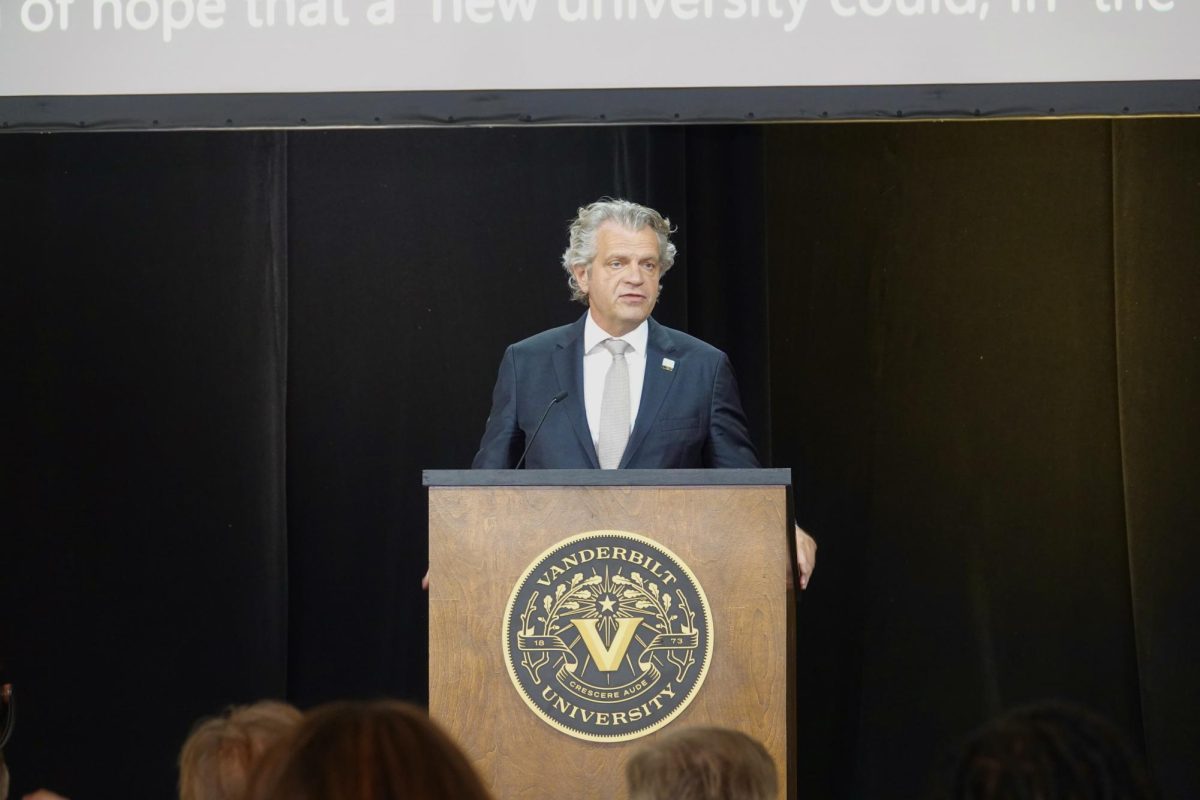
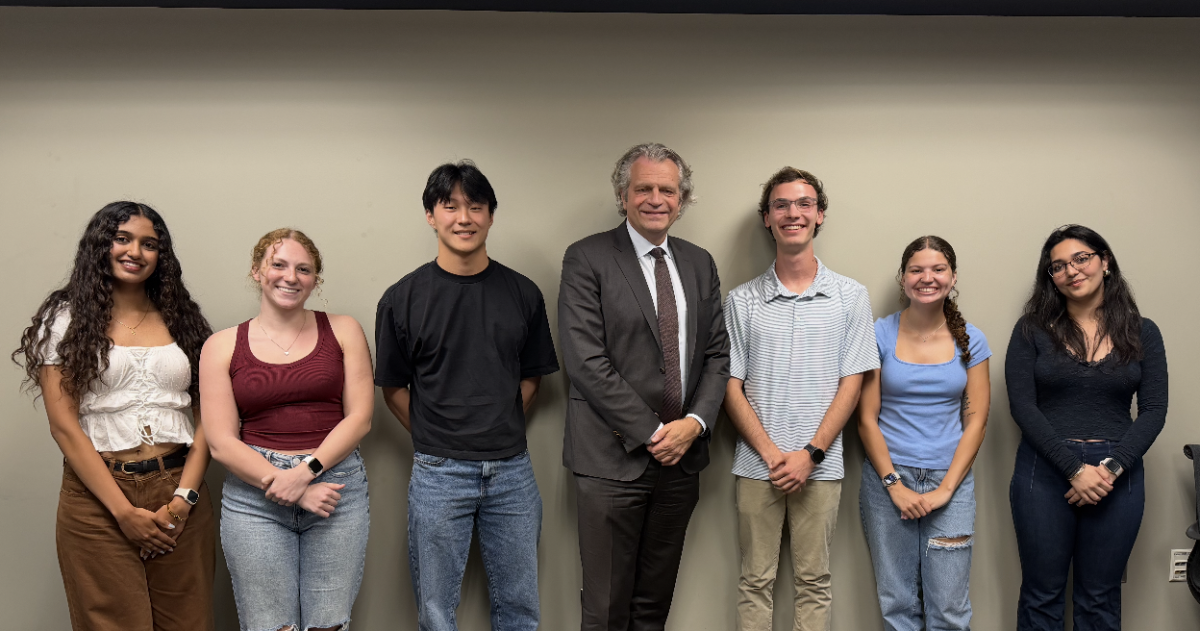
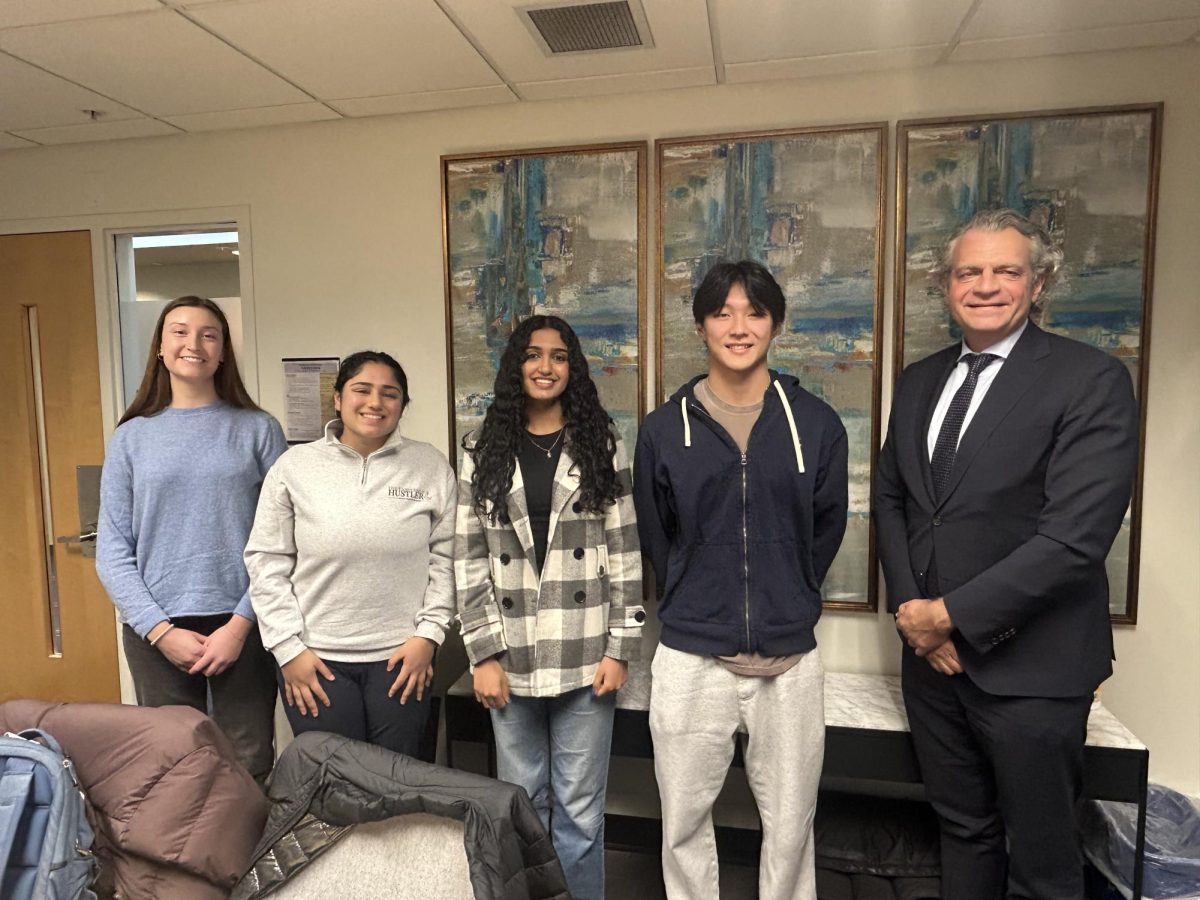
The Hustler sat down with Chancellor Daniel Diermeier for the first debrief of 2026. The chancellor discussed the recent closure of campus due to inclement weather and the decision-making process behind it, as well as the success of Vanderbilt Athletics and where the program is heading.
He also shared insight into the university’s ongoing conversations about the higher education compact, opening new campuses around the country, student safety, diversity and inclusion, AI use and Greek life.
Severe weather preparedness
The Hustler: The university closed school for five days last week due to snow, making up nearly half of the number of snow days the university has ever had in history — which we found to be 13. What goes into consideration for shutting down university operations, and how does the school plan to prepare itself for future storms in light of the long-lasting effects of the most recent one?
Diermeier: So, there are always two considerations. One consideration is campus safety, and that’s us making sure that people don’t get injured. And then on the other hand, of course, we want to maintain the high quality, great education that we provide for you. That’s why these decisions are always tough because every time we lose a day, we have to cut into the snow days, and it’s always a tradeoff between these two things.
When I look back over the last week, our people did an amazing job. I mean, really amazing. They were working around the clock. They [served 25,212 meals between Saturday and Monday]. We had power. We had heat. I’m 10 days now without power and heat. So, when you look at what happened to Nashville, I think that you can look back to that. And I think we did a very good job. It’s very hard to prepare for these things perfectly because there are sometimes kinds of typical events. A typical event for us, we usually get a couple of days of snow. The ice storm was one of the worst storms we’ve ever recorded in the history in Nashville.
What made it so difficult was that the ice was on the branches, the branches fell down, and the sidewalks were caked in ice. I think our people did everything they could to make sure that we were able to stay open, but after two and a half days, we just decided we just couldn’t do it. And we said, ‘We’re going to close the whole week.’ So those are the tradeoffs. Those are the decisions that always go in. On the one hand, campus safety. On the other hand, maintaining our commitment to a great education, and then you have to make those decisions based on where you are. So, I think overall, I think this went very well, but this was a really serious challenge, not only for Vanderbilt, but for the whole Nashville community. And as you know, the footnote on that is that we also opened up a warming center for the community, which was very well received by the community and much needed.
Some students took to social media throughout the snowstorm to complain about how there was an initial lack of action to cancel class, and the university often waited until the last minute to do so. What do you have to say to those who claim their safety and well-being were not adequately considered in the hazardous conditions?
Well, I can tell you their safety was adequately considered. But the problem is that you’re dealing with a situation that changes rapidly, and then there are just operational challenges that you’re dealing with. So, an important part that we were dealing with at the time was: How do we make the walkways accessible? And you may remember that there were multiple areas where entire branches were over there, and then they were frozen in, so then people tried to make it work. And then you just see what you can or can’t make work. What we do is we try to make sure there always is a balance. We try to, on the one hand, make the decision. On the one hand, the later you do make the decision, the more information you have. On the other hand, then it’s harder for people to prepare. So that’s the problem, and there is no way out of that because you’re dealing with an evolving situation. So, you always balance these two perspectives, campus safety, student safety, commitment to our high-quality education, and you do the best you can. Overall, I think this was very good. But I can always look back and say, ‘Why didn’t you say it two hours earlier? Why didn’t you do that?’ That’s the nature of the beast.
In addition to student safety, was faculty safety considered?
Of course. That’s a whole other set of concerns, right? How do people get to campus? Access roads, childcare. All that stuff is a whole other level of complexity that you have to consider. The first, most important thing is to make sure that people on campus are safe. And then the next question is, how does this affect our faculty and our staff, and how do you make that work? These are always difficult situations. Every time we have a situation like that, we also look back and see what we can improve. Process-wise, we’re going to do this again this time, but people need to remember that this was a monumental storm, unprecedented in the history of the whole of the city, or almost unprecedented in the history of the city. So that needs to be kept in mind.
Was there a reason that the university chose not to offer virtual classes?
Our commitment is to in-person education. This was before you were here, but we worked extremely hard to have a lot of in-person education during COVID-19. What we learned during that, and I think what many other campuses learned, is the value of in-person education, that we are a living-learning community, and that being together and going to class together and having conversations in class cannot be replicated to the same extent in a virtual environment. So we’re very reluctant to go there, and so we will always do everything possible to have the same commitment to education that we have every day, even when things get difficult.
Vanderbilt hosted a men’s basketball game Tuesday night, Jan. 27. Was that taken into consideration when classes were initially scheduled for Wednesday but then canceled once the game started, and how was fan safety taken into consideration?
Same thing. When we look at athletic events, we look at the safety. That was evaluated. Obviously, fans have to come in and out, and our campus operations and public safety team looked at that. When they decided that they were able to have the game on campus, they went ahead, and I think it went very well.
Athletics
Star quarterback Diego Pavia went viral across multiple social media platforms after comments and videos about his Heisman competitors and the Heisman voters. As we continue to grow in the public eye for our athletic programs, how do we continue to uphold Vanderbilt’s reputation as a prestigious institution and also help our athletes navigate media attention in the new world surrounding that?
We want to make sure that everyone who is part of our community represents themselves to the public, according to our values and standards. And I think that Diego learned from that. He has apologized for that publicly. That was part of his own development and growth. We spend a lot of time with our student athletes to prepare them for the fact that athletics gets a lot of social media attention in general, and that is an environment that they may not be familiar with. They are students, like every one of our students, and it’s not easy to deal with that. We try to prepare them as much as we can, but it’s difficult. There’s so much attention there, and we want them to represent the university well, and if there are things that didn’t go well, apologizing is the appropriate response.
How has the changing NIL landscape in the past few years affected the way the university looks to recruit and retain athletes?
NIL has been a big challenge for college athletics. It really changed the whole way college athletics is operating. Many of the rules that have governed college athletics, in large part because of legal challenges, were basically not operating in the last year and a half. That dramatically changed how athletics operates, and it already started the year before. The situation we’re in right now is that we have an antitrust settlement, the House settlement, which has put a structure for moving forward that would deal with some of the very unfortunate aspects of NIL. That allowed us, of course, to have a revenue share with our student athletes. The worry is that right now it’s not working so well yet, and there are complicated reasons for that, but the concern that many people have, and I share that concern, is that we had this phase where many of the rules were suspended. There was supposed to be a rule-based structure, but right now, it’s not so clear that that’s working, and so there’s always a sense of transition, but boy, it would be important that we get this straightened out.
In this year’s football transfer portal, Vanderbilt acquired 17 players, while 16 players from Vanderbilt entered the portal. What efforts has the university made to aid retention among Vanderbilt athletes and increase our appeal for those in the transfer portal looking to come here?
The roster of every sport is really what the coaches do, of course, together with the athletic director. That’s an important role that they have, and so they need to make sure that we have a competitive team next year. And then what we need to do is make sure that Vanderbilt is a great place for students when they come here to take advantage of legitimate NIL opportunities, and we’re doing that. There’s a lot of work that goes into it, and I think we do this very well. Vice Chancellor Candice Lee, but really the whole university, has been supporting that. This is the important thing. We want to make sure that we’re creating an environment where student-athletes want to be, where they can thrive, and where they can succeed in the world of current culture that includes legitimate NIL opportunities.
Both men’s and women’s basketball have had very successful seasons so far. However, student attendance at men’s games is much higher than student attendance at women’s games, despite the women’s team having a better record. Given today’s release of the new Anchored for Her program, what are the goals for this campaign? What other ways is the university working to drive up fan and student support for women’s basketball and other sports that don’t traditionally get as much media or fan attention as sports like football and men’s basketball?
We are very committed to women’s athletics. You mentioned the Anchored for Her campaign, and another example, our basketball operations facilities — including the practice courts — are exactly the same for both men’s and women’s teams, which reflects that commitment. We want our students to support both the men’s and women’s programs. The women’s team has had a fantastic, historic run. They’ve been phenomenal, and their games have been incredibly exciting. I would encourage students to come out and support both teams. This is a historic opportunity to see one of the great Vanderbilt teams compete, and students should take full advantage of it —especially when it’s cold outside.
Since launching Vandy United in 2021, the university has completed a number of athletics construction projects. With the tennis facilities and baseball stadium currently under construction and construction on the football stadium complete, what’s next for Vandy United?
So the next things we’re thinking about are in the next phase, and we will continue to extend our capital campaign for something in the football operations area. And then we have to think about what we’re going to do at Memorial Gym. We love Memorial Gym. It’s great. It’s a great historic facility. It’s a unique stadium. For those of you who have been to the games, when you’re there and walking in, it’s full of people as fans, and student engagement is fantastic. But there are also things that I think need to be improved. I think the hospitality and the food, things like that, are not at the level that we want them to be. So, both of these are big endeavors. They’re big projects. So right now, we’re really in the phase where we’re thinking through exactly what we want to do in these areas. I would say those are the two biggest things that we’re going to look at for the future.
As far as construction goes for the Anchored for Her campaign, what will facility enhancements look like?
There are big things, and there are smaller things that we do. I think on the basketball side, we’re really in super shape. This is arguably the best operations and practice facility in the country, and that makes a difference in terms of being a destination for student athletes and also having an environment where they really can succeed. There always may be specific other things that we’re going to look at, but my sense is that the big capital projects that we’re talking about would be part of how we think about Vandy United as well.
Do you have any details about the Women’s/Olympics Sports Performance Center mentioned in the Anchored for Her press release?
I think that’s another part, of course, the Olympic sports, where we have made great progress, for example, in track and field. Tennis is doing great. Golf teams are doing great. So there’s been a lot of progress on that. You know, women’s bowling is not an Olympic sport, but it continues to be a great source of pride for us. I think those things are still being conceptualized. We just kind of kicked up the process and exactly how this is going to manifest itself is a little bit down further.
Politics and the federal government
When we spoke to you last in December regarding the higher education compact, you said the university was willing to provide feedback to the federal government, but that no system had been set up for doing so. Since then, The New York Times reported that a second draft of the compact was in the works, and Secretary of Education Linda McMahon said in an interview with The Daily Signal that there are a lot of people — both university-affiliated and otherwise — providing input on a new version of the compact. Is Vanderbilt among those she is referring to?
We’re having all sorts of conversations. There’ve been conversations among university presidents. I have not heard anything that there is some kind of a second compact version in process, and because I haven’t heard anything, we haven’t commented on that. That’s news to me that that’s what the administration is thinking about. And you know, we then we need to wait for what the process for that is, but we haven’t read anything about a second draft or a second version, so we’ll have to wait and see what this looks like.
Are any of these conversations with the federal government or just with other universities?
We have all sorts of conversations with all sorts of people all the time.
If there is a final draft, do you envision that Vanderbilt will choose to accept or reject it publicly?
We don’t know even whether there will be a draft. Our view on these things is we’ll deal with the decisions when they’re in front of us, and we understand what they’re about and what the details are, and then we make the decisions that we want to make at this particular point. We have no idea what this is going to look like. We have no idea what the process is like, so we’ll wait until this has happened.
One of the stipulations of the original compact was a cap on international undergraduate student enrollment at 15%. According to The New York Times, when the original compact was not signed by any universities, the State Department started prioritizing visa requests from students at universities under the 15% mark. Vanderbilt is one of these universities (with around 11% international undergraduate student enrollment). Have you seen the effects of this prioritization of visa requests happening at Vanderbilt?
We don’t know whether they’re prioritized or not. We know that we have had a good success with having visa applications processed and accepted. We had challenges in the first half of the year, but much less so in the last half of the year. We don’t know whether they’re prioritizing or not. All we can speak to is what’s happening on our campus, and our students and their things are going fine.
Amidst news about the actions of ICE agents in places like Minneapolis and the protests happening there and elsewhere, what steps is Vanderbilt taking to prioritize the safety of its international students?
We always will, for all of us, want to make sure that they’re safe and that they’re protected. That hasn’t changed. We have a significant number of international students on campus, some undergraduate, some graduate students. Whenever we have a particular issue, there’s support for international students. The ISSS office is very knowledgeable on that and is supporting students on that. And it’s the same thing. We’ll deal with the challenges when they emerge, and we have a lot of support in place for our students on that. We’ve done this for the last year, and that’s what we’re going to continue.
If ICE were to come onto our campus, does the university have a plan of action? How would the university respond?
A hypothetical is always difficult because everything depends on what the circumstances are. Our commitment is to protect our students to the extent that’s permitted by law and to provide the appropriate support structures to any type of situation that we may face.
Are you able to give any reassurance to students that they would be protected from ICE if they were to arrive on campus?
Well, as I said before, we will support and protect our students to the extent that’s possible for us, that’s legal for us, and that’s what we would do. We did that last year, and we will continue to do that in the current environment.
The Multicultural Leadership Council, along with over 34 other student organizations, released a statement Jan. 22 calling on Vanderbilt University to uphold its stated values of inclusion after MOSAIC was cancelled. How does the university plan to continue protecting marginalized communities and promoting diversity in future Vanderbilt admitted classes?
What I would say is that our commitment to students from diverse backgrounds has not changed. It always comes in two parts. The first part is that we want to make sure that we remove barriers to access for students. Those are the financial ones. That’s where Opportunity Vanderbilt comes in, which is a great program to make sure that students can attend Vanderbilt irrespective of their background, irrespective of the financial resources their family has, and can graduate debt-free.
And then we want to make sure that when they’re here, they thrive. There are many, many things that we do for that, starting with the residential college model, the programming that happens during the first year, even how we welcome students to campus and the very rich student life that we pride ourselves on. So that’s our commitment, and that hasn’t changed.
And then you always adjust. You try to see what’s working, what’s working better and where there are new challenges. For example, one of the initiatives we started a few years ago was on the access side for rural students. We joined — along with the University of Chicago — as leaders in starting the STARS Network to make it easier for students from rural backgrounds to attend universities, because it’s not only financial barriers but non-financial barriers as well, and those are different for every student group.
We also have a partnership with Metro [Nashville] Public Schools. We want to make it easier for students who go to Metro Public Schools to attend Vanderbilt, especially those who come from very resource-constrained environments. The values are always the same, and the question is which programs to use to advance those values in the context you’re dealing with. That’s the way I would think about it.
A new batch of Epstein files was just released by the DOJ, a few of which mentioned Vanderbilt, VUMC and a former chancellor. Is the university planning to make a statement or address any potential connection to the files?
I have no idea. I mean, whenever there’s issues pertaining to the university, we would look into that. And then if there was a need for a statement, maybe we could make one, but we don’t know at this point.
Campus expansion
The university has now announced it will move forward with campuses in New York, San Francisco and West Palm Beach. At the New York campus, most students who attend will spend a semester taking classes and doing an internship. How does the process of securing that internship go about? Are there preset options that students will be placed in, or are they expected to find their own internships?
We’re working very hard at that, and we really want to make sure that students are participating in this study away experience that’s fully integrated and takes full advantage of being in New York in this particular case. There will be great internship opportunities for students because of the types of industries that they may be interested in and are particularly strong in New York. That’s going to be a great thing. There’s going to be great opportunities for our students, whether they want to spend their semester in New York or also they just have an interest in working in New York as part of their career or just having an internship.
Is Vanderbilt considering helping students find internships in Nashville in the same way or integrating internships or co-ops into the curriculum of Vanderbilt’s Nashville campus?
We’re very successful in that. I think it’s much easier to do it in Nashville because that’s where we’ve been for 153 years. So, we have great relationships with that. But not every one of our students wants to work in Nashville. One of the reasons, not the only one, we were looking at the New York Campus is that it is a big destination. It’s the biggest alumni chapter outside of Nashville, in New York. So, there’s a lot of interest in that, and for us, it’s important that the students that come here from all over the country have access to career opportunities where they want to be and in the industries or the areas where they want to work. So, for example, if you want to work in the visual art space, there are opportunities in Nashville, but there are a lot in New York because it’s the most important art city or art community in the country. Us being able to be there allows students to have opportunities there. You just have to be intentional about this, providing opportunities for students to have great access and career opportunities in particular areas.
Are there specific options for students who are interested in Nashville’s industries, like the music business for instance, to have a kind of semester away, but in Nashville, where they’re working in an internship for a semester instead of taking classes?
It’s a very good question. The way you want to think about it is like this: what these campuses, number one, do is they allow us to be connected with a community, with an ecosystem that we don’t have locally. Second, they allow us to experiment, so an important question for us is, if this works well, what we do in New York, we absolutely can think about offering something similar in Nashville. The demand for students to work in the music side is not very high. Where there’s a lot more demand from our students is in the healthcare side and the healthcare management side, and they are working very well. I think that’s more like a question of scale than it’s been a question of principle.
Switching to the West Palm Beach campus, it’s being marketed as a graduate campus, but will there be any undergraduate interaction with this campus?
What we’re envisioning there is a larger campus. We’re envisioning roughly 1000 students there and faculty, and most of them will be master’s students and Ph.D. students, but we want to do what we’re doing in New York. We want to have a study away program there as well for students that are particularly interested in those areas or in industries that are particularly strong in the Palm Beach and South Florida area. That’s an opportunity there. That’s still a little out because, in contrast to in New York, in Florida, we actually need to build a building, which is going to take a couple of years, and then, as we’re finalizing our programming there, we absolutely want to have an opportunity for undergraduate students there as well.
Can you speak a little bit as to what sort of graduate programs might be offered there?
At this point, you can think about us in two categories. Category one is at the intersection of business, finance and technology, and the second one is in engineering. And there we’re looking at a couple of areas where the region is particularly promising. One example is space. Blue Origin, for example, is about an hour, an hour and a half north, on the train. A lot of our engineering students are interested in the space side, and so that’s one example. There are also things in systems engineering. We’re looking at advanced manufacturing on the defense side. That’s not totally finalized yet, but that’s what we’re looking at.
For the San Francisco campus, why was it chosen to be a full-time campus where undergraduate students spend all four years as opposed to a study-away location like NYC?
It’s also going to be a study-away location. Everything we’re going to do, that’s always going to be part of it. And then the question is, how do you anchor that? In New York, it’s small enough. We have one master’s program, and then the campus is right there for the undergraduates. In West Palm Beach, we’re anchoring it with the graduate programs, but again, there will be an opportunity for undergraduates to spend time there. Chattanooga will be focused on quantum applications, quantum engineering, so for students that have an interest in that area, they can spend some time there. The same is going to be true in San Francisco.
The difference in San Francisco is that we want to conceptualize what kind of a different type of undergraduate education would look like. That is, if you will, just a kind of different way to think about what undergraduate education would look like in the age of technology. We don’t quite know exactly what that would look like, but that’s what we’re thinking about. The whole point of having a network is that there is flow back and forth, that there are different ways to think about education, and that these expand the opportunities for students. That’s the whole point. So to go back to the quantum campus, we want what we’re building in Chattanooga to allow for students, whether they’re from physics or from engineering, to work at the very cutting edge of quantum engineering, right there on site in what is now the leading quantum testbed in the country. That is not anything we can do in Nashville. It’s impossible to do. Whether it’s a community, whether it’s an opportunity because of a particular sector or whether it’s a particular research infrastructure, that’s the way we’re thinking about it.
Is there any possibility of San Francisco having athletic teams?
We’re not going to have a football stadium there. That’s not going to happen, but I think it’s a great question. I think something we are exploring is whether we can have a game a year there. If we could have a basketball game or football, that would be exciting. An important part for us is, how do we make sure that we have a common culture and a sense of one Vanderbilt there? Getting that right will be really important. And athletics, of course, can play an important role in that. So exactly how we’re going to do this, we don’t know yet, but the idea of having athletics playing a role is absolutely something we are going to consider.
How do you envision a unified Vanderbilt culture for students specifically being in San Francisco for four years?
This is super important, and one reason why students come to Vanderbilt is because of our strong culture, because of our commitment to the Dare to Grow pillar, where we want to make sure that our students grow academically and as people. And the second thing, the sense of community, when we talk about radical collaboration, we believe that students grow best and can realize their potential fully when they’re members of a community that’s supporting and challenging. That’s going to be the key. Now, you have to ask yourself exactly how you implement that in different settings. That is going to be a top priority for us because it’s super important that the thing, which I think makes Vanderbilt Vanderbilt, in an essential way, needs to be strengthened and prepared.
How does the university plan to reassure students staying in Nashville that their own experience will not be impacted by the increased delegation of resources elsewhere?
I wouldn’t call it delegation of resources, and I think people sometimes think that there is one pot of resources that just can be allocated. That is not true. People sometimes call it a kind of a zero sum fallacy. By that, I mean everything we do in this network of campuses enhances opportunity compared to where we are now. A vast majority of the resources are provided by the local community that is kind of welcoming. We’ve seen this now very, very clearly in West Palm Beach, where the city and the county have given us the land, and we have had great fundraising success by local people who have no connection with Vanderbilt. The way you want to think about this is that the vast majority of the financial support that we’re getting in West Palm Beach is not available for the Nashville campus, [it] would not happen [without West Palm Beach]. So think about this as expanding opportunities for students right now and expanding opportunities for the university as a whole.
Then remember we’re doing a lot on campus here as well. We did, for example, the College of Connected Computing. Recently, we’re massively investing in additional residential colleges. All that is happening right here in Nashville, so you don’t want to think about this as either-or, a fixed amount or zero sum. That’s clearly not the way this is working, but by doing things that are doing both, we’re expanding the resources that are there to support Vanderbilt and also the opportunities for faculty and for students.
Student life
Vanderbilt recently released new AI tools for students to use, including ChatGPT accounts associated with Vanderbilt emails. How is Vanderbilt navigating this environment of encouraging AI use while also ensuring enforcement of the honor code?
We have made the decision that we want to make sure that our students are proficient in using AI tools across the board. We have this from biomedical research all the way down to anthropology and history. This technology is dramatically enhancing the ability for education and for research. That’s the great thing, and we’re all in on that, and that’s why we have made this tool available to students. And we’re going to continue to do more. Our students, when they come here, they sign an honor code, and that honor code means that if in a class where they’re not allowed to use ChatGPT and they do, they’re violating the honor code, just like if they hire somebody to write their paper for them. It’s the same thing, so our approach has been to trust our faculty members who teach a particular class to decide, based on the pedagogical goals of the class, whether and how ChatGPT or other large language models can be used, or really any technology can be used, and then we expect our students to be compliant with that. If there’s a violation, and students are found in violation of a particular policy, then there’s a disciplinary process, just like with anything else when students violate academic integrity. Nothing is fundamentally different.
A couple of weekends ago, several fraternity parties were shut down after a multitude of police cars and ambulances arrived on Greek row. What are your thoughts about Greek life here on campus, and does Vanderbilt have any intentions to reform or disband it?
Greek life, I think, is an important part of the student experience. A section of our student body chooses to participate in that, and, for them, that’s a very important part. All of our students are expected to uphold the kind of standards of conduct that we expect from anybody, whether on campus or off campus. And if that’s happening, that’s great. If it’s not happening, then we have to take action accordingly. And it could be specific for individual students, or it can be with respect to student organizations, and that’s what we would do. So, there’s nothing really particularly different or new about that. It’s important for our students to understand that when they come here, there are expectations about appropriate behavior, and we put our trust in them that they do so, and then in the unfortunate case where they don’t, then there’s a potential for kind of disciplinary consequences, either individually or for the organization.
Editor’s mix
If campus squirrels could unionize, what do you think they would demand first?
Free acorns. I think free acorns and safety crossing the road. I think some place where there’s like a buffet of acorns.
How far do you predict Vanderbilt’s women’s and men’s basketball teams will make it into March Madness this year?
Well, as people say, predictions are hard, especially about the future. I’m very excited about the potential of the teams. The problem in the tournaments is that it’s one game, and there’s a last-minute buzzer beater, and it hits the rim, and you lose, and you make it and you advance to the next round. So, in the March Madness format, there’s a tremendous amount of randomness, but I think they have a really good shot.
If Vanderbilt Women’s Basketball secures a top-four seed and it gets to host the first and second rounds on our campus, will Vanderbilt do anything special?
We will definitely think about doing something special. I think we had the experience with football in the fall and what the success of the football team did to galvanize the campus community. I think our team is very creative and does exciting things. Remember the drone show for the first evening game, or when the parachuters were coming down. We have great, creative people, and if we are lucky enough to host that part of the tournament on campus, I am sure we are going to do something great.
Will you watch the Super Bowl on Sunday?
It’s always hard when you watch the Super Bowl, and there’s no real team to root for. I think they’re deserving teams, and I think it’s kind of like an American holiday, right? So I think I will watch it, but I am not going watch it, biting my nails, rooting for one team or the other.
Who do you think is going to win?
I don’t really know. I think there’s a little bit something about the Patriots that is kind of unlikely. I’m just going to say the Patriots, so I can say something, but it’s not clear to me. I think that this is going to be a tight game, and I don’t think there’s a clear favorite.









Bree • Feb 18, 2026 at 8:29 am CST
“We have all sorts of conversations with all sorts of people all the time.” i wish i could go back in time and decline my acceptance