Vanderbilt- and WashU-commissioned report on politicization of humanities fields sparks controversy among faculty, cited professors


Fernando Villanea, professor of anthropology at the University of Colorado Boulder, was among the professors whose work was cited in the report as a purported example of politically motivated anthropology research. Villanea believes the report’s authors mischaracterized his work, a cause for concern due to what he perceives as a departure from typical methods of academic research.
“None of the authors ever engaged with any active scholars in the fields they are criticizing,” Villanea said in an email to The Hustler. “They didn’t reach out to the many scholarly associations, never interviewed a single academic, they delegated their work to subwriters they don’t mention by name and even used AI to survey my and all my colleagues’ writing. They didn’t even make their internal reports available; they just ask us to believe their conclusion without showing us the evidence.”
In an interview with The Chronicle of Higher Education, author Kwame Anthony Appiah described how artificial intelligence and external researchers were used to survey large bodies of text and identify themes. The internal reports have not been made available due to some authors’ reluctance to release them, although others have said they plan to release the internal reports they worked on.
Villanea said his colleagues are outraged at the misrepresentation of their work and believe the report was commissioned in bad faith.
“[The authors] were lazy, and the report is slop. And now that’s attached to the Vanderbilt name,” Villanea said.
The report comes at a time when faculty and course offerings have already been affected for alleged politicization of academics. The University of Texas System has tried to limit its faculty teaching “controversial topics,” and Texas A&M’s similar restrictions on teaching gender ideology led to the removal of some sections of Plato from a professor’s course.
“I wish I could dismiss this report for what it is, the rant of some senior academics with axes to grind against a modern field of scholarship they no longer feel invited to,” Villanea said. “Unfortunately, we live in a moment in history where political ideologues are actively dismantling our research and higher education institutions, so we need to treat this report with a degree of seriousness it doesn’t deserve.”
Charlie Hale, dean of social sciences at the University of California Santa Barbara, also had his work questioned in the report; he published his interview with Inside Higher Ed in a blog post in which he said the authors mischaracterized his work. Hale said in the interview that the authors used the broad term “relativist” to label a wide range of studies in a derogatory way without properly understanding them.
“By equating this concept of positioned objectivity with shoddy scholarship, the authors leave the impression that they have not done their homework,” Hale wrote in the blog.
Vanderbilt professor and anthropology department chair Steven Wernke criticized the report’s methods and said its conclusions were based on a small number of provocative statements, rather than a true survey of literature or anthropology grants.
“Treating a few quotable sentences from a professional organization speech or a handful of articles as representative of a discipline of many thousands of working scholars is, ironically, close to indistinguishable from the kind of politicized non-scholarship that the report calls out as the central problem in the humanities and our discipline,” Wernke said.
Vanderbilt history professor Jefferson Cowie emphasized the committee’s demographics, noting that most members were “overly mature.”
“[The committee] is a very generationally specific group of people. I believe that the average Ph.D. of the committee members was granted around 1989,” Cowie said. “With one outlier, none of them were from the 21st century. How can you address the problems with the humanities if you’re not going to engage with the issues that younger — or even mid-career — faculty are interested in?”
Cowie also criticized the report for its narrow focus. Cowie listed what he believes are “larger existential issues threatening university and intellectual life,” including the cost of education, the emphasis on pre-professional majors, increased limits on hiring and maintaining departments, student disengagement and state attacks on academic freedom.
“[The committee] risks making one of the great analytical fallacies: taking a piece of the crisis [of higher education] and making it into the whole thing,” Cowie said. “By doing so, they provide cover for stripping resources from the very things they claim to love rather than dealing with the larger crisis of higher ed.”
Regarding the report’s assessment of humanistic works and departments, Fine said the authors used a variety of methods and tried to find objective data.
Rubin, who said she plans to release a revised version of her internal reports, said the report was intended to provide an overview before getting more specific.
“For field-specific points and evidence, folks will have to wait for the internal reports. We wanted the caveats to sink in before releasing the more specific points,” Rubin said.
The other authors — Paul Boghossian, Appiah, Joseph Henrich, Katherine Fleming, Jason Merchant, Gary Morson, Gideon Rosen and Sean Wilentz — did not respond to requests for comment.

The Vanderbilt and Washington University chapters of the American Association of University Professors released a joint statement in response to the report. They condemned the report for weakening faculty governance.
“We call on our chancellors to rescind the report and affirm their commitment to the intellectual autonomy of faculty, academic departments, and governing faculty bodies,” the statement read. “Administrative interference into academic departments, as licensed by this report, is a violation of the standards of academic freedom that have made American universities the envy of the world.”
Wernke said the report has unsettled some Vanderbilt faculty because of its association with the Vanderbilt name and its potential implications for how the administration views certain departments.
“The report has introduced uncertainty about academic freedom and about the deference to disciplinary expertise that the report itself rightly identifies as essential to a well-functioning university,” Wernke said.
Wernke also said the report overreacts to and misrepresents the concept of relativism, which contrasts with the cultural relativism that is an important tool for interpretation in anthropology, not a theory about truth.
“A key principle of anthropology is cultural relativism: the commitment to understanding beliefs, values and practices first within the cultural frameworks that give them meaning, rather than measuring them against the analyst’s own as if those were the natural or universal standard,” Wernke said.
Cowie stated that while he believed the report had some valid concerns about the presence of some bad, overly politicized scholarship, it failed to engage with the dynamics between social and intellectual power and knowledge.
“Since the 1960s, people have been trying to make sense of an enormous set of challenges to existing social and intellectual hierarchies. A world has been turned upside down, and the report seems to simply want to turn it ‘right’ side up rather than work through the questions of the relationship between power and thought,” Cowie said.
Cowie also criticized the report’s presentation of objectivity and disinterested inquiry, stating his belief that scholarship involves “ongoing, discursive debates based on new sources and fresh questions.”
“Sure, left-wing scholarship makes mistakes, including becoming kind of narrow-minded in their own sensibility. But that will naturally be challenged by other work, and that’s the great thing about academic life,” Cowie said.
In an email to The Hustler, philosophy professor Matthew Congdon criticized the evidence on empirical and logical grounds.
“Empirically, the ‘Report’ fails to provide evidence that politically motivated research is widespread in the humanities, and often bizarrely obsesses over dated research,” Congdon said. “Logically, it cherry-picks cases to support its sweeping conclusions and conflates epistemological claims about the importance of context with wholesale denials of objectivity.”
Congdon also warned that the report can pose difficulties for scholarship in the humanities.
“Regardless of the authors’ intentions, it is poised to justify real harm to scholars sincerely and rigorously pursuing truth in the humanities, including here at Vanderbilt,” Congdon said.
In response to criticisms from some members of the academic community, Fine said the importance of the report’s findings outweighs the potential drawbacks of its release, and people should maintain an open mind about the possibility of a scholarship problem in higher education.
“I take very seriously the concern that, even if the findings in the report are correct, it might be better, all things considered, not to make them public,” Fine said. “I agonized over this, but decided, in the end, that it would be far better, even in the current political climate, for universities to be open about the problems that they face.”
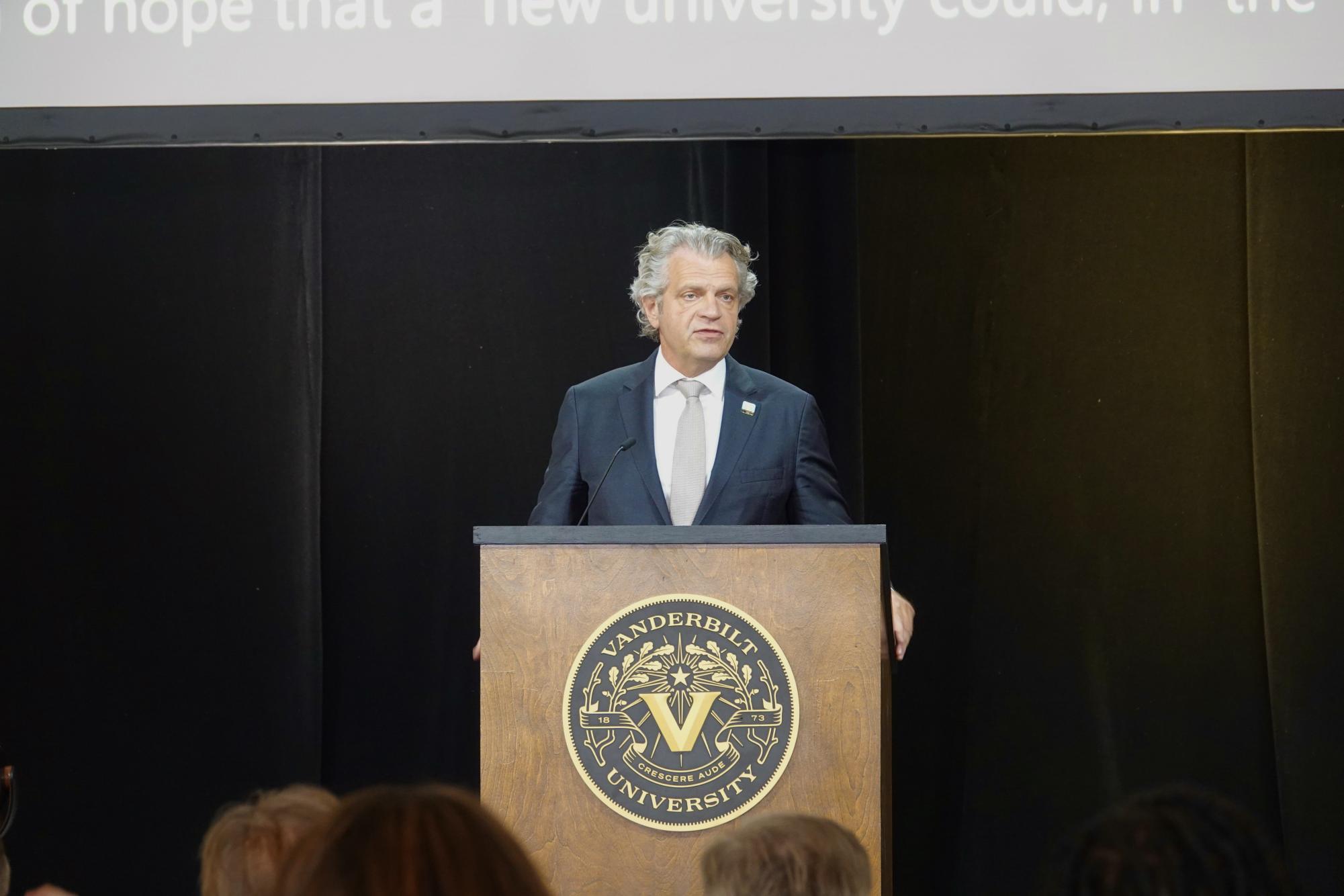
In a statement to The Hustler, Diermeier said he hopes the report encourages discussion on strengthening public confidence in the fields of the report’s focus and sustaining their contributions to the world.
“Chancellor Martin and I commissioned this report because we share a long-standing concern about declining public trust in universities, and particularly in the humanities and humanistic social sciences,” Diermeier said. “We believe research universities matter too much to society to let that erosion of trust go unexamined.”
Diermeier acknowledged the debate sparked by the report and emphasized the independence of the commission.
“Some scholars agree with the commission’s approach and conclusions, others disagree. That kind of debate is exactly what rigorous inquiry invites,” Diermeier said.
Washington University in St. Louis representatives did not respond to requests for comment.