

We have truly lost the point of institutional neutrality at Vanderbilt.
Institutional neutrality, originally based on the University of Chicago’s 1967 Kalven Report, encourages university leaders to refrain from taking public stances on controversial issues facing our community unless the issue is directly connected to the university’s core mission. Implementing this ideology should encourage students and staff to use their voices freely in and around campus without fear of retribution.
The chancellor has named four reasons to practice institutional neutrality: neutrality relieves universities of the pressure to hastily take stand on complex policy issues, neutrality is a safeguard against double standards, institutional neutrality keeps universities from becoming politicized and institutional neutrality celebrates expertise.
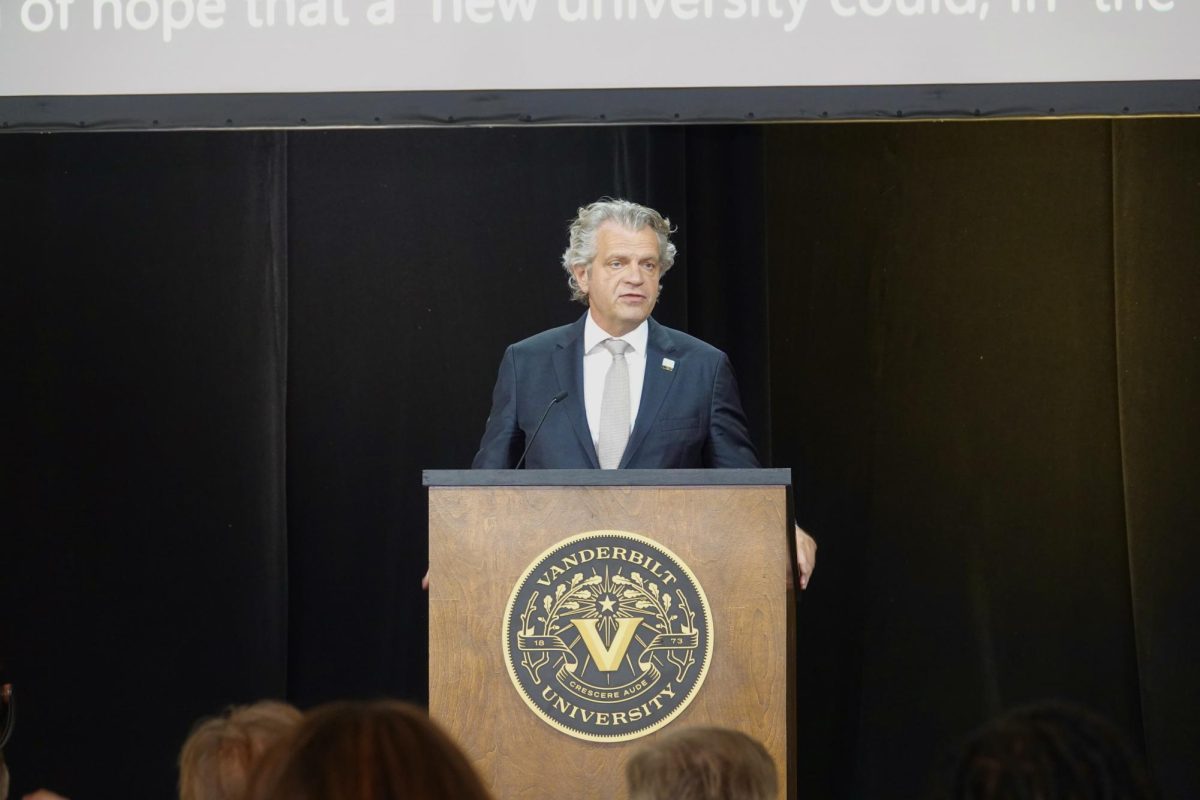
In a fall 2024 interview with The Hustler, Diermeier expanded on these pillars further, encouraging other university chancellors and presidents to enact similar procedures.
“We don’t want to create a chilling effect – faculty and students should feel free to discuss or debate issues without worrying that they’re violating a party line by the university,” Diermeier said. “Second, if universities constantly take positions and try to settle debates, politicization on campus will be encouraged. The third thing is that it also undermines our commitment to expertise. Institutional neutrality is about putting restraints on the leadership of universities to free up space for faculty and students.”
Sounds like Vanderbilt, right? Surely free speech should be protected and encouraged among the entire Vanderbilt community, right?
What happens when your chancellor, an outspoken figure in advocating for institutional neutrality across universities, commissions a report attacking the validity and scholarship of humanities and social sciences, specifically on the fields’ approaches and conclusions? Institutional neutrality dies and credibility tanks.
Commissioned by Diermeier and Andrew Martin, chancellor of Washington University in St. Louis, the Report on the State of Scholarship in the Humanities and the Humanistic Social Science goes against everything institutional neutrality aims to establish on a college campus.
On its face, the report reviews swaths of material from different humanistic disciplines such as history, philosophy and anthropology. The writers analyze whether political ideology influenced experts in these fields when producing their research as opposed to solely searching for the truth and pursuit of knowledge. But who is to say what is deemed as bad scholarship?
Beyond this search for “bad scholarship,” the report foreshadows dangerous new leadership coming to Vanderbilt. Jason Merchant, incoming Dean of Arts & Science at Vanderbilt, was a commissioned author of the report. The conclusions drawn from the report are a result of Merchant’s personal findings of humanities. According to Diermeier’s principles on institutional neutrality, no leader, including those of different departments, should outwardly express their own views in order to protect the common interest on campus.
So why hire someone with such outlandish findings, now set to lead an entire team of exceptional scholars?
For many scholars, professors and students alike, this report signals only the beginning of new surveillance set to happen across campus, instilling fear in our scholars and preventing them from achieving their best academic work possible, thus breaking the foundation of institutional neutrality.
We must note, however, that Diermeier did not directly write the report. But by commissioning an almost one-year-long search for bad scholarship, using Merchant as an author on the report and loudly encouraging surveillance on different disciplines, his actions are more than enough to establish a concrete connection between his commission and the overall product. It should be clear enough for the Vanderbilt community to understand his stance on issues based heavily on the content presented in the report.
For instance, the report labels philosophy as an isolated problem, history as inadvertently political and anthropology as an extreme deterioration in scholarly standards. Blatantly labeling these disciplines as such, especially from university chancellors, spreads a dangerous rhetoric for past, present and future scholars in these research areas.
Throughout the report, it utilizes different topics to justify good and bad scholarships such as critical race theory, slavery, feminism and biology, among others. By denying many of these politically charged topics and blatantly using them to justify scholarship across different fields, Diermeier is once again following the interest of greater power instead of the Vanderbilt community.
The Trump administration and conservative politicians already make it tougher for many to obtain higher education, as we saw in the policies passed under the One Big Beautiful Bill Act. Releasing reports such as these are damaging to the reach of higher education, undermining its purpose in American society.
Take the fall 2025 compact for higher education sent to nine universities across America, for example. Vanderbilt was a minority in deciding the fate of the compact, choosing to continue conversation with the Trump administration rather than rejecting it, even after strong opposition from the Vanderbilt community.
Coincidentally, the compact would have established free tuition for hard science majors. The humanities report is coming from the university that did not reject the compact. If we consider the totality of circumstances, isn’t this report strictly attacking social sciences and humanities, majors that are not hard sciences, thus executing the motives behind the compact?
The humanities report aims to stay neutral on its face but fails to succeed in that realm. There is nothing neutral about the compact, and goes against your prideful institutional neutrality, Chancellor Diermeier.
If institutional neutrality had a strong presence at Vanderbilt, the compact would have been denied, respecting the overwhelming unity of the community against the compact. Following the logic, this report would not have been written. The report undermines scholars, politicizes Vanderbilt as an institution, indirectly instills fear in our greater community publishing future research and ultimately has created double standards. On its face, this report directly contradicts the chancellor’s four pillars of institutional neutrality, compromising the concept’s validity and ultimately Vanderbilt’s credibility.
To put it blatantly: This Report only confirms Vanderbilt’s stance on controversial topics. Institutional neutrality, as the chancellor puts it, must be all in or out. You cannot play around with the concept of justifying certain actions but denying others. In a politically charged world, we can do everything in our power to escape politicizing research, but our world has inherent political influences. Anyone can choose to admit or omit these elements. The reality is that most humanities must have some political charge to explore different perspectives and interpretations. These different works produced by such talented scholars are the reason why our communities continue to diversify, aligning with different perspectives and reaching different audiences. That’s the beauty of research and scholarship that should be promoted, not reprimanded.
Chancellor Diermeier: Your Vanderbilt is watching. When motions like these proceed to indirectly suggest incompetency toward well-renowned scholars, institutional neutrality is no longer present. As a concept, neutrality should be used to strengthen our community, not tear it down.
Either amend institutional neutrality to fit Vanderbilt’s bread-crumbing way of addressing politically controversial issues, or commit fully to the concept. Your choice.
What will your legacy be, Chancellor?