

I remember learning, in the first grade, the difference between a right and a responsibility. A right is a freedom. A responsibility is a duty. It seems like a simple concept, right? I mean, first-grade-level simple.
So why does it seem like America has forgotten the distinction between the two?
What I’m referring to specifically is our misconception of the right to free speech. We often conceptualize free speech via its legal foundation, the First Amendment to the Constitution of the United States. We learn early on that we are protected, that we can criticize and challenge authority without fear of government retaliation. And that protection, the unequivocal right to speak, is one of the most critical and defining hallmarks of American identity. But is it a responsibility?
In today’s climate, it feels as though it is. There is a pervading mentality that simply having a voice isn’t enough anymore; one is required to use it. Especially in moments of crisis, silence is slowly becoming unacceptable. The increasingly popular phrase, “silence is complicity,” constitutes proof of that. But that expectation ignores an uncomfortable reality: speech is not equally safe for everyone.
We tend to imagine free speech as a simple act of expression, but for many, it is anything but. For some, it is a calculation shaped as much by consequence as by conviction. Americans celebrate the act of “speaking out” while ignoring the uneven risks — from public backlash to government retaliation — attached to speaking in practice. But if we are unwilling to protect people from those risks, then we have no moral authority to demand speech in the first place.
I’ve been thinking about that contradiction a lot lately, and for good reason.
I am an Iranian woman. Over the past two months, global conflicts have intensified and conversations surrounding Iran have become more widespread. In lieu of that, I have been asked repeatedly — insistently, even — to share my thoughts and speak out on the conflict and its implications for my family and me. Friends, acquaintances and even people I barely know have reached out, ears perked, with the expectation of some kind of profound response from me. For a while, it felt like my comments on the issue were the only ones people cared about.
And the truth is, I absolutely have thoughts. I have burning opinions I could share, arguments I could make, positions I could defend. But before opening my mouth, I am repeatedly struck by the realization that my opinions do not exist in a vacuum. If I speak, I am subject to perception. To criticism. And in this case, potentially even punishment.
Am I in the wrong for staying silent? Am I complicit?
I’d venture to say that for most people, the answer is “no.” My silence is clearly not by choice, and if anything, it would be reckless of me to fail to consider the consequences of my words. “But Mahsa,” I can hear you say, “You are at the whims of a different country, different leaders. Nobody in the States would ever retaliate against your opinions!” Well, let’s examine if that’s actually true.
In its 2025 College Free Speech Rankings, the Foundation for Individual Rights and Expression reported that the average campus speech climate in the U.S. scored just 58.63 points out of 100. A majority of surveyed students reported that they frequently self-censor in political conversations on campus and feel uncomfortable posting unpopular opinions on social media for fear of backlash. The report went so far as to describe campus speech environments as “hostile,” pointing to a growing disconnect between the legal promise of free expression and the unfortunate reality students are experiencing. Once is a fluke though, right?
But this distrust among college students makes sense when you examine cases of protesters like Mahmoud Khalil, a Columbia University graduate who was detained after organizing pro-Palestinian protests on campus. Khalil was never charged with a crime, yet immigration authorities pursued deportation proceedings against him, citing his political activity. In his case, speaking out had consequences even beyond public criticism. And in an era of crackdowns issued by the Trump administration, he is not the only one. Just last month, an immigration appeals board denied Khalil’s latest attempt to dismiss his case, bringing him closer to possible removal from the U.S.
Once is a fluke, twice is a coincidence.
Relative to its counterparts in the Americas, the Inter American Press Association’s 2025 press freedom index found that the U.S. experienced the sharpest decline in freedom of expression and the press last year, dropping to 11th place. The report attributes this decline in large part to President Trump’s attacks against media and journalists. The U.S. is now considered to be in a state of alarming decline.
Once is a fluke, twice is a coincidence, but three times? That’s a pattern.
That pattern is one that simply does not reflect the type of attitude our country signals and demands of others. Frankly, this country is not in a position to push the envelope of free speech and activism in an environment that simply is not conducive to it. If we have the audacity to call silence “complicit,” if we really want people to speak up, then we have to guarantee safety for them when they do. We cannot ask people to jump off a cliff without promising to catch them.
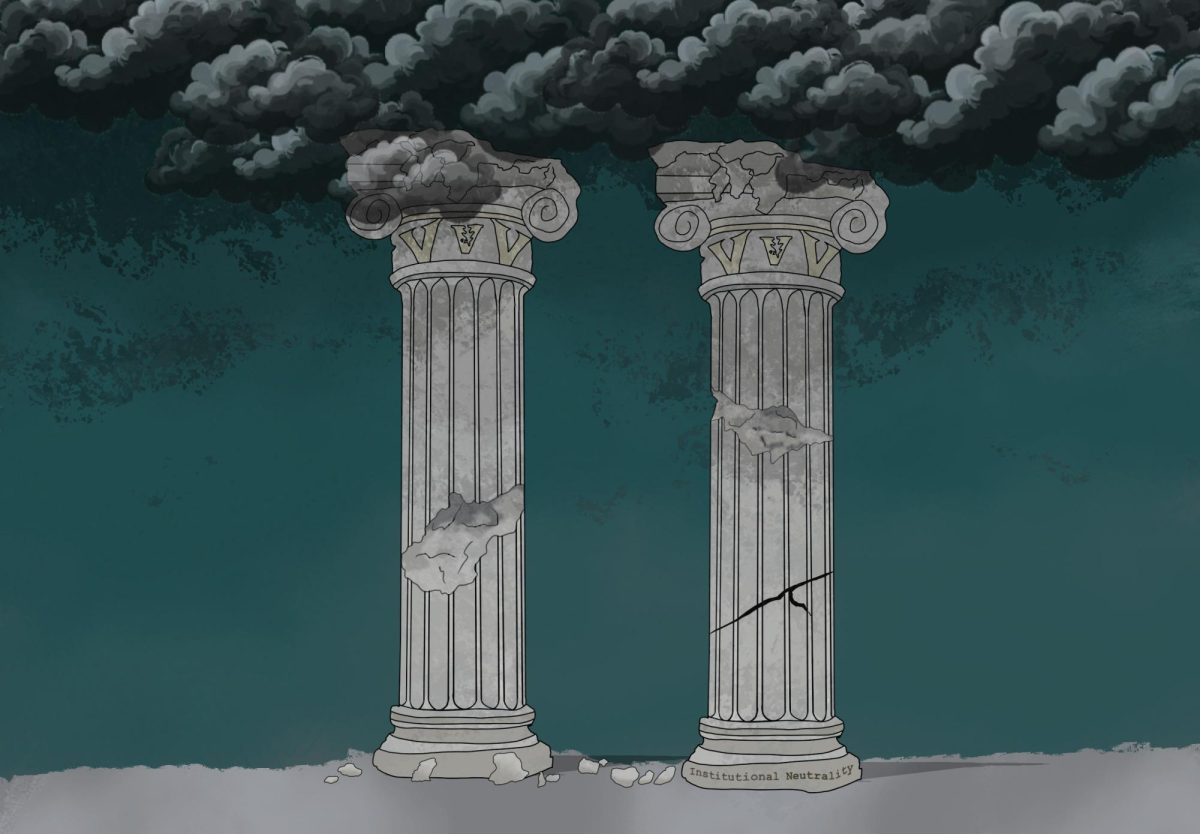
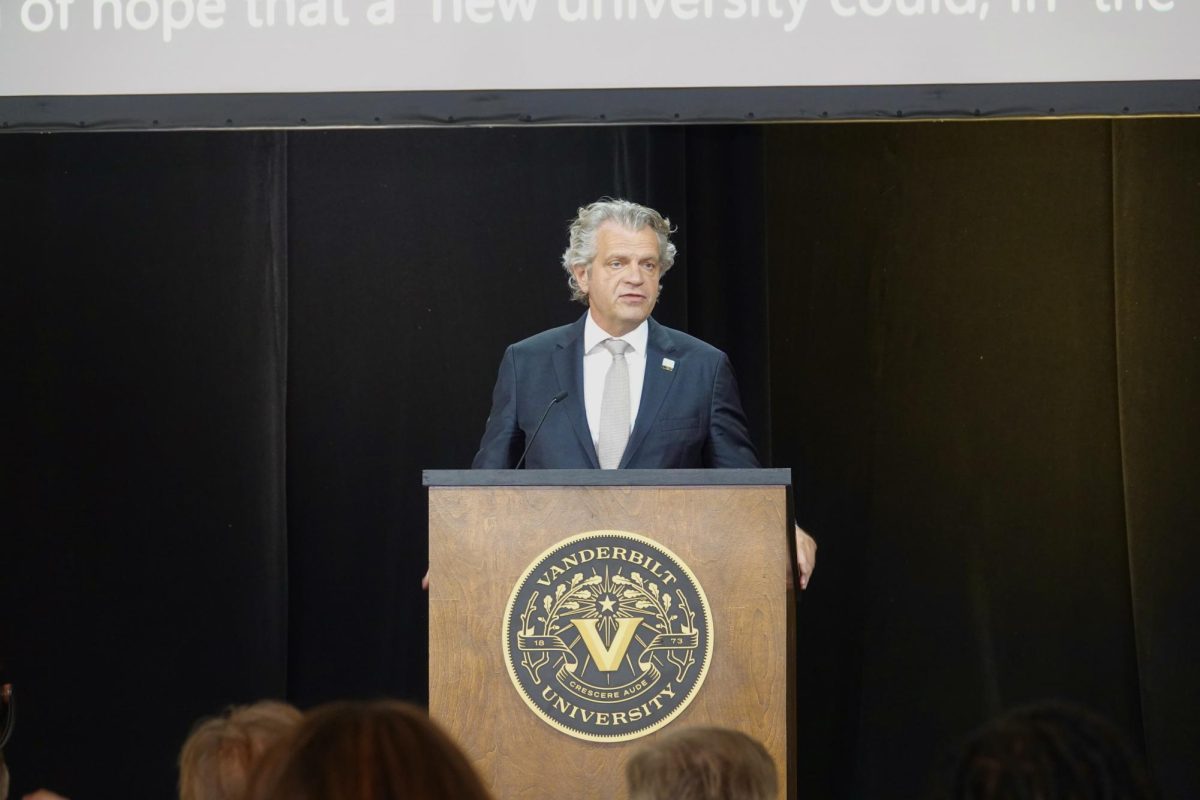
Not even Vanderbilt is immune from this hypocrisy. In the aforementioned College Free Speech Rankings, Vanderbilt actually landed a spot in the top 10. Students claimed to feel relatively comfortable speaking up about pressing issues and the university prides itself on its commitment to “institutional neutrality” as a way of preserving that dialogue. But even then, this campus has seen its fair share of silencing. In 2024, four students and a reporter were arrested during the Kirkland Hall sit-in. The aftermath included an open letter with roughly 173 faculty signees criticizing the university’s response, a student protest over the suspension of 27 protestors and intense public backlash.
It is clear that not even Vanderbilt, with its glowing top 10 rank for free speech, is a place where students can feel well and truly safe expressing their views. When push came to shove in an event as historic as the Kirkland sit-in, the university exposed the limitations of its own understanding of institutional neutrality. Speech is protected only until it becomes disruptive enough to challenge comfort.
What all of this ultimately reveals is a fundamental misunderstanding of what free speech actually means. We treat it as a guarantee of expression, but it increasingly feels like a test of courage, one not everyone can afford to take. Because for many people, speaking is not just a matter of having something to say, but of weighing what they stand to lose by saying it. So no, silence is not always apathy or complicity. Sometimes it is self-preservation.
So, what does a meaningful response look like? The first step is being realistic about expectations, because we simply cannot expect people to speak freely without creating conditions where that is materially safe. For Vanderbilt, that means protecting students from political retaliation and recognizing that institutional neutrality cannot simply mean institutional disengagement whenever controversy emerges. For the country, that means rejecting anti-free speech policies and politicians who support targeted restrictions on media, civil disobedience and public discourse.
If we are going to continue to frame speech as a moral obligation, then we need to be honest about what that really requires: not just courage from individuals, but protection from the broader public. Because a right that comes with unaffordable consequences is not, in practice, a right at all.



Ronald Wilson • Jun 20, 2026 at 3:55 pm CDT
Your views express your anti Trump bias. If anything, pro Isreal speech is met with MUCH more violence and lack of tolerance. Anti leftist speech is met with MUCH more violence, and bad grades from college profs. If somehow you failed to notice, after the unbelievable cowardly massacre by palestinians in Israel, and the even more unbelievable support for these murders/ kidnappers/ rapists, pro palestine ” gatherings were consistantly antisemitic and violent. Colleges who at first went along with this blatant violence were soon silenced. You know this .
BA 98 • May 11, 2026 at 12:58 pm CDT
Reasonable time, place, and manner restrictions have long been permitted in the exercise of free speech. The university handled the Kirkland Hall incident appropriately and made clear that childish efforts to dictate policy through obstreperous conduct have no place at an institution of higher learning. I am unsure of what opinions the author wishes to express with respect to Iran (if any), but it is also worth pointing out that while the First Am does restrict retaliatory conduct by the government, it does not grant blanket immunity towards the reactions of other, private individuals. In this sense, some element of courage will always be required to express one’s thoughts, particularly on matters of public controversy. This cost exists for
anyone who wishes to speak on points that may be unpopular.