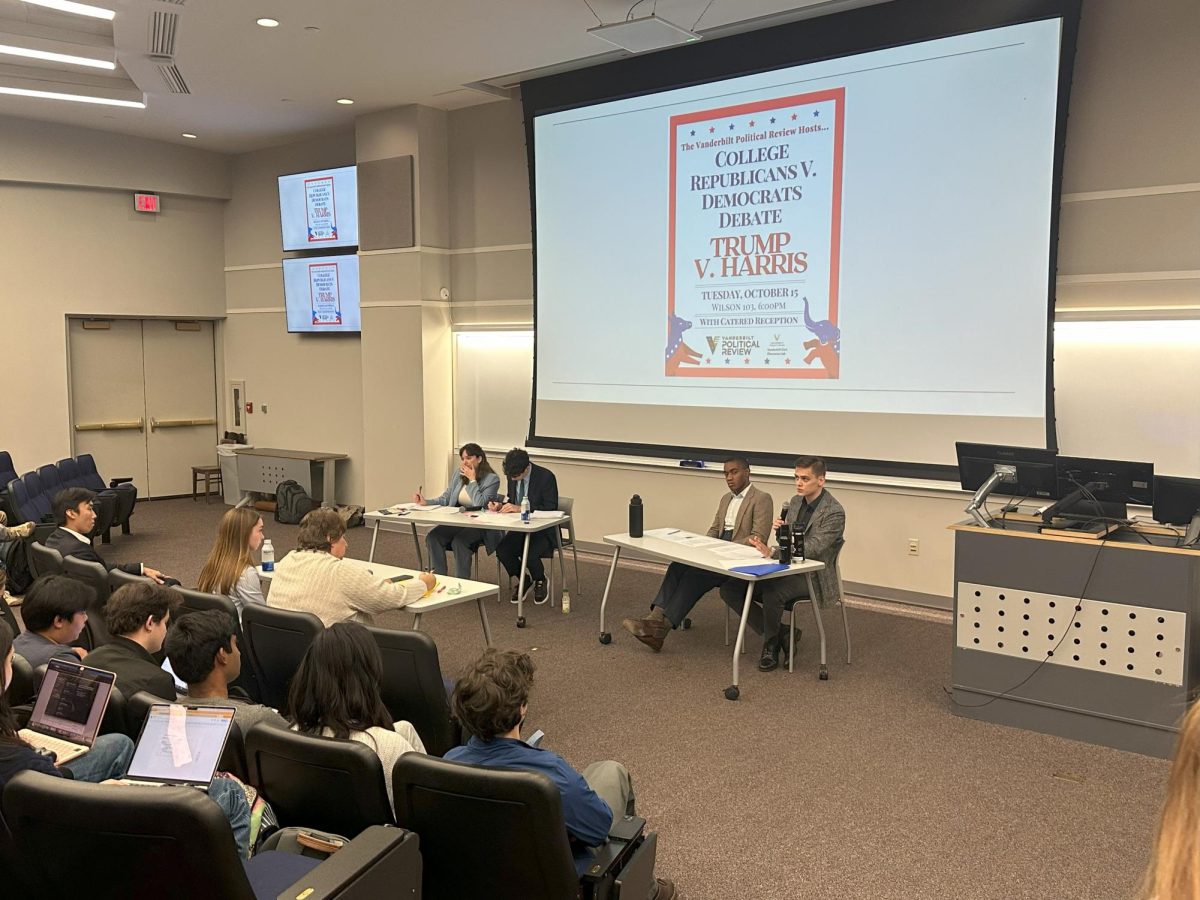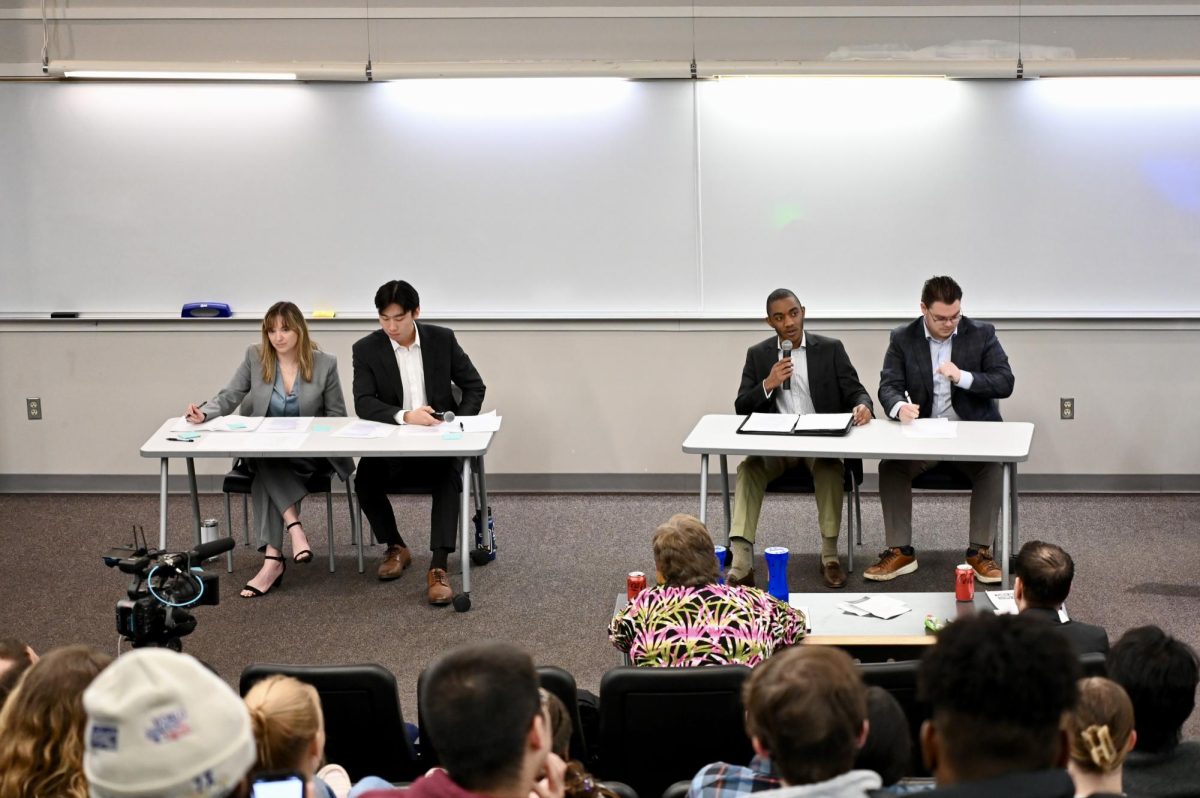


Vanderbilt Student Government hosted a panel on the “Compact for Academic Excellence in Higher Education” on Oct. 20. The panel took place just hours after Chancellor Daniel Diermeier shared a statement via email with the Vanderbilt community announcing the university was asked to provide feedback on the compact, rather than to accept or reject it.
Questions posed by members of VSG, including student body president Soham Saraf and chief of staff Eliza Brennan, asked members of Vanderbilt College Democrats and Vanderbilt College Republicans about their initial impressions of the compact, the approach taken by Vanderbilt and federal oversight on research funding.
Reactions to the compact and Diermeier’s statement
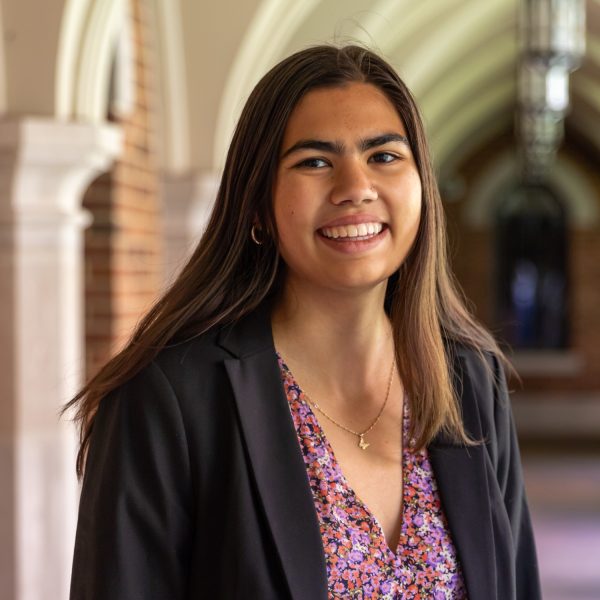
The discussion began with Saraf asking the panelists about their initial impressions of the compact. Junior RaeAnna Morales, VCR’s media director, responded first. She described how honored she was that Vanderbilt was chosen to be part of the compact.
“[VCR] has been fighting for free speech on campus and less polarization throughout Vanderbilt. So, we think these 10 commitments represent American values and can make our campus have more free speech, fairness, merit and true institutional neutrality,” Morales said. “We view it as nonpartisan because the points in this compact reflect all students and protect all students.”
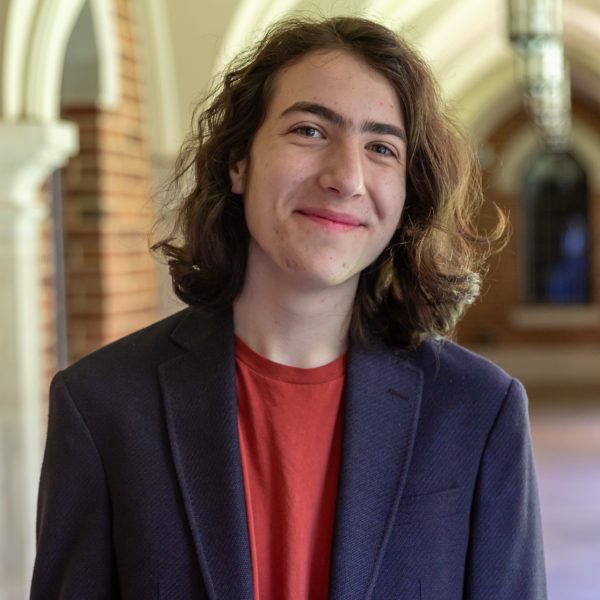
Junior Drew Spiegel, VCD’s co-president, replied to Morales by expressing his concern over the degree of federal oversight on higher education.
“I do not believe the federal government should have this kind of influence on our private universities. That is completely invasive,” Spiegel said. “It is absurd that they think that they should be telling us how many international students we have or how we define gender. I think the federal government should leave us alone.”
Saraf then asked the groups whether or not they believe the university should accept the compact. First-year Lucas Oland, a member of VCD, argued that while any negotiation would be futile, accepting the compact would violate Vanderbilt’s core values.
“I personally know a lot of the people who agree that because this compact is so inherently in bad faith, there is no positive potential negotiation that will make the compact actually agreeable to the point that it will not violate our core values as an institution and our freedoms,” Oland said.
Morales then said that the university should negotiate to find a way to pass the compact and maintain crucial federal funding.
“I think the compact was fine in the way it was presented to Vanderbilt, but if it brings our campus together, it’s important to negotiate it and find a way to pass it with those negotiations,” Morales said. “It’s important sometimes to ask ourselves if the federal government should be involved or not because we see Vanderbilt cannot survive without federal funding.”
Free speech and institutional neutrality
Panel members then discussed institutional neutrality and free speech. Everyone agreed Vanderbilt fosters a wide exchange of ideas and that there are free speech protections currently on campus. Morales said the compact will ensure professors will teach their students how to think, instead of what to think.
“Vanderbilt does do well in many aspects of free speech,” Morales said. “I think one thing that Vanderbilt doesn’t do well at is that the professors, at times, do get out of hand. Instead of teaching students how to think, they teach them instead of what to think. That’s stated in [the] compact that professors will now reflect the institutional neutrality that Vanderbilt claims.”
In response, Spiegel said that it is difficult to maintain institutional neutrality because that depends on how certain issues are politicized. He believes this allows the university to avoid potentially controversial issues, since they are more concerned with maintaining federal funding.
“Institutional neutrality is very hard to find because you can’t find a principle that will single-handedly decide when an issue is political or not, especially when it pertains to the university or not,” Speigel said. “So, what this really becomes is a way for the university to cop-out of commenting on divisive issues when they’re worried that their federal funding is at stake.”
Federal oversight
As the discussion continued, VSG leaders asked the panelists about how much oversight the federal government should have on research funding at Vanderbilt. Spiegel said that the federal government has no business being involved in decisions regarding research funding and that Vanderbilt receiving federal funds was not considered “charity.”
“I want everyone to know that the government giving the school money is not charity. That’s an investment; universities can use that money to make innovations that may save some of your loved ones’ lives from certain diseases,” Spiegel said. “And maybe universities should be a place where you feel a little challenged, where there’s some projects and initiatives at the school that you don’t necessarily believe.”
Junior Sam Bodwell, VCR’s president, spoke about how his belief of liberal ideas being advanced, along with discovery and creation at Vanderbilt. He argued that more moderate ideals should be pursued.
“You look at research and innovation, and those things are being accomplished [at Vanderbilt]. And simultaneously, there’s other progressive ideals that have also been pushed with that,” Bodwell said. “From a Republican perspective, we want to rein that back in more towards the middle because an institution should be trying to rebalance both of these things, right?”
Q&A
After VSG leaders asked their questions, they shifted to questions submitted by students and faculty via an online form. One of the first questions focused on how the compact might affect who is accepted into Vanderbilt, especially as Vanderbilt’s Black student population has decreased considerably in the past years.
Morales said that students should be accepted based on their actual skills and merit, rather than race or gender orientation.
“College is for kids who work hard and who are educated,” Morales said. “Should sex, education, background, political views, gender identity [or] religion outweigh the grades, the extracurriculars and the skills of students?”
Spiegel then spoke about how, if Vanderbilt signs the compact, social concepts, such as racial identity and gender identity, could become barriers for students in the college application process.
“I think that we should be taking into account certain factors, but ultimately, by signing the compact, you are essentially making sure that one of those social concepts [like religion, race and gender identity] will become another barrier that will essentially be considered in a much more negative way than it is now,” Spiegel said.
This question opened a long discussion on admissions policies, with a new focus on merit, holistic review and scholarships.
Toward the end of the debate, a question submitted by a faculty member asked panelists whether they believe a university should be treated like a business. Members of both VCD and VCR acknowledged the power of education, community and knowledge, while also voicing their separate opinions on whether funding should or should not affect the decisions the university makes.
Student reactions
Following the discussion, Spiegel told The Hustler he was disappointed in Chancellor Dieremier’s failure to showcase courageous leadership in response to the compact.
“Regarding the state of the compact, I was deeply disappointed with the Chancellor’s statement yesterday,” Spiegel said. “This compact is a defining moment in the future of higher education, and we should have stood with the vast majority of our fellow institutions that were offered the compact and rejected it. This moment calls for courage from our leadership.”
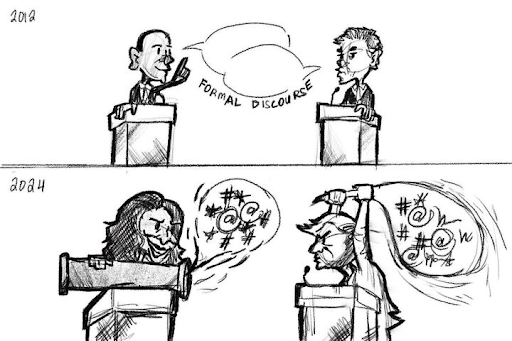
Spiegel also showcased his gratitude for the opportunity to have civil dialogue with members of VCR and within the student body. His hope is that there will be similar discussions in the future.
“I am always grateful that VCD and VCR have a relationship that allows us to have discussions like the one last night. I am glad I could share some of my concerns about the compact with a broader segment of the student body, and I enjoyed hearing the Republicans’ perspectives as well,” Spiegel said. “While I fear the compact, at least in its current state, would kill this type of free speech on campus, I hope that we can continue traditions like this in the future.”
Morales spoke with The Hustler following the discussion about her support for the compact. She said that the values of the Vanderbilt community already align with many of the compact’s principles and its purpose of protecting education.
“This compact protects all voices on campus, liberal and conservative, ensuring every student has the right to speak, learn and thrive without political violence or harassment. It holds institutions accountable and simultaneously uplifts ideals that any university should support,” Morales said. “When education is rooted in truth, freedom and protection, all students can flourish, our communities and colleges thrive and our country grows stronger as a result.”
Morales believes it is important to have future conversations between VCR and VCD, since she believes academic freedom encourages discord, conversation and learning opportunities.
“It is essential that we continue fostering civil discussions between both political parties on campus, as we did during our panel on the compact,” Morales said. “Universities are meant to be spaces where ideas are shared and challenged. True academic freedom means creating room for disagreement, dialogue and growth.”
First-year Gabriela Matis said she enjoyed the conversation but was disappointed in its structure and tangents.
“I thought [the discussion] was very insightful, but the conversation went off topic, and it felt a little unstructured,” Matis said. “Both sides represented their points well, but a better structure of debate would have conveyed the compact’s importance to each side better.”