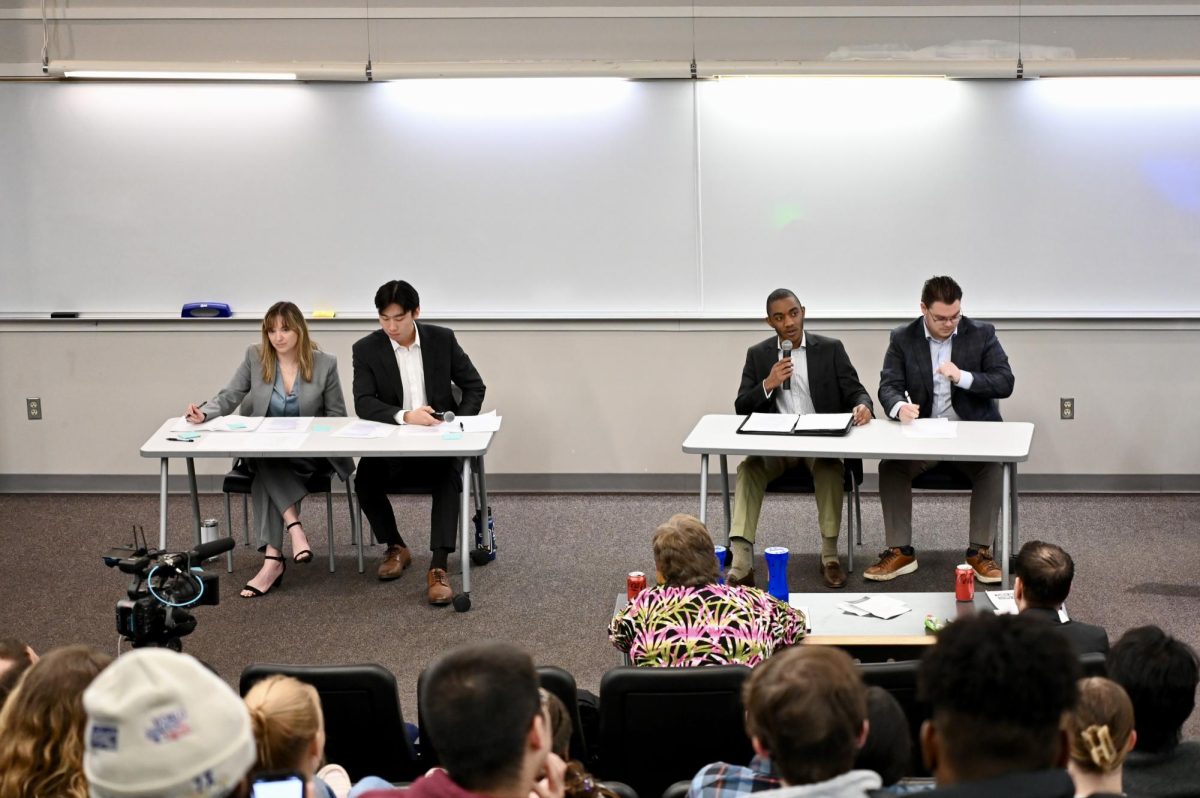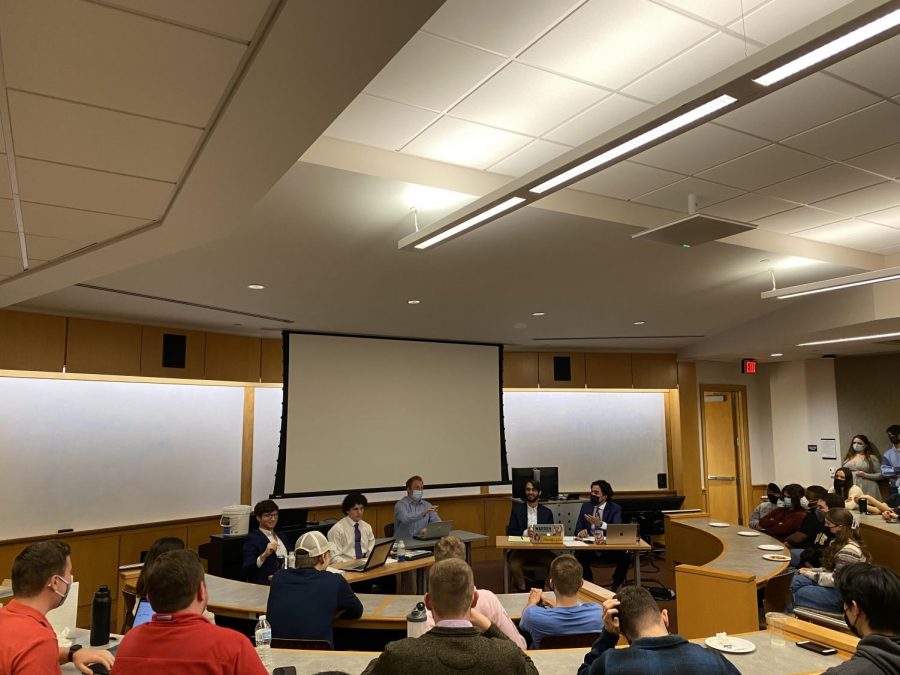


Vanderbilt Political Review hosted a three-way debate along with Vanderbilt College Republicans and Vanderbilt College Democrats on Sept. 30. The debate focused on President Trump’s recent deployment of National Guard troops to key US cities.
Unlike previous debates held by VPR, the debate was largely unstructured, with panelists having near free rein over how they responded to questions from the moderator. Aside from the limited amount of time given to panelists to establish their positions, no restrictions were made on how long each person could speak. Junior Alicia Isasi, VPR’s editor-in-chief, served as the moderator for the debate.
“In the past, we had very structured, traditional debates,” Isasi said. “You have a timed response to others. You couldn’t really directly engage with each other. So, our goal with this debate was to create more discussion or dialogue.”
Legitimacy of the deployment
The debate opened with the question of whether the deployment of the National Guard was a legitimate use of executive authority. Sophomore Emily Won, a member of VCD, responded that the Court of the Northern District of California found the stationing of the California National Guard in Los Angeles to be unlawful.
Senior Noah Jenkins, chairman of VCR, countered by saying that the court’s logic was “faulty,” and the deployment of troops was lawful under an exception to the Posse Comitatus Act.
“Whenever the president is unable, with the regular forces to execute the laws of the United States, the President may call into Federal service members and units of the National Guard of any State in such numbers as he considers necessary to execute those laws,” Jenkins said.
Sophomore Elliott Cruz, a member of VCD, argued that the Posse Comitatus Act was inapplicable to the case of Los Angeles because the LAPD was capable of peacefully resolving the protests. When asked why the LAPD failed to do so, Cruz noted that they were not given a chance due to the influx of the National Guard.
Jenkins then referred to the protests that occurred in Los Angeles as a “riot,” which prompted a fierce argumentation from members of both VCR and VCD that was soon quelled by Isasi. The question of whether the situation in Los Angeles could be characterized as a riot became a frequent refrain of the debate.
VCD and VPR then expressed what they felt was a politicization of crime, wherein cities with falling crime rates, notably Washington D.C., were still described as “war-torn” and “cesspools of violence” by the Trump Administration to justify the use of National Guard troops.
Implications for federalism
The next three questions Isasi posed were all related to the topic of federalism. Participants were first asked if Trump should be able to deploy troops without the consent of state governors. Second, do the historical deployments under the Eisenhower and Johnson administrations help justify deployments in general? And third, did the deployments undermine federalism?
In response to the first question, first-year Saadika Salauddin, a member of VCR, emphasized the need for the federal government to collaborate with state governments to avoid the negative effects associated with the deployments. She said that kids are not going to school, and people cannot go to work because they are scared.
Jenkins added that although cooperation between the governments would be present in a normal state of affairs, the states and localities’ inability to maintain law and order necessitated the involvement of the federal government.
“It does go to the federal government to ensure that law and order is maintained in the country, because when localities fail, states step in,” Jenkins said. “When the states fail at their jobs, the federal government is the last line of defense to ensure an ordered society.”
Cruz said that the use of National Guard troops should only be required in “very extreme cases,” such as the 1992 Los Angeles Riots. Cruz added that none of the cities where National Guard troops were deployed to in 2025 were extreme cases because none of them had high enough crime rates.
Jenkins said that Trump’s deployments do not undermine federalism because local authorities had been given ample opportunity to resolve crime rates on their own but had simply failed.
Threshold for deployment
Participants were then asked to determine the specific crime threshold that would call for mobilization and whether that threshold would be determined by data or principle.
Jenkins said that although data is important, it cannot be relied upon in isolation when making decisions. Instead, he believes a line must be drawn by an executive authority.
“I think you need a principle to come in and say ‘all right’ when it is such a significant degree that we can no longer trust the locality. That’s what it comes down to,” Jenkins said.
Cruz agreed that a line needed to be drawn but said that it cannot be established unilaterally by a single authority and should be a joint effort that is fully supported by data. Cruz reaffirmed his argument that crime rates were dropping, noting that the “millions of dollars” being spent on moving troops were being wasted.
“It comes to a joint effort of establishing that line,” Cruz said. “One executive authority cannot establish that line. Now, I agree. It’s difficult to see where that line can be drawn. But I think that the line that’s been drawn today and in these past couple weeks is nowhere near that.”
Possible precedent
As the debate drew to a close, both sides considered what precedent would be set by the dispatch of resolve troops under Trump and what potential dangers this could cause. Jenkins argued that the National Guard’s mission, specifically in reducing crime, outweighed any psychological effects.
VCD disagreed and questioned what the National Guard had actually done to reduce crime beyond simply being present. Cruz summarized the Democrats’ arguments, stating that the data indicated that the deployment of troops would not be beneficial in the long run.
Student reactions
First-year Evan Wong said that he was pleasantly surprised with how the debate went, noting that he had expected the participants to shout over each other more.
“I thought it would be more fierce than it was,” Wong said. “But it ended up being a pretty flexible discourse. It was pretty interesting.”
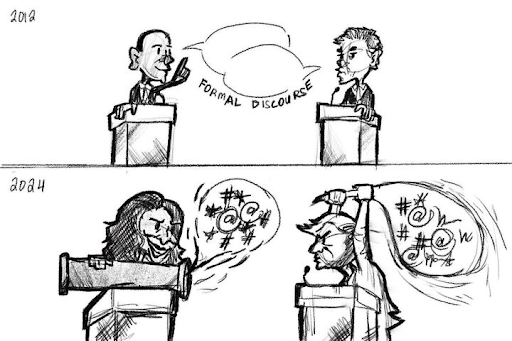
First-year Jack Koo also had reservations about how vitriolic the debate could be based on his prior experiences watching debates between Democratic and Republican presidential candidates.
“From what I’ve been growing up to, I’ve been used to the Trump debates with Biden, and it’s all just mudslinging,” Koo said. “So then, I come to Vanderbilt, and [I thought] ‘is this going to be a lot more peaceful, or is it gonna be still polarized?’”
Koo said that although in the first five minutes the participants seemed to break into an argument, they eventually came around to having a productive conversation.
Senior Paulo Nicoli thought the debate featured solid argument but wished more concrete evidence had been used.
“I do think that it was productive,” Nicoli said. “I think that there was good argumentation. But I wished there was more hard evidence that they [used] to support each of their respective claims and beliefs.”