
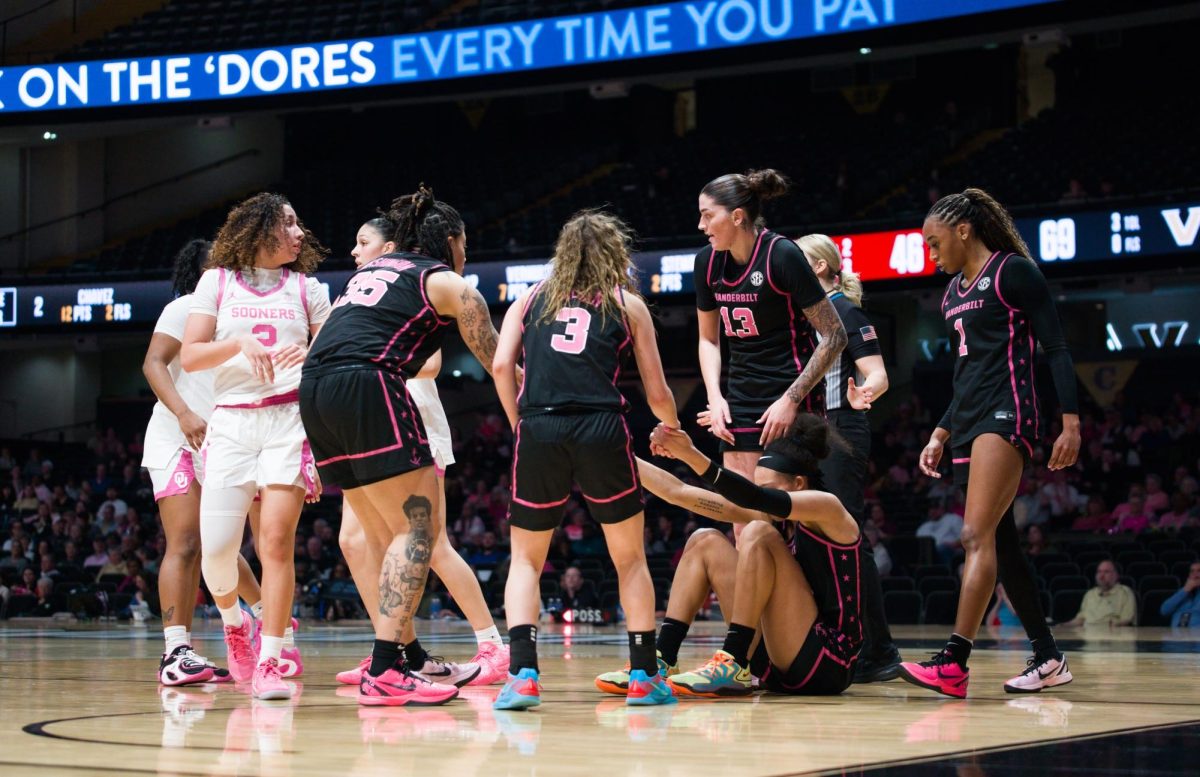

This year, the SEC remains a powerhouse in women’s basketball, but the season is already playing out very differently than the preseason poll predicted. South Carolina was the clear favorite in the preseason media poll, followed by Texas, LSU, Tennessee and Oklahoma, with Vanderbilt projected seventh.
Today, the standings tell a more dynamic story. South Carolina remains the league’s powerhouse, but Vanderbilt has jumped to third, passing LSU and Tennessee en route to emerging as one of the nation’s biggest surprises. Georgia has quietly risen from a predicted 13th to the top half of the conference, and LSU has rebounded after early losses to Kentucky and Vanderbilt, proving the Tigers are still a force. Texas holds near the top, while Oklahoma continues to compete for favorable NCAA Tournament positioning.
The SEC is projected to send 11 teams to the NCAA tournament, reflecting the league’s depth and competitiveness. At the bottom, Missouri, Auburn, Arkansas and Texas A&M remain in familiar positions to years past, with Arkansas still seeking its first SEC win.
Off the court, the races for SEC Player of the Year, Freshman of the Year and Coach of the Year are contentious, keeping storylines exciting as the regular season winds down. Furthermore, the SEC contains some serious contenders for the nation’s most prestigious awards. With powerhouse programs, breakout teams and award races all in play, the SEC is shaping up for a thrilling March. Here is the current state of the SEC.
Everyone is chasing South Carolina
Despite the depth of the conference, the race to the top has yet again taken on a familiar shape: Everyone is playing for second behind the South Carolina Gamecocks.
The Gamecocks sit at 27-2 (13-1 SEC) and two games clear of the Texas Longhorns, their only losses coming by two points to Texas on a neutral floor in nonconference play and in overtime at Oklahoma. They’re beating opponents by an average of 31.3 points — including a 103-74 win over Vanderbilt — and are virtual locks for a No. 1 seed come March.
This dominance is familiar. Under head coach Dawn Staley, the Gamecocks have won nine of the last 11 SEC Tournament titles, captured 10 regular-season titles in 13 seasons (including five straight) and reached each of the past four Final Fours, en route to winning two National Championships.
What makes this run especially telling is what South Carolina has absorbed. Despite losing star frontcourt players Ashlynn Watkins and Chloe Kitts to season-ending injuries and seeing MiLaysia Fulwiley transfer to LSU, Staley’s group hasn’t blinked. Tessa Johnson, Joyce Edwards, Ta’Niya Latson and Agot Makeer have stepped forward, Raven Johnson provides veteran stability and the midseason addition of 6’7 forward Alicia Tournebize from France only deepened the frontcourt.
The result is the same story the SEC has seen for years — South Carolina alone at the top, and a crowded race forming behind it.
The race for the final No. 1 seed
With South Carolina Women’s Basketball firmly atop the SEC, the battle for the final No. 1 seed is shaping up as a showdown between No. 4 Texas and No. 5 Vanderbilt. The stakes are significant: a 1-seed typically has an easier path to the Elite Eight than a 2-seed.
Texas (26-3, 11-3 SEC) holds the resume advantage. The Longhorns have a higher NET ranking (No. 4 vs Vanderbilt’s No. 7), the same SEC record as the ‘Dores, nine Quad 1 wins to Vanderbilt’s seven, a top-six defense per Torvik and key wins over No. 2 UCLA and No. 3 South Carolina. Their overall profile and metrics suggest they are the more complete team, built for a deep NCAA run.
Vanderbilt counters that resume with a head-to-head victory and late-season momentum. The Commodores took down Texas 86-70 in Nashville, handing the Longhorns their largest loss of the season — an outcome the selection committee weighed heavily in the first top-16 reveal which gave the Vanderbilt the final 1-seed. However, since then, the Commodores dropped a close game to then-unranked Georgia, which is a blemish on their resume.
Ultimately, it may come down to how the regular season and SEC Tournament finish. If Vanderbilt wins-out and makes a strong tournament run, the combination of head-to-head and momentum could be decisive. If it falters before the SEC finals, Texas’ stronger resume and Quad 1 record will likely carry the final No. 1 seed.
Tennessee’s season has fallen short of expectations
Few SEC teams have underperformed preseason expectations more than Tennessee (16-10, 8-6 SEC). The reasons are layered.
Second-year head coach Kim Caldwell runs one of the SEC’s most distinctive systems. Tennessee regularly plays 11 players for double-digit minutes and often swaps out full five-player units every two to five minutes in a hockey-style rotation. The goal is clear: keep fresh legs on the floor to fuel relentless full-court pressure and a green light from three, even early in the shot clock or in transition. The Vols are certainly firing, averaging 31.1 attempts but only 9.6 makes from deep.
But the results — and the body language — haven’t matched the theory. ESPN analyst Andraya Carter noted before Tennessee’s Sunday’s loss to Oklahoma that it hasn’t consistently looked bought into Caldwell’s system, raising the broader question of whether the roster or the scheme ultimately needs to adjust.
Warning signs have piled up. Tennessee suffered the largest loss in program history Feb. 8, falling to South Carolina by 43 — a defeat that prompted Caldwell to say her team showed “a lot of quit.” Off the court, the season has been uneven as well: guard Ruby Whitehorn was dismissed following two arrests, Janiah Barker did not travel to Oklahoma Feb. 22 for “not meeting program expectations” and after a Jan. 29 loss to Mississippi State, Caldwell told the media that the team had been late to shootaround.
The slide has been steep. Tennessee opened the year No. 8 in the AP Poll and fifth in the SEC preseason media poll. Now the Vol’s sit outside the Top 25 and seventh in the conference, with looming games against LSU and Vanderbilt that could push them further down the standings.
Taken together, the pieces explain why a team that entered the season with national top-10 expectations now finds itself fighting to hold position in the middle of the SEC pack. Tennessee is at risk to miss the NCAA Tournament for the first time in program history.
Who other teams don’t want to see in March
When it comes to NCAA Tournament success, teams with high-tempo play and strong guard talent are the most dangerous. Momentum and guards’ ability to handle the pace is everything in single-elimination games, and several SEC squads fit the bill.
LSU (24-4, 10-4 SEC) operates at a 75.8 adjusted tempo and boasts talented veteran guards in Flaujae Johnson and Mikaylah Williams, along with freshman talent in Grace Knox. The Tigers stumbled early in conference play with losses at Kentucky and Vanderbilt but have since found their stride, with their only setbacks coming against South Carolina and Texas. Their guard play is strong enough to knock off any team if they catch fire.
Oklahoma (21-6, 9-5 SEC) is even quicker, at 78.1 adjusted tempo, with key backcourt players Peyton Verhulst and SEC Freshman of the Year contender Aaliyah Chavez. The Sooners have already proven their ability to beat elite competition, including a marquee win over South Carolina.
Kentucky (20-8, 7-7 SEC) combines shooting and size. Guards Amelia Hassett, Asia Boone and dynamic point guard Tonie Morgan provide perimeter scoring, while dominant center Clara Strack makes them hard to defend — opponents can’t easily double the post without leaving shooters open. Four of Kentucky’s SEC losses came while forward Teonni Key was injured; she has since returned as another dynamic scoring option.
Ole Miss (21-8, 8-6 SEC) is a physical, versatile team led by Cotie McMahon, a forward who often functions like a big guard. McMahon can handle the ball, attack the rim and create mismatches. The Rebels have already beaten both Vanderbilt and Oklahoma this season and found their way to the Sweet Sixteen last year on its thrilling and scrappy play style.
Georgia (21-7, 7-7 SEC) is the SEC dark horse. Originally predicted to finish 13th, the Bulldogs sit at ninth in the conference and No. 23 nationally. Sophomore guard Dani Carnegie leads the team with 18.3 points and 5.6 rebounds per game, and Georgia has picked up huge wins over Vanderbilt, Ole Miss and Kentucky, showing they can compete with anyone in the conference.
Any of these teams could make a deep tournament run, and they represent matchups that could be challenging for opponents come March. How will the SEC fare in the coming weeks? We will have to wait and see.








Michael McGee • Feb 26, 2026 at 9:37 am CST
Wonderful article with lots of valuable info. I hope you’ll forgive one small clarification, You reference Texas as the number-two team in the conference, but if the season ended today, Texas and Vanderbilt would be officially tied for second in the record books, but in the all-important tournament seeding, Vandy would actually be the conference’s second seed by virtue of its win over the Longhorns.
The number two and number three seeds will be bracketed together in the SEC tourney, so, assuming both win their first game in Greeneville, Texas and Vandy would likely play in the semi-finals, and all questions about which deserves a number-one seed in the NCAA tourney would be settled.
I enjoy the coverage you folks have provided this season. In fact, I see it as the best and most consistent coverage of the women’s team. Keep up the great work.