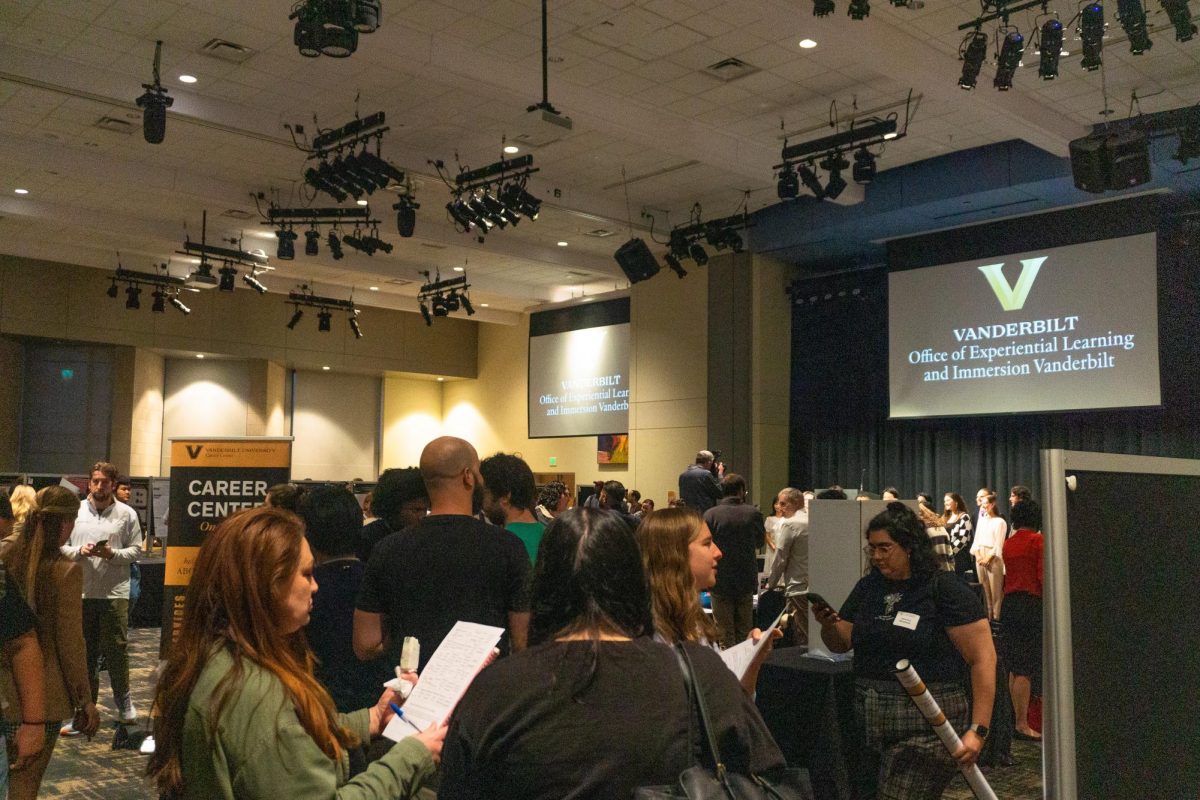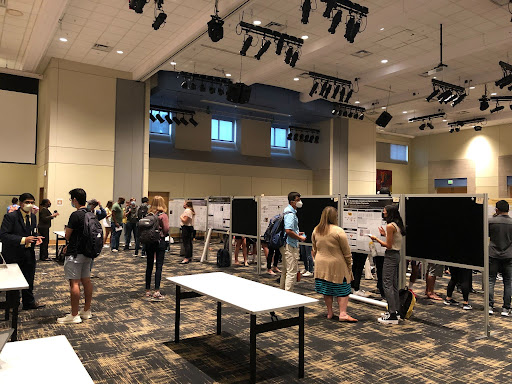


The fall 2025 Vanderbilt Undergraduate Research Symposium took place at the Student Life Center ballroom on Oct. 30. Over 100 students presented their research that they conducted via Immersion Vanderbilt to the event’s attendees. Students traveled across the country and world to explore their fields of interest, ranging from environmental science to cognitive studies, with five “poster winners” and an additional five runners-up.
The symposium has been sponsored by Immersion Vanderbilt, the Office of the Provost and the Office of the Vice Provost of Undergraduate Education since 2018. It provides an opportunity for students to showcase their research to fulfill their Immersion Vanderbilt graduation requirement.
Carolyn Roberts, senior director of Immersion Vanderbilt, spoke with The Hustler about her excitement about the students’ work and the real-world impact their research had.
“Immersion Vanderbilt has been hosting this since 2018 and every year, we are so impressed with the level of research that our students are doing, especially under the guidance of our faculty,” Roberts said. “They are just so engaged and doing substantive research and solving real-world problems. And it’s incredible to see it come into action and to talk with them and see them talking with other people and sharing so freely of what they did.”
Roberts said she appreciates how the Vanderbilt community supports the undergraduates presenting their work and how they have multiple sponsors who contribute to the event.
“One of the things I really love is how the community comes together and supports them. And everyone’s so interested,” Roberts said. “We’ve got the popsicles. We have a [Vandy Pin Drop] today. We’ve got partner offices that come, but this level of support for what students are doing in research is really exciting to see.”
Sophomore Tobasum Mandal displayed her research at the symposium titled, “Modelling Object Categorization at Different Levels of Abstraction,” which focused on cognitive object categorization. Mandal worked in a cognitive studies laboratory through the Vanderbilt STEM Transition and Retention program, which is dedicated to ensuring first- and second-year students have STEM research opportunities. She used computational methodologies to complete her research.
“We were basically trying to model object categorization at different levels. When you look at an object, like the image over there [of a dog], you could call it ‘a dog,’ ‘an animal,’ ‘a Labrador.’ And there’s a difference in response times,” Mandal said. “The basic level has the fastest response time. So, this is something that’s been established in cognitive science research with actual participants, but it’s not something that has been computationally explained or modeled yet.”
Senior Michael Witherspoon researched the vertical profiling of carbon dioxide in the atmosphere at the University of North Dakota where he built his own weather balloon. His research was titled, “Development of a Weather Balloon Package for Vertical Profiling of Carbon Dioxide.”
“I was able to make a weather balloon with two different sensors and other sensors that collected temperature, humidity [and] carbon dioxide,” Witherspoon said. “It was important for that project in itself to help advocate for climate control as we continue to go beyond 420 parts per million of carbon dioxide [in the atmosphere] and really understanding the effects.”
Junior Larissa Ramirez conducted her research on glacier snow and its water content by using ground-penetrating radar to investigate the change in snow water content over time. Ramirez conducted her research on the Vaughan Lewis Glacier, located in an icefield an hour outside of Juneau, Alaska, culminating her research in her project titled, “Signals in the Snow: GPR Time Series of Density and Water Content on Vaughan Lewis Glacier.”
“I was basically on a glacier for two months, and I investigated, through a technique called ground-penetrating radar, how snow water content on a specific glacier called the Vaughan Lewis Glacier changes over time,” Ramirez said. “Sea level rise is increasing because of melting glaciers, so I just used different physics techniques to [respond to] that question.”