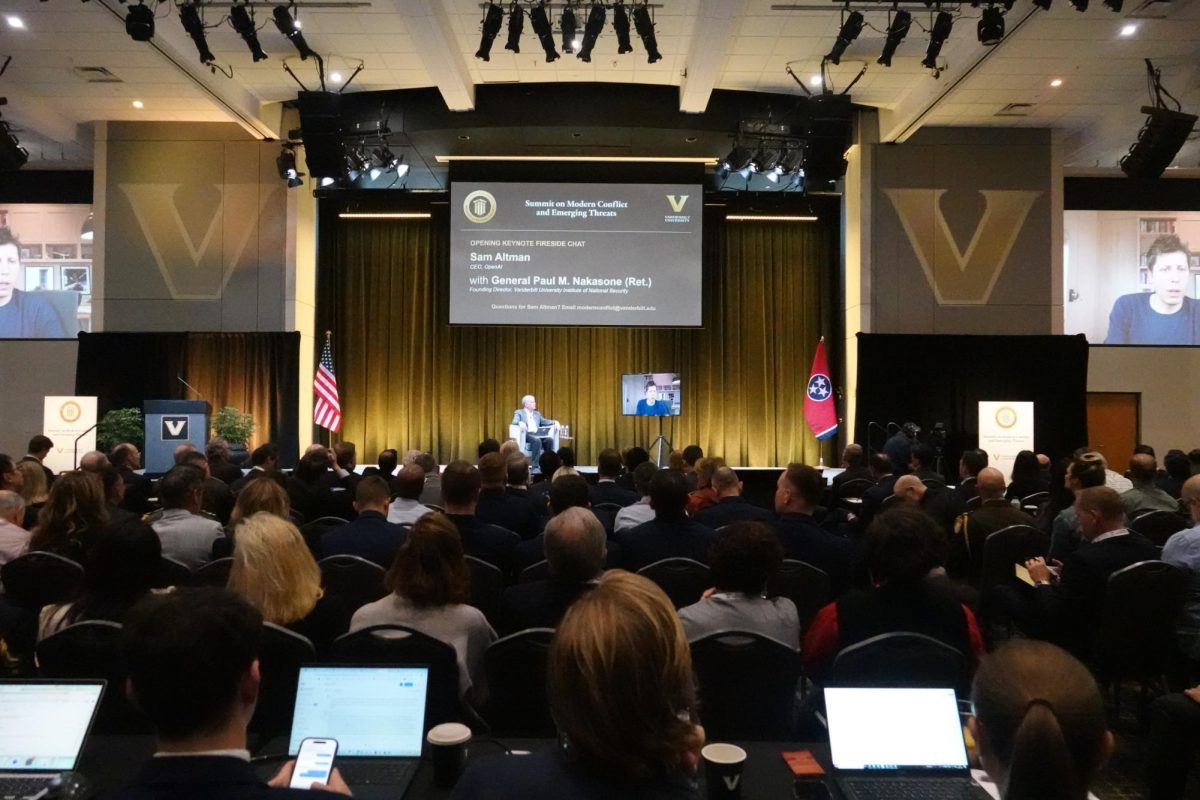


Annie Jacobsen, Pulitzer Prize finalist and bestselling author, visited campus on Oct. 23 to participate in a series of events as part of the Institute of National Security’s Fall 2025 Lecture Series on Modern Conflict and Emerging Threats and to celebrate her new book, “Nuclear War: A Scenario.” The sessions were held in the Alumni Hall Reading Room and focused on nuclear war and modern conflict.
About 100 students, faculty and community members attended the events, which included a student roundtable, fireside discussion with retired Lieutenant General Charlie Moore and a reception where Jacobsen signed guests’ copies of her new book.
During the student roundtable, the first event of the afternoon, Jacobsen spoke with a group of approximately 20 students about her work as an investigative journalist covering a variety of topics related to national security. She said she aimed to talk to high-ranking individuals when reporting so she could better inform the public.
“What I do is talk to individuals that are highly placed, that help me understand the narrative behind specific facts that might not make any sense,” Jacobsen said. “I am really interested in educating society in sort of a sneaky manner. In other words, it’s been really entertaining learning a lot of really critical information that actually makes all of us safer.”
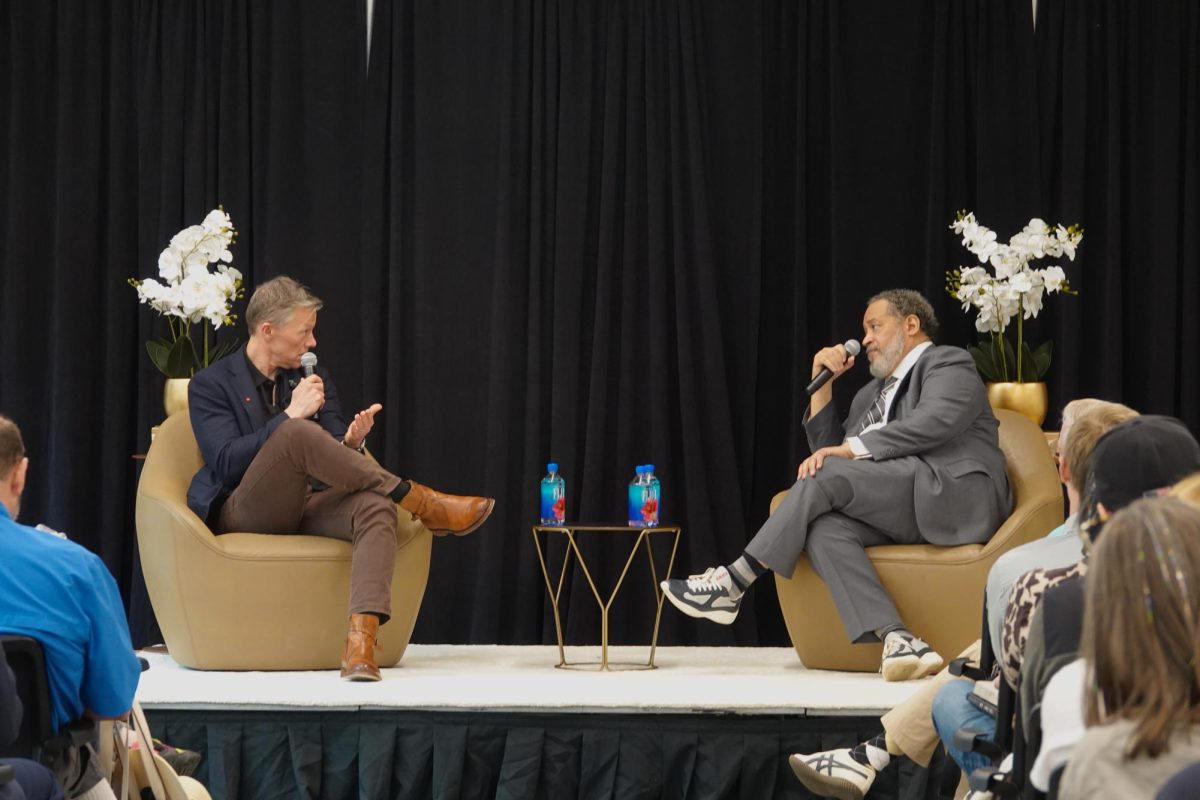
After the 45-minute roundtable discussion, Jacobsen joined Moore for a fireside chat to discuss her new book and how it relates to modern conflicts, including nuclear weapons and AI. She said she believes it is important to raise awareness and have discussions about these issues.
“The hopeful and also the terrifying thing is [the world is] just as dangerous [as it was] in the ‘50s and the ‘60s, perhaps more so because of the newness of all the nuclear weapons,” Jacobsen said. “And now, you get into these other complicated issues where you have AI and command and control, perhaps [making the world] more delicate because of issues like cyber and hacking. I really believe that public awareness helps all of us. It’s a whole of society problem, so these kinds of discussions are worth having now.”
Jacobsen also discussed her research process and motivation for writing her new book, explaining that she wanted to provide a detailed account of the consequences of a potential nuclear war. She noted the importance of accuracy and specificity in journalism to maintain credibility with readers and explained that her sources were mainly retired individuals because active personnel with security clearance may not always be able to be interviewed.
“Most people don’t come into this book knowing that that the president, and the president alone, decides to launch nuclear weapons, doesn’t ask permission of anyone, of the [Secretary of Defense], the Chairman, Congress. There’s no time,” Jacobsen said. “And time then became another issue for me. As I’m reading, I learned that it takes 33 minutes for an ICBM (intercontinental ballistic missile) to get from Pyongyang to Washington, D.C. 33 minutes. And an ICBM cannot be redirected and cannot be recalled.”
Jacobsen then discussed the significance of national security and the far-reaching implications it has for the future of the country.
“Once I got onto the beat of national security, I realized that there is nothing more dramatic than some of these existential risks. In a career in national security, you can really put your mind on something,” Jacobsen said. “And also, I love thinking about what keeps us engaged in the world. [National security is] short term, medium term, long term, and you have that because what’s happening now is really important and super interesting.”
Retired General Paul Nakasone, founding director of the Vanderbilt Institute of National Security, said after the lecture that he admired Jacobsen’s ability to pursue her work with a sense of accuracy as well as interest.
“[Jacobsen’s book] is [an] example of national security storytelling. Annie Jacobsen really talked about narrative. She is so skilled at being able to take a very complex topic and then communicate it to an audience to make them understand what’s going on,” Nakasone said. “This is a critical skill of what happens in national security, and few people have done it better than what we heard tonight.”
First-year Alena Peethala said she is interested in studying national security and that her favorite part of the event was Jacobsen’s explanation of how she was able to investigate complex scientific and technical topics without having a strong STEM background.
“I’m still kind of deciding [whether] I want to study national security through more of a political lens versus more of a technical lens,” Peethala said. “It was just a good reminder of [the fact that] not understanding all perspectives can still be valuable and how [I can] bridge that gap between political and technical terms in national security.”
In a message to The Hustler, junior Elsa Steer said she enjoyed the event and appreciated Jacobsen’s emphasis on the high stakes of a potential nuclear war.
“I really liked the Institute’s event with Ms. Jacobsen because I thought she brought up a side of national security that isn’t talked about as much, that most people don’t realize how high the stakes are. She mentioned a gap between the public’s awareness and the responsibility we are entrusting to elected officials, especially since they would have to make a world-changing decision irrationally quickly,” Steer said.
Junior Alícia Isasi, editor-in-chief of Vanderbilt Political Review, said she appreciated that the events addressed current issues, specifically the risk of global nuclear war.
“I really appreciated [the event], especially in today’s climate where we do have a number of states with nuclear weapons, and you do have the risk of nuclear war, where we see with India [and] Pakistan, Pakistan’s predelegation. And you have Ukraine [and] Russia, where Russia almost launched nuclear weapons, so I think it was just incredibly relevant,” Isasi said. “Overall, I really appreciated what the National Security Institute was doing, and I thought it was a really unique opportunity as a student.”