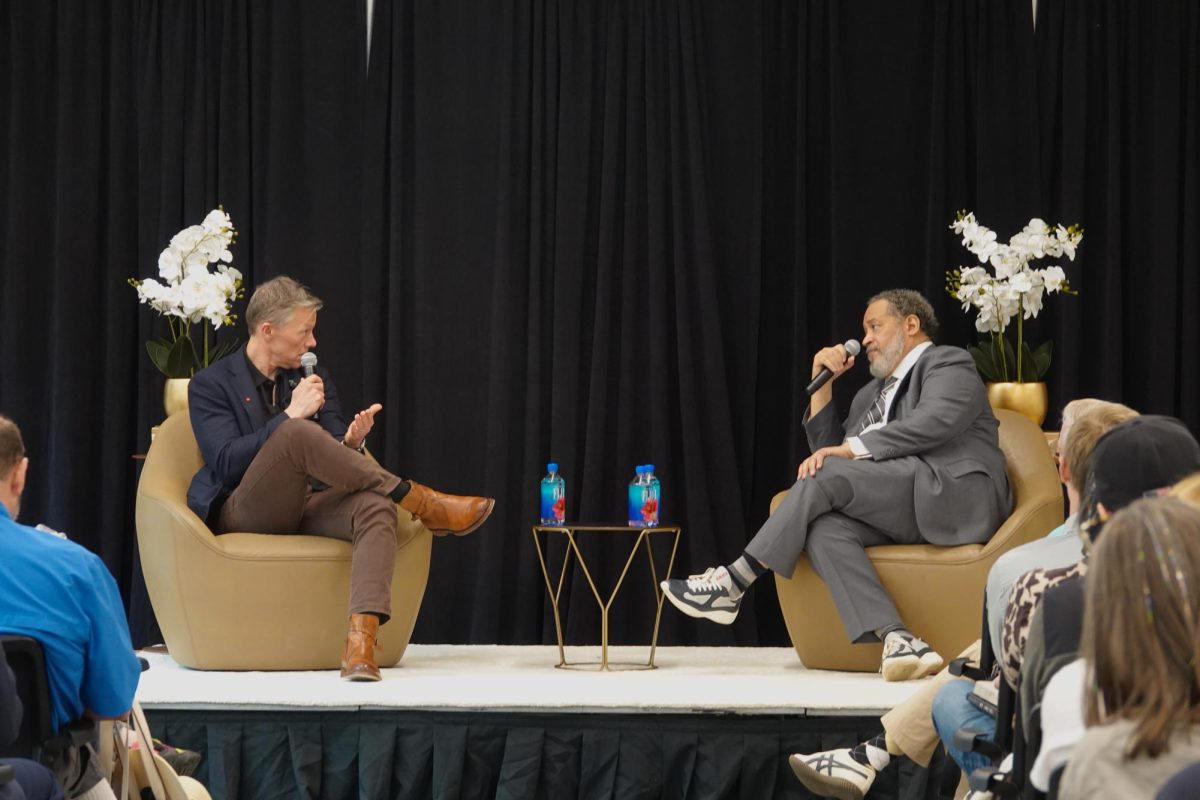

Vanderbilt’s James Lawson Institute and Dialogue Vanderbilt hosted Matthew Desmond April 2 for a conversation on poverty, housing and inequality as part of the final event of the “Community Over Chaos” series. Professor of Ethics Michael Eric Dyson moderated the conversation. Roughly 75 people attended the event, including students and members of the Vanderbilt community.
Desmond is a Pulitzer Prize-winning author and founder of Princeton’s Eviction Lab, which conducts research and shapes policy through a nationwide eviction database. He has published over 25 books, including 7 New York Times best-sellers, and is the recipient of the Langston Hughes Medal, the American Book Award and two NAACP Image Awards.
Dyson first opened the talk by praising Desmond’s work and its influence on public discourse in the United States. Desmond then explained how his upbringing ignited his interest in studying poverty.
“My daddy was a preacher, and so that meant we didn’t have a lot of money. And, you know, our gas got shut off, and our lights got turned off, and then the bank took our home before it was all the rage. And then, you know, I think I reacted like [how] a lot of kids react in those circumstances,” Desmond said. “I blamed my daddy, but I think part of me started asking this ‘why?’ question. Like why is this how the country handles a family who falls on hard times? Why is there so much poverty in this nation of dollars?”
Desmond explained how poverty in America is often not in spite of wealth but because of it, through exploitation of labor, housing and financial markets. He criticized the subsidization of affluence over fighting poverty and called for collective responsibility to address poverty.
“I feel [that] when it comes to the poverty debate, we continue to subsidize affluence a lot more than fighting poverty in America. We give a lot more to the folks that lead it and need it the least, and then we continue to be segregated, right? And this is especially a word for my fellow affluent whites in the audience,” Desmond said. “We build walls around our communities, and reward opportunities behind those walls, and there’s a side effect of that, right? And so, I think that a lot of us benefit from poverty, are connected to poverty, which means, though, that we’re connected to the solution if we’re also connected to the problem.”
Desmond urged Americans to reconsider how their consumption and financial habits contribute to inequality.
“I think for those of us that are trying, striving for a different kind of country, I think we need more skin in the game, and I think we need to make poverty less of a ‘them’ problem, and the ‘them’ can be a lot of people,” Desmond said. “It can be the poor themselves. It can be Congress, like the super-rich, or the Republicans or the Democrats. We all have a ‘them.’ And what if we started making it our problem? So, what does that look like? Well, that might look like shopping differently.”
Shifting the focus from those most affected by eviction to the small concentration of benefactors who profit from it, Desmond challenged the audience to reconsider how power, not just vulnerability, shapes housing inequality.
“Take a problem, like eviction. So, a lot of times when you approach that problem, you got to talk about the racial inequality. You talk about women and kids getting evicted more. These are all important things to talk about. What if I told you this is a true statistic that we’re just figuring out 10 people in Boston evict like half the city,” Desmond said. “Now suddenly we’re asking a different kind of question, right? We’re like, ‘who are those guys?’ And so, I think that the more we can shift the aperture onto power and away from the victims and onto the benefactors of this, I think there’s a lot of purchase there, but that often does come with giving up maybe some policies that we often really believe in too.”
In an interview with The Hustler, Desmond explained that young people seeking to make a difference should do so alongside pursuing their interests.
“When I was your age, I always asked the question, ‘How can I make the biggest difference?’ But [now] at the end of my life, I don’t think that’s the question. I think the question is, ‘What do I love, and how can I improve that with what keeps me up at night?’ So anti-poverty movements need lawyers and nurses and artists [and] accountants,” Desmond said. “We need everyone. So, I think that for young folk seeking to make a difference, I think it’s really kind of trying to be in touch with your talents and your motivations and then tying those in to figure out how they fit.”
Desmond advised the younger generation to recognize the power of collective action to enact social change.
“I also think it’s important to recognize that young folks have led when it comes to social movements, like the Civil Rights Movement, young folks played a major role in that, and they’re playing a major role in the environmental movement. And so young folks often feel pretty powerless, but together they’ve enacted real change and found power,” Desmond said.
Imaad Muwahid, a senior and member of the Dialogue Vanderbilt student advisory board, said he appreciated Desmond’s insight on community-building and leading with compassion.
“I think, for me, this event was so insightful because he spoke about how we’ve lost this moral ambition and how what we are facing is a spiritual poverty, which I think is particularly relevant because I think, right now, we’re getting stuck in these contemporary debates of like ‘is the minimum wage going to raise unemployment?’ [or] ‘is welfare going to cause a scare in the economy?’” Muwahid said. “In the grand scheme of things, poverty is depriving the nation and the people of so much in terms of ambition, in terms of livelihood and just what it means to be a better community. And this idea of neighborliness, this idea of a politics of empathy is something that particularly stuck with me.”
Sophomore Emile Brozaityte said that her biggest takeaway from the event was that society should focus on fixing the system perpetuating poverty in America rather than the desperation of its victims, which are symptoms of the problem. She alluded to a metaphor by author Tommy Orange, which was referenced in Desmond’s lecture, that compares people in crisis to individuals jumping from a burning building.
“I think it’s time that we start looking at the fire, or the roots of the problem [of poverty], rather than the jumpers. Rather than [focusing on] the victims, we should be looking at the people who benefit or keep the system running,” said Brozaityte.
Jo English, a first-year master’s student in Peabody’s Community Development and Action program, said that she was hopeful at the prospect of effectuating social change through community-building.
“Small movement can make big changes. I’m excited to continue to be in spaces like this where we can build community and talk about issues that matter in our communities,” English said.