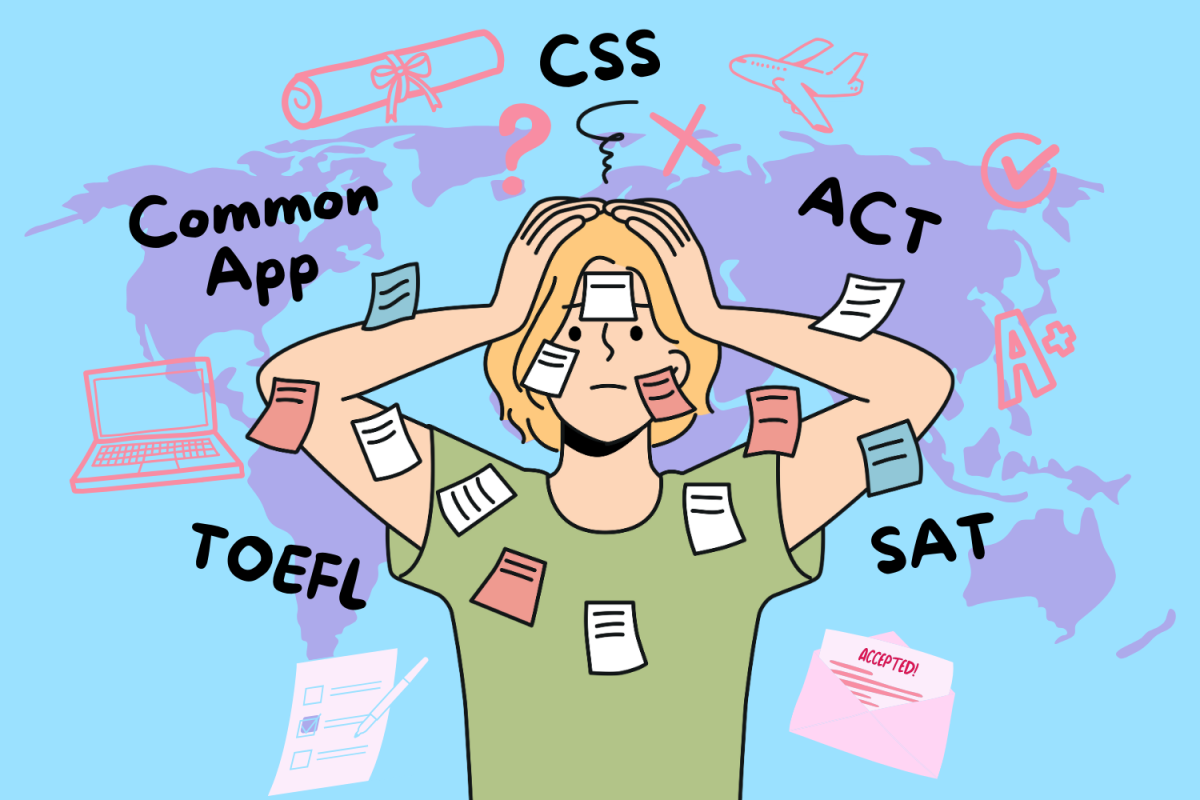

Imagine if your entire life, from marriage prospects to your corporate ceiling to your social circle, was determined by your fluency in Spanish. Imagine if top universities taught exclusively in Spanish, and the “American Dream” was accessible only to those who could afford $800,000 in private Spanish education. While this seems absurd, it defines my life in Korea. Despite being born and raised in Korea, my parents will have spent $800,000 on private English education by the end of undergrad to make sure I speak English like an American. That is a 4,000% markup over the $20,000 cost of a local Korean education.
That $782,000 gap did more than give me fluency in a second language. It replaced much of my Korean identity, making me feel like a stranger in a country I grew up in. In Korea, English fluency is not only a marker of class but is increasingly becoming a cultural divide. Yet, for all its divisiveness, English is also increasingly uniting the nation through shared sacrifice.
Unlike developing nations where emigration is the path to prosperity, Korea is already one of the richest countries in the world. It boasts its own culture, food, identity and global soft power, more comparable to France. Yet while the French fiercely guard their language, Koreans race to learn English.
The motivation lies in history. Just two generations ago, devastated by war, Korea was in a “gritty, poverty-racked” state. Only by aggressively selling goods and services abroad did the nation achieve one of the fastest economic growth stories in modern history. Success had a formula: work hard, export relentlessly and invest in your children’s education. As globalization took hold, that formula added a new necessity: English. Without speaking the world’s language, it would be increasingly difficult to thrive.
However, as Korea’s economy matured and its social classes became largely fixed at birth, what was once an optional strategy for upward mobility became a necessity for survival. English now sits at the center of rituals for survival, being the most intensely studied subject. With a rising floor one can’t afford to fall through, an average parent spends roughly a third of Korea’s average monthly salary on private English lessons, less as a tool for mobility than as a means of maintaining social status.
For the top 10% of Koreans, private lessons often stretch until 10 p.m. every night, creating disparities in English fluency as early as elementary school. Meanwhile, elite families increasingly bypass the domestic academic race altogether through a full immersion in English-speaking K-12 schools, followed by enrollment at American universities.
Yet this carries a grim tradeoff: the local language and culture.
Imagine if the future successors of Google, Walmart and Meta grew up watching Stranger Things with Spanish subtitles or knew about every Spanish monarch but nothing about the Pilgrims. In Korea, the newest generation in charge of the top 100 businesses is more American than Korean.
Elites aren’t just abandoning the country’s most prestigious universities for American ones. According to my dad, 90% of affluent parents in his social circle enrolled their children in private English-speaking schools from as early as kindergarten. He says that in today’s world, English fluency is no longer a choice but a “prerequisite for survival,” and even minor differences in fluency make a difference between “heaven and earth.”
These machines, international schools, often provide an American curriculum in a bubble, complete with white American teachers, AP courses and SAT testing centers. Although originally built for foreigners, they have been manipulated as a hub for Korean elites, with 8 in 10 students being Korean nationals.
To qualify as “foreign,” some families, including mine, even go as far to split continents for several years. Mothers move with their children to English-speaking countries, while fathers stay behind to finance the arrangement. The number of international schools is only increasing, with 17 in Seoul alone.
My experience attending an international school meant I learned how to count dimes and nickels before learning how to say my grandma’s age in Korean. At seven years old, I gave a presentation about Lewis and Clark and westward expansion, but I didn’t know about Korean history until seventh-grade world history class. When “Squid Game” came out, it was a symbol of Korean pride as it went viral, and I did not participate in the patriotism, as I had secretly watched it with English dubbing. I recall during cheer practice when our instructor asked for our KakaoTalk handles, equivalent to America’s iMessage, my friend replied: “I don’t have that, but you can have my Snapchat.” To that, he replied: “What’s that?” While my mom ordered packages overnight with domestic apps, I spent $15 on shipping to order used Brandy Melville clothing on Depop from someone in Ohio. Slowly, the cultural gap deepened into a social one. To this day, none of my inner circle of friends are primarily Korean-speaking.
If there were a version of myself who received a Korean education, I don’t think we would be friends. We would still struggle to understand each other’s jokes or cultural references and struggle to bond over similar tastes in music or movies. She would implore, in Korean, that I stop wearing my pink Lululemon Align tank top as it’s too flashy and revealing. I would argue back, in English, that her entirely black-and-white wardrobe isn’t fashion but a copy-paste of everyone else. Beneath the surface, she would find me too direct and too much, and I would find her too uptight and reserved.
My experience does not stand for all 40,000 Korean nationals studying in American colleges, the third largest group of international students. Some built a stronger Korean foundation before entering international schools, even speaking better Korean than English, and consuming more Korean media. But individual variations don’t dismantle the structure. As machines are only growing stronger and international schooling becomes the default for elites, Americanization is becoming harder to resist.
If the sons of American billionaires spoke better Spanish than English, the public would call it a national identity crisis. Yet in Korea, it is patriotism. Choosing fluency in a language spoken by 1.5 billion people over one spoken by 80 million people isn’t abandonment. It’s retracing the same fierce bargain our grandparents made, relentlessly exporting goods abroad to turn a war-ravaged country into an economic miracle. Only now, sixty years later, globalization has made English the necessity.
The elites and struggling classes represent two sides of the same coin: one sacrifices their identity, while the other sacrifices their life savings. If patriotism can look like upkeeping the traditions that shaped the nation, then maybe, sacrificing my Korean–ness may be the most Korean thing I’ve ever done.