
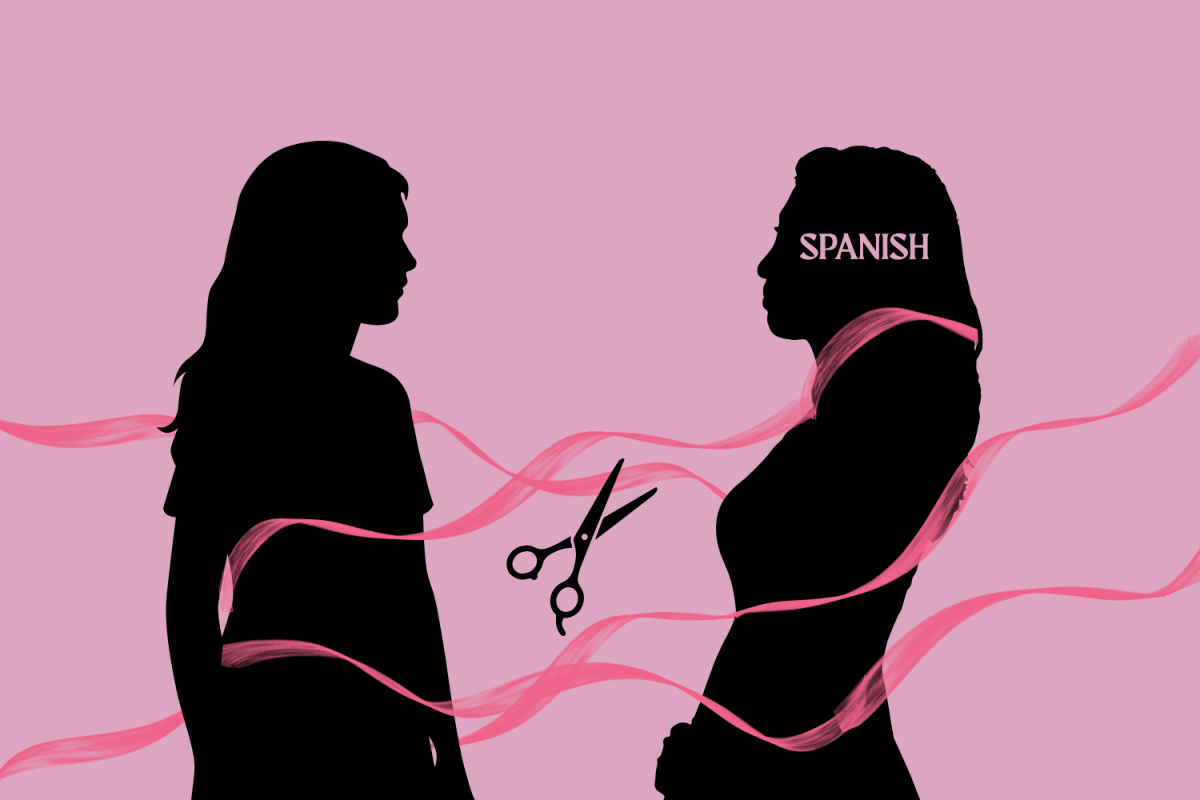
I owe Spanish a decision regarding our ongoing situationship. When my professor asked during office hours whether I would continue taking Spanish classes, I said yes. Fresh off the adrenaline rush of finishing my first semester, I was certain I loved it. And I did, just without understanding the extent to which love demands exclusivity and commitment. Now, I must say, I don’t see an ‘us’ anymore.
When Spanish first began flowing from my textbooks into actual conversations through SPAN2201, the world also became livelier and more reachable. I gladly took on the obligations of being trilingual, rehearsing Spanish’s intricate grammar and conjugations as I loved my own English alphabet and Korean hangul. After just four months, our relationship had gone public — at Christmas, a Korean-Latin American expressed in awe: “You speak the best Spanish out of any Asian woman I know.” However, what others didn’t see was the guilt that crept in every time I would opt for Tate McRae instead of Reggaeton, attend worship groups on Mondays instead of the Spanish table or end my night journaling instead of reviewing Spanish flashcards one more time. The honeymoon phase devolved too quickly into Spanish begging me for attention, and I had forgotten what it was like to pursue other vocations.
Blinded by love, there were red flags I had overlooked. Particularly, upkeeping the devotion meant having to sideline English, a medium that holds everything about me, from my thoughts to my voice. English colored my world from infancy and shaped how I showed up in the world at all. Yet, I realized I had invested deeply in something secondary. Before Spanish, I owed myself English.
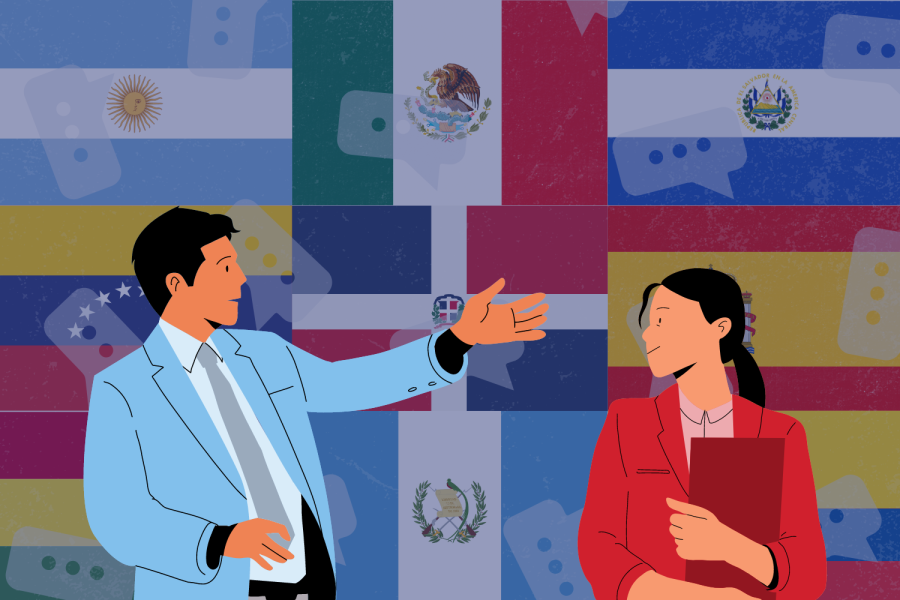
Denial clung to me because Spanish was a whole catch. I was enthralled at how, unlike other classes, Spanish refused to be outsmarted, with no shortcuts, strategies or a guarantee that my wit would carry me through. Getting out of an Uber, I began to say, “Que tengas un buen día,” leaning into the subjunctive tense that doesn’t exist in English but shapes how Spanish speakers view the world. I stopped having to translate every sentence but learned to exist without the cushion of English, witnessing the raw emotions, complexity and humanity of Spanish speakers without English smoothing its edges. Spanish offered me a portal into a continent I’ve never visited, with dreams of Chile’s roaring oceans and exquisite eel soups reshaping its identity from an oddly long country on a map. It handed me access to the rituals and histories of 21 Spanish-speaking countries across the Americas and Europe, worlds that did not circulate anywhere in my Korean upbringing, barred by geographical and cultural distance.
I adored the agency and sense of power. However, back in my English-speaking world, I still watched as my thoughts arrived distorted: thoughtfulness mistaken for hesitation, silence for indifference and sincerity for performance. Growing up with selective mutism, I was only able to speak to family and a few friends, and years without a reliable voice revealed how crucial language and self-expression were for agency. Spanish gave me a voice, but not in everyday situations where I needed to get myself across to others. That was a job for English.
Spanish’s worth in the market also meant it did not leave room for much else. The freshest memory I have from the first semester of freshman year, a period meant for discovering places, belonging and possibilities, was being locked up in that one study room, at 5 A.M., munching on a cold bagel as breakfast with a mountain of handouts spread out and fingers sore from working relentlessly for a biweekly Spanish exam.
I never saw rigorous courses as something to avoid; mastering difficulty signaled discipline and prestige. At some point, I began to actively seek challenge, as if rigor had become a part of my identity. Challenge led to character development, while ease felt stagnant, like I was cheating myself out of my potential. Thus, it was almost instinctive when, despite placing for SPAN1103, I chose to enroll in SPAN2201, to get the most out of my semester.
However, what I mistook as optimization was, in reality, a failure to honor my own needs and limits. In exchange for growth, Spanish monopolized my time and energy, leading to constant dread, anxiety and feelings of worthlessness. Having faced a semester of burnout, I realized my resources are truly finite, as echoed in a Forbes article about taking the narrow path.
“Life will choose [hard things] for you eventually,” the Forbes article reads. “The question is whether you’ll practice first, while you still have the luxury of choosing which hard things, and when.”
True maturity, I realized, is not about rashly stacking demands, but discerning which ones I can afford and when, particularly choosing those that are the most central to my growth. As Vanderbilt students, we don’t need a wide array of challenges, but better frameworks for choosing commitments that are the most meaningful to us.
Staring at the spring course registration page for SPAN2202, I remember feeling paralyzed, realizing a commitment I loved was no longer healthy. Assuming I would manage the demands better next time would just be repetition compulsion, or our tendency to repeat the same distressing experiences in hopes of finally conquering them. Studies show harder intermediate levels will yield diminishing results in “a period of immovability” where it’s likely to feel one is not making “advancement in accordance with the requirements of the course.” The remedy for pushing through sounded too familiar — speak as much Spanish, practice every day, memorize new words and phrases — echoing a time when it monopolized my life. What made it difficult to part was my fear of losing Spanish abilities, which turned out to be a sunk cost fallacy. The truth is, the costs of retaining vocabulary will only pile up as time progresses. At some point, the choice had narrowed between stepping away deliberately or having the commitment turn into a loss-preventing proposal.
This spring, instead of taking SPAN2202, I built a semester around specific English classes that would help me hone in on the complexities of my inner world and share them with the outer world. Now, my academic life feels demanding without feeling suffocating. I feel excitement and occasional stress, but never dread, panic or anxiety.
Taking Spanish was an essential stop on my journey. It proved that I could master a skill starting from nothing. More importantly, Spanish helped clarify how central language is to my sense of self and gave me the courage to leave a commitment to pursue more urgent needs. Stepping away isn’t a rejection of rigor, but a refusal to outsource worth to workload intensity. Through leaving it behind, I reclaim the capacity to pursue my passions and become the version of myself I hope to be.
So, to Spanish, to love you is to part with you.
Love,
An almost-Spanish-minor




Robin Raborn • Mar 2, 2026 at 3:16 pm CST
I spent my junior year in Madrid, 1973-74, with one semester with Vanderbilt and one with Middlebury. Everything I studied counted as Spanish: art history, history, poetry, theater, etc. I had a Spanish major even though I didn’t have the required courses for the graduate record exam in Spanish. Franco was in power then and I lived with a family who had lost many relatives in the civil war. It was a year of cultural and political enlightenment. I earned an MBA at Thunderbird in global business and worked overseas. I use Spanish everyday in California. Spend a year abroad in any language and expand your perceptions.