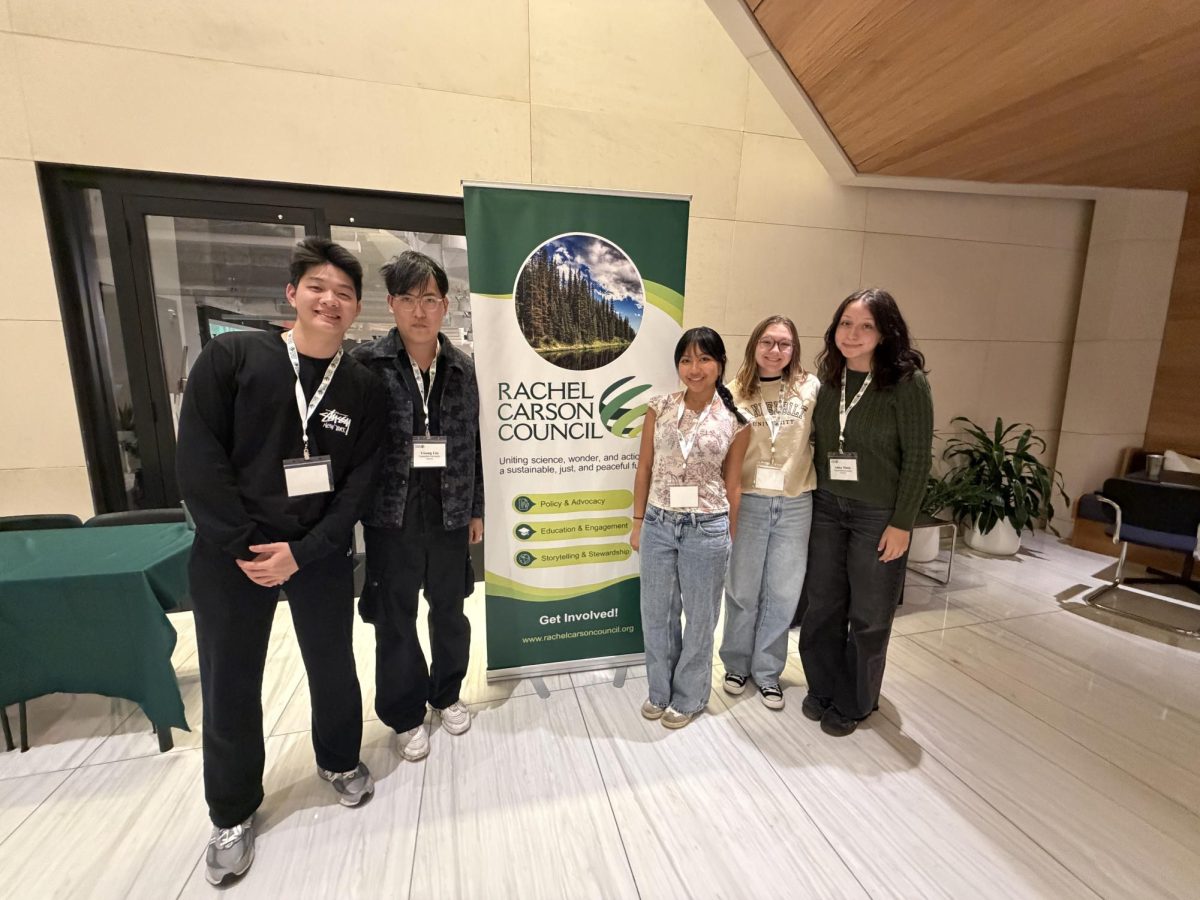

Five Vanderbilt students were selected to participate in the Rachel Carson Council’s 2026 Advocacy Day March 25-27 in Washington, D.C. The annual event is a hands-on program that trains and mobilizes college students to engage directly with federal lawmakers on urgent environmental issues.
During the three-day program, participants attended policy briefings and advocacy workshops before traveling to Capitol Hill to meet with congressional offices and discuss key environmental issues. Topics this year included federal support for industrial wood pellets and environmental policies negatively affecting forests and frontline communities.
Diego Tovar, director of campus engagement for the Rachel Carson Council, described the primary aim of the advocacy day and how its mission has evolved.
“The primary goal of Advocacy Day is to empower students to bring their lived experiences, research and stories directly into conversations with policymakers,” Tovar said. “At its core, it’s about bridging the gap between grassroots environmental action and federal decision-making. Over time, that mission has evolved from simply introducing students to advocacy to actively training and equipping them to be effective advocates in their own right.”
Tovar also explained that this year’s issues were selected because they combined environmental justice, public health and federal accountability.
“One of our major asks was for lawmakers to oppose the wood pellet industry, as the industry drives forest destruction, worsens air pollution and burdens on frontline communities,” Tovar said. “We also urged support for the Opportunities in Organic Act of 2026, opposing the pesticide manufacturing industry to gain legal immunity over state and local regulation and advocated for the Polluters Pay Climate Fund Act to help fund weather resilience and preparedness projects.”
Junior Chloe Whalen reflected on her initial experience attending the advocacy day. Whalen also serves as The Hustler’s Games Editor.
“We had several insightful conversations with staffers and legislators from Tennessee, including senators and House representatives,” Whalen said. “I think the most impactful part was being in the Senate and House office buildings and seeing how much is going on. People are walking around, bringing memos, letters and bills to be discussed. It was a bit of a surreal experience to just be there.”
Whalen also described what it was like speaking with policymakers for the first time.
“I felt more or less prepared from the discussions that we have in class [as they] mirror the discussions that I was having with staffers about these issues,” Whalen said. “It is also very important to have a bipartisan view on a lot of these issues because we talk to staffers who work for legislators on both sides of the aisle with many different viewpoints on a lot of these issues.”
Whalen further highlighted the challenges of communicating complex environmental issues with people who are not scientists.
“How do we not necessarily change their minds completely but reframe this in a way to where they see that this is an issue that needs to be addressed despite their historic views on climate change, sustainability and environmental regulation as a whole?” Whalen said. “This includes focusing on the economic side of things, especially in Tennessee, where this is a problem for your rural constituents.”
Sophomore Adna Mutic shared her motivation toward environmental advocacy and participation in Advocacy Day.
“Environmental advocacy is important to me because the environment is voiceless. When we decide to do things to human society, a lot of the times we learn [the environment] is affected negatively and so often are human communities,” Mutic said.
Mutic said meeting with aides from Rep. Valerie Foushee’s office was one of the most meaningful moments of her experience.
“Overall, it was really uplifting [seeing their work]. Right in front of me were people with the power to do something positive, who are using that power to do positive things for our communities,” Mutic said.
Mutic also expanded on getting involved in environmental advocacy for students who may be new to the path.
“Environmental advocacy is not only advocating for clean rivers and water in our environment but also advocating for the communities who are affected by that polluted drinking water. There are so many different issues to tackle, you just have to start,” Mutic said. “That could be academic personal projects or working with larger grassroots organizations or attending a program like I did, which is annual so people can apply for next year.”
Senior Grace Park emphasized how the Advocacy Day complemented her academic learning.
“There’s a lot of components about policy, legislative actions, state and federal regulations and how all of that plays a very significant role in the current climate crisis,” Park said. “I did not have any hands-on policy experience, but the Rachel Carson Council provided me with that.”
Park further discussed how the Vanderbilt team met with Tennessee representatives.
“We met with the staff members of each of the senators and the representatives, and even though their political agenda might not completely align with the environmental advocacy group, they were very engaging, asked very thoughtful questions and did their research beforehand,” Park said. “It was very enlightening [to see] the strong impact of open discourse and civil dialogue.”