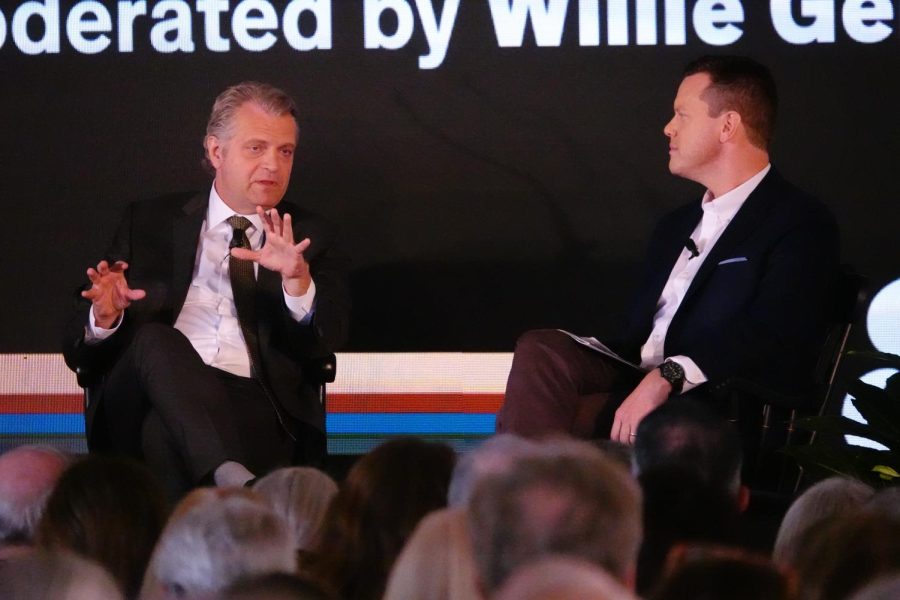


Willie Geist (B.A. ‘97), host of NBC’s “Sunday TODAY” and co-host of MS NOW’s “Morning Joe,” visited Nashville Jan. 19 for a live taping of his podcast “Sunday Sitdown” with guest Luke Combs. The Hustler sat down with Geist before he interviewed Combs to talk about his time at Vanderbilt and his career in journalism.
The Vanderbilt Hustler: I’d love to start by talking about your time at The Hustler. What was it like to be on staff in the late 90s? What are some memorable moments? What are some things that you learned there that have helped you in your career?
Geist: I got to Vanderbilt, and I tried to walk on to the basketball team. I played basketball in high school. They were not looking for my services, it turned out. They said, ‘Thank you very much, we’ll keep your resume on file.’ The closest I could get to being a part of the team was to cover the games. I had written for my school newspaper, and my father was in journalism, so it wasn’t a foreign idea. It wasn’t such a wild idea, so I was a staff sports writer. They didn’t give me the basketball and the football games. That was for the older guys; you know how that works. So, I would go cover lower profile sports, but it was such great training. That was really the first time I learned how to write on a deadline or write well in journalism.
My friend, now for many years, Tyler Kepner was the same year as me. He was a prodigy from Philadelphia. He’d been sending out this baseball newsletter in the early 90s when he was in high school as a teenager that became used by Major League Baseball teams because it had so much information and reporting in it. He basically got recruited to work for The Hustler, so he was always a great advocate for me. He was a sports editor, and then he became the editor of the entire newspaper. Lee Jenkins was there, who went on to write for Sports Illustrated and now works for the Clippers. I mean, the list is so long, but it was such a talented group of people. To have Tyler be your editor and be like ‘I don’t think you need that’ or ‘Did the coach say anything about this?’ was very, very informative and lit the spark for a journalism career. I went from sports, and then I became sort of a columnist, which is nice because I can write about anything. Didn’t have to be sports, and often wasn’t. I could write a lighter piece, something humorous about something at school. To have that platform to do that at that age was amazing, as you guys know.
We saw online that you drove a liquor delivery truck after you graduated from Vanderbilt. Not having a job lined up after graduation can be very scary, so do you have any advice for students that maybe don’t have their dream job coming out of college?
I’m glad you brought that up because that’s really important to know. I remember, even in the beginning of my senior year, people were starting to have job interviews. Guys I knew were in suits with one of those leather things you put your resume in. I was like, ‘Where are you going?’ ‘Job interview.’ We’re getting jobs? Now? There was a company called Anderson Consulting at the time that was scooping up all these Vanderbilt kids, and they all got hired in October or something, so that inspired a little bit of panic.
I didn’t have a job when I graduated, so I went home to New Jersey. It was supposed to just be a month or two in the summer, driving the liquor delivery truck for Wine and Spirit World. It was one of those brown, two-tone panel vans that needed some serious repairs. It was fun, but it went through the summer, and I was sending out resumes, but wasn’t getting a lot of bites because I wanted to work in journalism. And then by the time I got to Thanksgiving, my parents were like, ‘Hey, we kind of just sent you to Vanderbilt for four years. We gotta plan here?’ So I decided to move to Atlanta, where a bunch of my friends were living, and I applied for a job at CNN and a job at the Atlanta Journal Constitution. Those were the two big outlets there. AJC was not hiring. CNN was, and I got a job in the sports department at CNN. I didn’t start what you would call a regular job until January after I graduated.
So, to answer your question, my advice is don’t panic. You’re going to see a lot of people around you getting jobs. You’re going to hear about them making X dollars and getting an apartment in New York, and you think they’re going to fly past you. It’s a long game. Do the thing you want to do. It might take a little longer than you think it’s going to take. It’ll pay off if you’re doing something that you enjoy doing in the long run. A lot of those jobs with the guys with the suits and the leather things lasted like a year, and then they’re like, ‘Oh, I hate this,’ but it was the jobs they took, which I don’t blame them for. They pay the rent for a year, but it’s okay if it doesn’t happen right away.
You have been a publicly outspoken fan of Vanderbilt Athletics even when its teams have had limited success. What has it been like to be a fan since your time as a student, in less successful years but especially these past few years, as we’ve seen some historic athletic success?
These last two years have been the best of my Vanderbilt fandom. As you say, there have been some lean years. When I was in school, we’d win two games, three games a year at football. We had great defense, so we would keep the games closed with a bunch of NFL players on our defense, but we couldn’t score any points, and we’d lose. At some point, we’re always fans. We’d come back and go to a couple games in the fall. We’d watch them on TV. We’d be in text chains complaining about the team or the coach or whatever. We were always there. But it was sort of a curiosity like, ‘Oh, the game’s on. I’ll watch it if I can,’ and you sort of knew how the season was going to go. You might steal a couple wins, but you weren’t going to get to the point where it was a bowl game or something.
Then James Franklin came in and had a couple good years. I thought, ‘maybe it is possible here.’ Maybe there’s a formula that could work here. Then we kind of went back down into the valley a little bit, but, obviously, Clark Lea has changed everything. Candace Lee is amazing. She was a couple years after me at Vanderbilt. I knew her a little bit, and I’ve gotten to know her now. And of course, Pavia came in the last couple years and really electrified and put us into warp speed. So, it’s been a thrill. In some ways, it’s disorienting to spend 30 years understanding who we are in the SEC, where we belong in the SEC, in some ways, just sort of accepting that. So, to have Pavia come in saying, ‘I’m gonna win the Heisman trophy, and we’re going to playoffs,’ and then he does it; he almost wins the Heisman trophy, and we should have been in the playoffs.
It’s incredible, and you have to give credit to the investment the school has made in sports, to Candace, to Clark, our basketball programs, men’s and women’s. The women’s win again today against Michigan was really good. You have Mikayla Blakes, Shea Ralph. We have the best coaches, and now we’re getting the best players to come in. And the portal has helped, and NIL has helped, but it’s been disorienting and absolutely thrilling. The fact that we’re watching us just pound Tennessee in Knoxville, this does not happen, right? There’s no doubt that we’re the better team in most of those games. The fact that we were mad that we lost to Alabama and the fact that we were mad we lost that game in Texas just shows you how far we’ve come. We would have been thrilled to keep those games close in the past. It’s been so much fun, and I have a feeling we’re going to keep it going because they’ve decided that it’s important at this school.
You’ve conducted countless interviews in your career. What makes one memorable for you?
If you learn something about the person that you didn’t know before. A lot of these people do tons of interviews, but [Combs] doesn’t, which is nice about this. Sometimes when somebody’s on a media tour, you see them on the late-night shows, and then they’re on every podcast you see, and they’re all over the place. [Combs’] album doesn’t come out for two more months, so there’s no specific reason for him to do this other than he’s a good dude and wanted to do it. It’s cool to grab somebody like this and spend an hour and talk about his life and his journey. I think scarcity, people you don’t see a lot, is great, and then learning something new about them, getting a story that he’ll tell you that you haven’t heard before. Those make good interviews, just trying to make them authentic and as comfortable as possible because, as you know, a TV interview is a weird thing. It’s like you’re trying to have a normal conversation, but there are lights on or microphones or ‘Quiet, please. Turn off your phones,’ and everybody kind of clams up a little bit. So to the extent we can just be talking, then that’s when they’re at their best, when I can make the other person feel as comfortable as possible. They feel relaxed enough to tell their story and maybe share something they haven’t said before.