

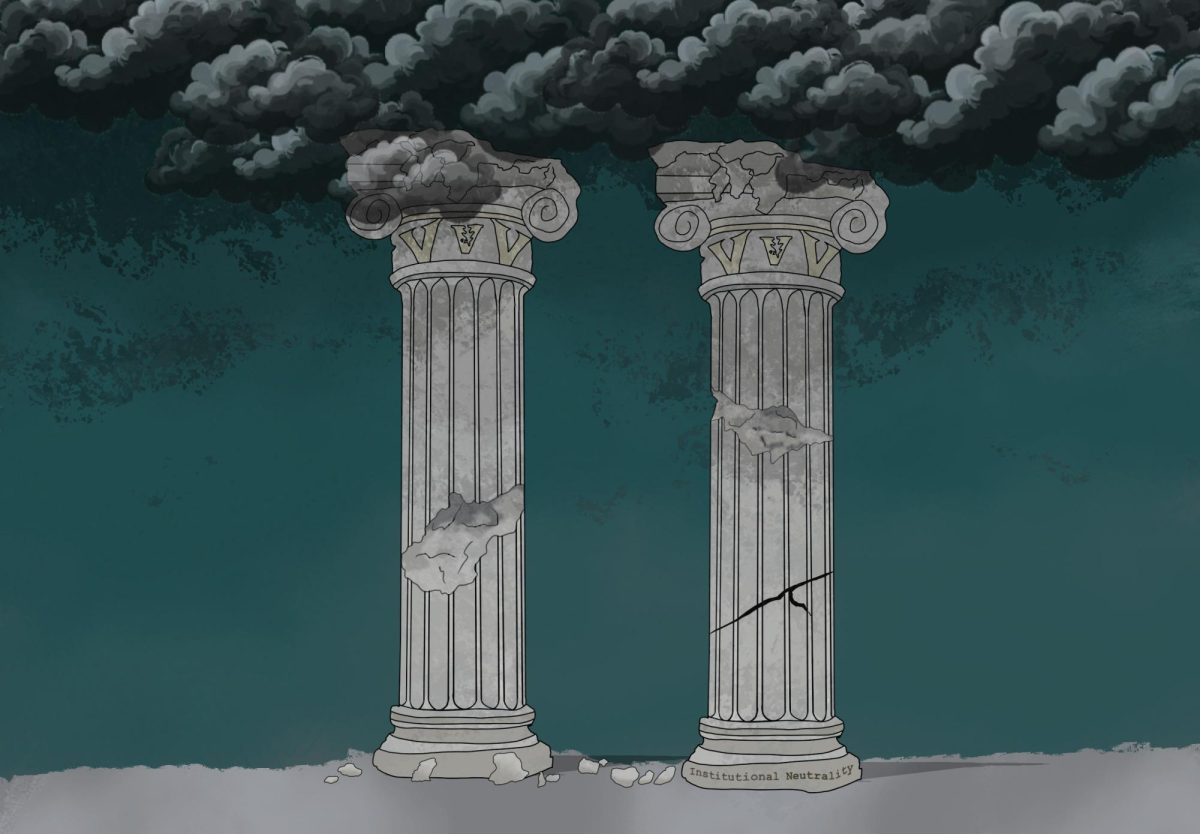
Over 150 Vanderbilt students, faculty and staff gathered outside Kirkland Hall on Nov. 5 to protest President Donald Trump’s “Compact for Academic Excellence in Higher Education.” Indivisible Vandy, Vanderbilt Graduate Workers United and the Vanderbilt chapter of the American Association of University Professors co-organized the event.
At a similar rally last month, VGWU members delivered a petition signed by over 1,000 people calling on university administration not to sign the compact. Since then, Chancellor Daniel Diermeier has explained the university’s ongoing process of responding to the compact. The university has not yet officially accepted or rejected the compact.
Seven individuals made speeches at the Nov. 5 rally, including sophomore Zofia Sante Hunter, whose speech opened the event.
“We feel betrayed that our administration — the board, Diermeier — sees this attack on higher education and goes in for more,” Hunter said.
Anthropology professor Carwil Bjork-James spoke next and highlighted the parts of the compact that cause him the most concern.
“We saw how, in the compact, there is again and again language about neutrality that is then counterposed with demands of ideological affinity, of shutting down particular voices, of cutting down particular departments,” Bjork-James said. “We saw the ways that this compact is filled with lies and contradictions.”

Jonathan Gilligan, an earth and environmental science professor, said they chose to speak at the event because they’re concerned about threats to free expression and inclusion on campus.
“I’ve been here at Vanderbilt 31 years. I’ve seen lots of changes, and I feel that what’s happening right now with the compact, but also more broadly with a lot of what Chancellor [Daniel] Diermeier has been doing under the name of principled neutrality, has been really threatening a lot of what makes Vanderbilt great,” Gilligan said in an interview with The Hustler.
When Ethan Thorpe, climate governance fellow at Vanderbilt Law School, addressed the crowd, he invited them to share why they came to the rally. People cited their anger at the compact and fear of losing their jobs if the compact is signed as their motivation for attending the rally.
“In terms of specifics, I think that the limits on international students are really frightening to me,” Thorpe said in an interview with The Hustler. “To say that we are about meritocracy and about highlighting the best and the brightest of the next generation is clearly contradicted by the idea of saying that you can only have this many students who are from outside of the country.”
Throughout the rally, speeches were intermixed with chants such as “hands off Vandy,” “stand up, fight back,” “no compact” and “this is what community looks like.” Attendees also held signs with messages like “smash the compact,” “protect religious minorities” and “black ‘n gold, not red tape.”
At entrances to campus near Kirkland Hall, signs were posted saying that demonstrations on private campus property are limited to members of the Vanderbilt community. Lynne Berry, a faculty member in Vanderbilt University Medical Center’s department of biostatistics, acknowledged that the university had legal authority for the signage but said she found it disappointing for alumni and other community members.
“That’s one of the blessings of this time, is that the actions against us are so extreme that it makes it easier to see through the gaslighting,” Berry said in an interview with The Hustler.

Senior Isabella Backus said she attended the rally because she believes the compact threatens the university’s academic freedom.
“Our fundamental right as a university to protect our students, our professors, our graduate students, to teach whatever we want, essentially to be a university is at stake whenever we are willing to submit to the administration,” Backus said. “This isn’t just an olive branch. This is appeasement, and if you’ve ever taken a World War II history class, you know what appeasement does.”
Nick Goodell, a sixth-year graduate student, helped organize the protest. He said the compact concerns him particularly as a historian of modern Germany.
“I teach courses on social movements, and I’m going to teach courses on modern European and German history. To do my job, I have to talk about politics. I have to talk about the history of fascism,” Goodell said. “It’s really concerning to me, this idea that I can’t belittle conservative ideas. I need to be able to openly discuss these histories to do my job.”
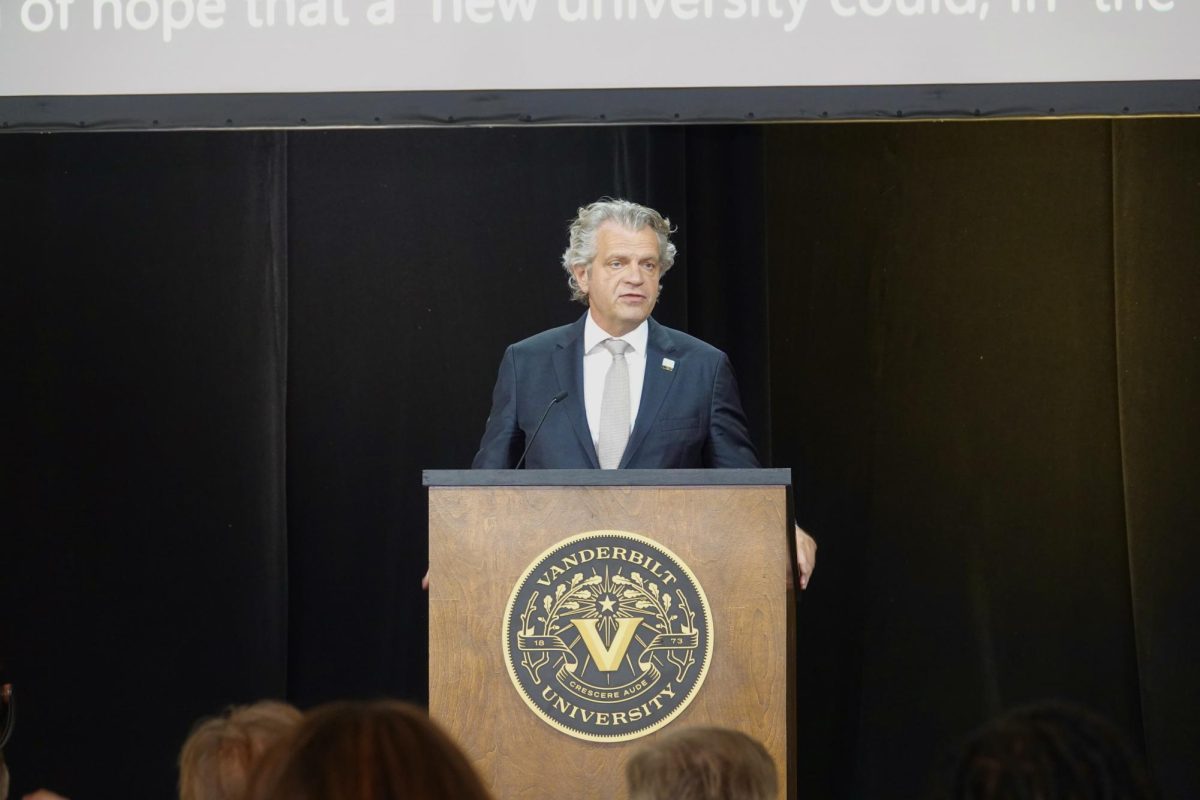
In a statement to The Hustler, the university said free expression and constructive debate are essential to the university’s mission.
“Members of our community continue to share their thoughts and ideas, which help to inform continued conversation with leaders in government and higher education to restore trust in America’s great research universities,” the representative said.







Carl • Nov 6, 2025 at 1:46 pm CST
“Vanderbilt believes deeply in the power of constructive dialogue, particularly among people of differing views and perspectives. This is often how the greatest progress is made. We look forward to continuing the conversation—on our campus and with leaders in government and higher education—as we work toward our shared goal of restoring public trust in higher education and ensuring that America’s universities remain the best in the world. ” – Diermeier in his email on October 20.
Chancellor Diermeier, this is not a conversation. We have tried to start a dialogue, at this point with countless letters and shouting your name outside your office twice now. “Dialogue Vanderbilt” is clearly about your dialogue with the fascists and billionaires in power, not a dialogue with the people in your community who teach the classes, do research, learn from world-class professors, and bring unique perspectives to this school. Vanderbilt is great, despite your best efforts, and we invite you to talk with us about how to keep it that way.
– Carl, current grad student