

The Vanderbilt community celebrated Women’s History Month throughout March, with the Margaret Cuninggim Women’s Center hosting various events to commemorate the occasion.
In an interview with the The Hustler, Rory Dicker, director of the Women’s Center, shared that planning for the programming began in the fall semester and aimed to include a mix of annual events and programs developed in collaboration with campus partners.
“In building the month’s calendar, the Women’s Center aims to reflect the many experiences of women and create opportunities for all members of the Vanderbilt community to connect, engage and learn,” Dicker said. “This year’s programming included conversations on ecofeminism, reproductive dignity and justice, first-generation women in the academy and financial confidence.”
Here is a close look at three of those events The Hustler was able to attend.
Kickoff celebration
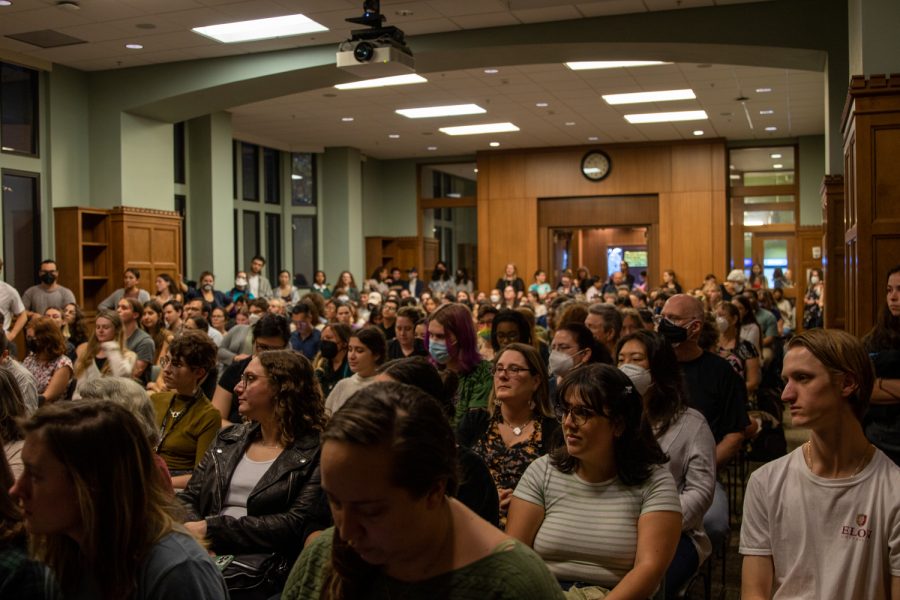
The Women’s Center hosted the Kickoff Celebration to Women’s History Month March 3. The event included an introduction to the month and its celebrations, along with its history at Vanderbilt. The 45 attendees enjoyed refreshments and engaged with one another in conversations about the month, its history and the planned events.
Sophomore Neža Račečič, an intern at the Women’s Center, said March is the center’s busiest but “also favorite month.”
“It’s very rewarding to see how the preparation of our director and other staff is resulting in diverse programming for the Vanderbilt community this month,” Račečič said.
Gender and sexuality studies professor Stacy Simplican emphasized the importance of the center’s inclusivity and reach across campus.
“It’s really great to see so many students, staff and faculty here,” Simplican said. “Something very special about the Women’s Center is that it serves so many aspects of the Vanderbilt community, from undergrads to post docs, to faculty. I think that they have lots of different events, from interactive to speaker to book studies, so there are a ton of ways to get involved this month.”
“Women’s Center Conversations: What is EcoFeminism?” lecture
The Women’s Center hosted the lecture “What is EcoFeminism?” March 16. Kristin Rose, senior lecturer in the Department of Gender and Sexuality Studies, led the event, and approximately 14 individuals were in attendance.
Assistant Director of the center Jennifer Gutman said that the event was inspired by the National Women’s History alliance.
“This is the first of the series that we hope to run here at the Women’s Center, known as “‘Conversations at the Women’s Center,’” Gutman said. “This event was hosted [because] there’s been a lot of interest surrounding the center regarding environmental issues in relation to feminism and womanhood.”
During the lecture, Rose provided a definition for ecofeminism, introducing it as both an activist and academic movement.
“The term [ecofeminism] was coined by Françoise d’Eaubonne and by women working in labor rights, environmentalist, feminist and LGBTQ+ activism in France and North America,” Rose said. “But it has long been a paradigm for women fighting for equality. You can’t talk about the capitalist destruction of the environment without also talking about inequality in global relationships and patriarchy.”
Rose emphasized the importance of understanding ecofeminism and applying the term’s key concepts and understanding.
“Taking a feminist approach helps us see all the possible dangers women face as a result of climate issues. Women are being disproportionately harmed by the exploitation of nature and land: water pilgrims, domestic pollution, natural disasters, health disparity in terms of food scarcity and care work,” Rose said. “Ecofeminism gives us decolonial and intersectional frameworks. It teaches us to protest patriarchal and capitalist violence. It helps us understand that human trafficking, sexual assault, war and the mining industry are interconnected. It allows for coalition building. It teaches us to fight for policy change through environmental protections, reproductive justice and pay equity.”
A recent alumnus in attendance, Xinrui Li (B.S. ’25), said he found the event to be impactful and important.
“I wanted to learn more about the term and am deeply interested in the concept of intersectionality and seeing how ecofeminism is intertwined with the world,” Li said. “Especially coming from a country from the Global South, which is deeply impacted by fast fashion — as discussed in the talk — I can notice the exploitation of land and women. The event has given me more understanding on how we can move forward for equality for people around the world.”
In a message to The Hustler, Rose shared that she honors the work that women have done globally and hopes that Women’s History Month reminds the Vanderbilt community to continue “the fight.”
“In the larger context of the U.S., the fight for gender equality is far from over. Women’s History Month invites us to reflect on women’s historic victories in our nation, while bringing us together in community to prepare for the ongoing struggle for true equality,” Rose said. “My greatest hope coming out of Women’s History Month is that we take a page from the ecofeminists whose activism is deeply rooted in ethics of care. None of us make it through this life and this world alone. Let’s take care of one another and the place we call home.”
“Reproductive Dignity and Justice” lunch and learn
The Women’s Center, in conjunction with the Divinity School, hosted a lunch and learn on “Reproductive Dignity and Justice” March 23. The lunch included discussions on the intersections of religion, gender and sexuality in today’s society. The lunch hosted two guest speakers, Tiye Link and Rabbi Laurie Rice, who shared their experience with reproductive healthcare, dignity and justice throughout their careers.
Link is program coordinator for Nashville CARES, a local non-profit providing sexual healthcare across the greater Nashville area. She serves on the Scientific Review Committee for the Vanderbilt Institute for Clinical and Translational Research and the Epidemic Advisory Workshop and has also provided patient education in the first-year doctors’ program at Vanderbilt University School of Medicine in addition to serving as a guest lecturer for other VUSM programs.
In response to a question of what reproductive dignity and justice means to her, Link explained that to her, reproductive dignity and justice is having access to things she needs to live her life safely.
“It’s not personal autonomy over my body to have children or not have children, broader than that is to have a safe space to raise my family, to make sure that I have the medical healthcare that I need, and for me, living with HIV for over 23 years, to make sure I have my medication,” Link said. “Dignity is that I’m not judged, I’m not hindered, I’m not told I’m going to hell. All those things connected, that I can live a safe life with my medication, with my healthcare.”
Link described how in her work with Nashville CARES, she deals with social stigma around reproductive health, and she seeks to ensure that women have access to medical care they need despite this stigma.
“Tennessee has maternal care deserts, with 46% lacking OB-GYN. When you’re talking about reproductive health, that’s a big portion that’s left out that don’t have access to a doctor. Only 40% of Tennessee has full access to maternity care,” Link said. “We’ve got a barrier of transportation, which we deal with a lot at Nashville CARES. We have to go out to pick someone up in a country and bring them all the way to Nashville for care to our clinic because in a small town, you know somebody that works at the clinic, and they’re either going to know that you’re pregnant or that you have HIV, and they’re going to tell.”
Rice from Congregation Micah was the other guest speaker for lunch. Rice is the current co-chair of The President’s Rabbinic Council for the Hebrew Union College Jewish Institute of Religion. Rice also sits on the board of the Heather Abbott Foundation, which works to provide prosthetics to individuals who have suffered traumatic limb loss. Rice is also a consultant to the university on Jewish engagement and strategic initiatives.
Rice, responding to a question regarding how she views reproductive dignity compared to reproductive justice, said it is more about ensuring everyone has access to their reproductive rights.
“In the Jewish community, we talk about [how] reproductive justice is not the same as reproductive rights. Reproductive rights is, ‘I need to make sure that I continue to fight to keep abortion legal,’ but reproductive justice is what needs to happen to make sure that everybody has access to that right,” Rice said.