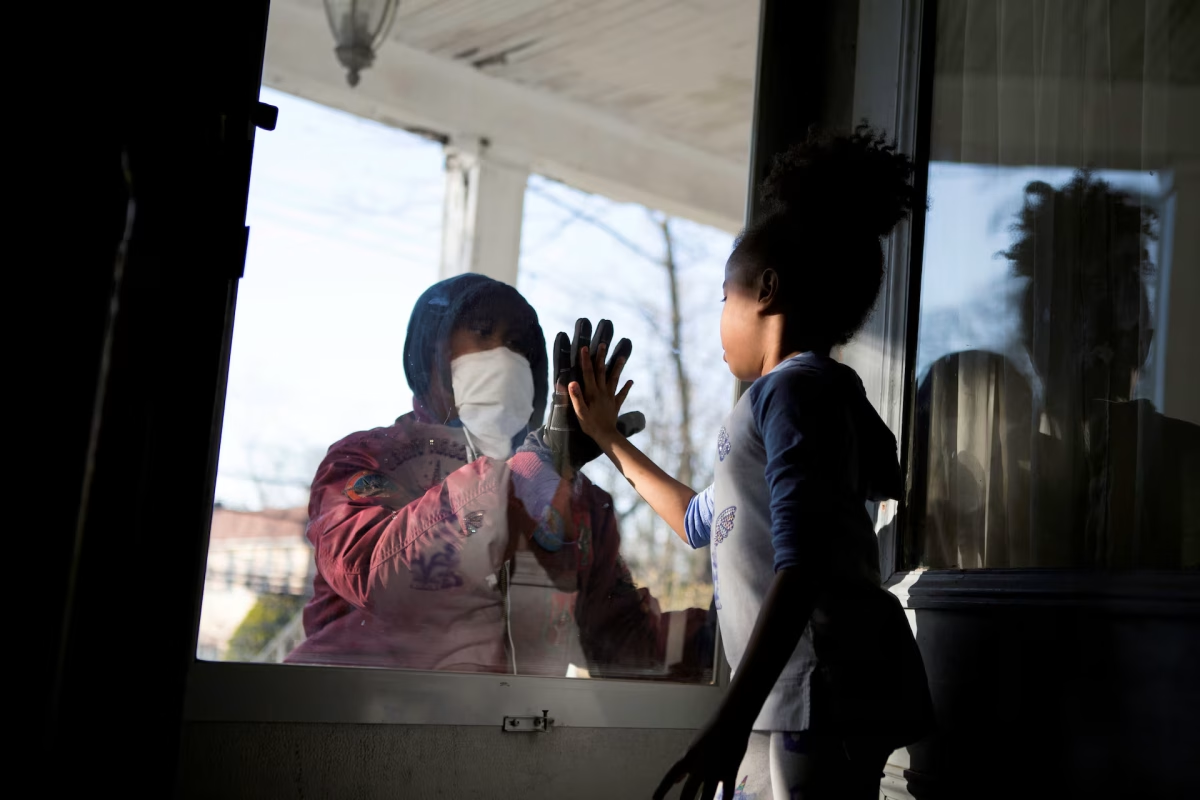

I recently came to a horrible realization — this past March marks six years since I was an innocent middle schooler watching as school closures were being announced in response to something called the coronavirus. I was excited for a few weeks off from school and an extended spring break. What followed, none of us could have expected.
A sweeping public policy response ensued, extracting an enormous and still unaccounted-for toll on our generation. It became a scary demonstration of how quickly a free society is willing to concentrate absolute power in the hands of the few for the supposed benefit — which proved to be to the detriment — of the many. Six years on, as memories begin to fade, too few in our generation are animated by the disastrous manner in which our leaders failed us, and how young people bore the cost more than anyone. The lessons of the pandemic era came at great cost; we cannot afford to forget them, lest in the future another crisis is taken advantage of and used as an excuse to trample over our livelihoods.
The virus was every bit as tragic as it was real. However, it was clear early that the infection fatality risk for young people was near zero, with the most vulnerable being the elderly over 65 years of age. A rational and targeted response would have focused on protecting for those most vulnerable while allowing society to function. Instead, sweeping society-wide lockdowns and mandates reduced COVID mortality by a mere 3.2% while coming at “enormous economic, social, and political costs.” It was almost immediate that the rewards of such policies were minimal relative to the risks, and yet they persisted.
The collateral damage was just as catastrophic as it was predictable. Slamming the brakes on the economy caused U.S. unemployment to hit 14.8%, erasing 22 million jobs overnight, hitting hardest the working class, who unlike white-collar “elites” so to speak, couldn’t work remotely from a cushy home office. While we were tunnel-vision focused on a respiratory illness, childhood vaccination rates plummeted, countless cancer screenings never occurred, mental health deteriorated, drug-related overdoses skyrocketed and 138 million people globally faced starvation as livelihoods were destroyed by these policies. The idea of policy trade-offs was thrown to the wind. “Zero-COVID” mentality led to irrational failures, chief among them, the keeping of students out of schools, in spite of their relative safety.
Our society will face a great reckoning: An entire generation was robbed of those irreplaceable formative years to develop reading, writing, mathematics and socialization. The enormous learning disruptions that occurred will lead to more than $28 trillion over the course of a century due to the societal impacts of a lower-skill workforce. That number represents countless futures in our generation crippled in the name of “safety.” We can only begin to imagine the countless unquantifiable consequences of an entire generation’s formative years developed with half their face covered by a mask, behind the pixels of a computer screen and in the abyss of the internet.
What makes all this worse was not just how ineffective the response was, but the arbitrariness and irrationality that accompanied it, revealing something deeply troubling about living in our democracy.
Somewhere, faceless bureaucrats in an office conference room arbitrarily decided that small businesses needed to close, while big-box retailers were “essential,” despite the fact that standing in line is the same everywhere. While restaurants in New York City were forced to shutter, Alexandria Ocasio-Cortez — a loud proponent of social distancing measures — was seen dining maskless in Miami. As California schools were under strict lockdown, Governor Gavin Newsom was dining with political elites at one of the most expensive restaurants in America. While Chicago barbers and stylists lost their livelihoods due to mandated closures, Mayor Lori Lightfoot got her hair done privately, justifying it by saying she was the “face of the city.” While a Chicago Teachers Union leader insisted on keeping students out of school, she was soaking in the sun on a vacation in the Caribbean.
The politics of those who trespassed their own COVID standards is irrelevant. The takeaway here is apolitical: a certain “let them eat cake” pattern emerged across our society. The rest of America, those who couldn’t afford to switch to their weekend homes, move to another state, and send their children to private school, were left burdened with the devastating consequences. The impacts of lockdowns transcended politics, affecting most the unprivileged of our society, radically exacerbating inequality across our society. Lockdowns for thee, but not for me.
Recall that these policies were justified because we had to “trust the science,” and questioning them was not just wrong, but dangerous. Well, it turns out that many of the most consequential decrees were far less scientific than advertised.
Did you know that Dr. Anthony Fauci testified that the 6-foot social distancing rule “sort of just appeared” — there was no study, data or basis for it? Did you know that surgical masks were known to be ineffective at preventing the aerosol transmission of viruses like COVID-19? Did you know that “15 days to slow the spread” was never temporary, with officials planning to extend the shutdowns the moment they were announced? Did you know that the “conspiracy theory” of COVID-19 originating in the Wuhan Institute of Virology Lab is now considered by intelligence agencies to be the plausible reality? And did you know that long before the pandemic, the evidence for the effectiveness of lockdowns was “very low quality,” with public health authorities recommending lockdowns only as a “last resort” because of their devastating collateral impacts? These were some of the most important actions in uprooting our lives, and one could not question their bases without consequence.
Mark Zuckerberg testified that senior Biden administration officials pressured social media sites to censor content contrary to the mainstream public health agenda — and in Orwellian fashion, they complied. When globally respected physicians and researchers, including the now-head of the NIH, Dr. Jay Bhattacharya, penned the Great Barrington Declaration arguing for focused protection and reopening of society, the then-head of the NIH demanded a “quick and devastating” takedown of the document. Translation? Censorship. Dr. Bhattacharya ended up “trend-blacklisted” on Twitter. Because legitimate discourse was suppressed, damaging policies persisted without basis. For that, there has been no accountability, and no apology.
Looking back, it is deeply unsettling not just how wrong our leaders got the response to COVID, but how fast our liberal democracy devolved to emulate a totalitarian regime across the board. Then Gov. Andrew Cuomo of New York perfectly captured the zeitgeist: “If everything we do saves just one life, I’ll be happy.” This was not a governance policy, but a justification to concentrate enormous power in the hands of the few using an emergency as an excuse. In driving cars, flying on planes and using electricity, we constantly assume an acceptable risk for a positive trade-off. The arrival of COVID was a tragedy, but as with all pandemics that have come and gone through human history, the goal should have been to protect those most at risk and allow life to go on. Too few in our generation are animated enough about what was done to us. The pandemic has become something we collectively agree to misremember as just a tough time we got through together, but forgetting is how future crises will be exploited. And so, six years on, never forget how our elected leaders and bureaucrats, like a herd of panicked cattle, barreled toward policies that trampled all that stood in its way, especially us, the youth.




Janet Clark • Apr 13, 2026 at 9:14 pm CDT
While I agree that Covid lockdowns were devastating and left an indelible mark on an entire generation, I believe this article oversimplifies an experience of epic magnitude for people of all ages around the world. In the spirit of civil discourse, I would argue that this article relies too heavily on selective evidence, emotionally charged language, and disputed claims presented as established facts. While the economic and educational costs of pandemic policies are very real, the author oversimplifies the complex trade-offs required to adequately support the well being of all people and ignores a large body of research showing that interventions like distancing, masking, and temporary shutdowns did reduce transmission and prevent the collapse of the health system. The article also presents controversial and minority interpretations (such as the “3.2%” lockdown claim) without acknowledging that they are highly debated and uses one-sided anecdotal examples of political hypocrisy and threatening language (like “our society will face a great reckoning”) to inflame readers when it would be more useful and instructive to discuss the evolution of our scientific understanding of Covid, associated policies, their implications on Gen Z, and what can be done to support a generation that suffered deep deprivation because of the experience.