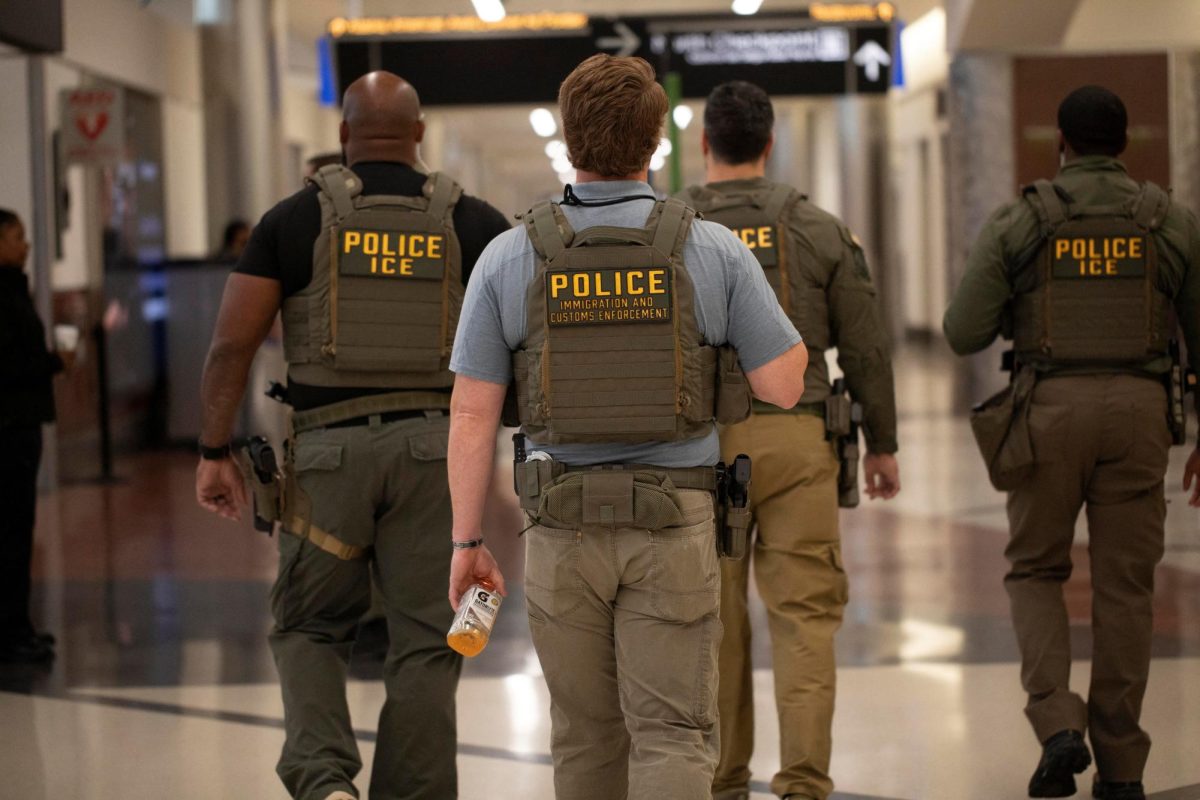
Tom Homan, White House “border czar”, confirmed March 22 that Immigration and Customs Enforcement officers would be dispatched to airports starting March 23 to assist TSA workers with staff shortages amid the partial government shutdown. Since the announcement, ICE agents have been placed in 14 airports across the country, and in an interview with CBS, Homan said the agents will remain in airports “until the airports feel like they are 100%,” even after they begin to receive pay.
Due to the partial shutdown, TSA employees stopped receiving pay after Feb. 14. One month later, President Trump signed an executive order to issue funding to the Department of Homeland Security to pay TSA employees, with the first round of paychecks to be sent out March 30. This executive order came after the House failed to pass a bill which would fund the entire DHS.
Senior Adam Hosein, editor-in-chief of the Vanderbilt Political Review, said he believes that while stationing ICE officers in airports may be a solution, this is not within their role.
“While I think in theory stationing ICE officers in airports may sound like a short-term solution to addressing the shortages of TSA officers, it doesn’t seem like they have enough training to truly be able to serve as effective replacements,” Hosein said. “The TSA officers receive specialized training to deal with baggage screening and security checks of passengers, but ICE has not received this same training by virtue of the different missions of these respective agencies.”
Hosein also said he believes this should not be a long-term solution to government shortages and that compromise is needed.
“The only long-term solution to [TSA shortages] would be for Congress to end its impasse and pass legislation to fund the TSA. Both sides need to accept that they are going to need to compromise and that neither side can simply have an ‘all-or-nothing’ attitude,” Hosein said.
Junior RaeAnna Morales, president of Vanderbilt College Republicans, said that the benefit of having ICE officers in place during these shortages has been instantaneous.
“The benefit of having ICE officers stationed in airports has been both immediate and obvious. ICE agents have served as a force multiplier in managing high‑volume travel during this peak spring travel period. Just last week, airports were packed wall‑to‑wall. Today, lines are short, and ICE agents are helping move passengers through TSA checkpoints safely and efficiently,” Morales said.
Morales said she agrees that ICE officers should not be a long-term solution to problems with TSA. However, she believes that ICE agents do serve a role within airports.
“ICE officers do have a valuable role to play at airports, but that role should focus on enforcing immigration laws, investigating federal crimes related to border security and targeting individuals with outstanding deportation orders — not alleviating the chaos, disorder and dangers imposed on American travelers by yet another Democrat shutdown,” Morales said. “If Democrats do not want it to be illegal to enter our country unvetted and without proper permission, then they should work to change the law, not defund the agencies tasked with enforcing it.”
Senior Melanie Gerko, co-president of Vanderbilt College Democrats, said she believes the presence of ICE agents across the country has been unlawful.
“The continued proliferation of ICE agents in public spaces has been detrimental to communities across America,” Gerko said. “Airports, and all community spaces, should allow people to be free from fear of intimidation or disappearance by federal authorities acting outside clear and lawful procedures.”