
Coming into Vanderbilt as a first year, I have been bombarded with a myriad of amazing opportunities, experiences and work happening every day on campus. Everywhere you go, you can expect to find a fellow Commodore grinding out a remarkable passion-driven pursuit bound to be meaningfully impactful. The Middle Eastern Virtual Clinic, founded by Vanderbilt junior Elijah Boktor in his sophomore year of high school, certainly fits these parameters. MEVC is an international nonprofit dedicated to providing free, accessible healthcare services to children and families without medical access in Egypt. Now a full-time college student studying Medicine, Health and Society and biological sciences, Boktor has proven himself more than capable of balancing his college commitments, on top of remotely running his organization in a totally different time zone.
Fascinated by how such an endeavor could be accomplished, I sat down with Boktor for a Zoom call over winter break to break down the secrets of starting up and maintaining a passion project as a busy college student. This conversation has been edited for length and clarity.
From what I understand, MEVC was founded on the basis of providing free, accessible healthcare to children without access in Egypt. What experiences can you share that inspired your founding of the organization?
It started out in 2021, during the summer going into my sophomore year of high school. My church has been donating to this orphanage in Cairo for years. The bordering slum communities end up collecting all the garbage from Cairo, and they are notorious for experiencing scarce healthcare. The children there are always dealing with illnesses that are completely preventable and treatable with proper care. After I got back to the United States at the start of COVID, I took advantage of the Telehealth platform used during the pandemic. What I did was set up children from that orphanage with Arabic-speaking doctors on virtual appointments — doctors I knew as family friends and acquaintances. From that point, the organization started growing organically. My cousin, who was a social worker in Egypt, looked for a career change, so she was hired as a full-time on-site program coordinator in charge of building a local sustainable network.
How did you go about setting up the organization?
At first, we used the virtual Telehealth system until we realized the scale of need that was present in this community. A multitude of needs were brought to our attention — promoting health education, medical knowledge, being able to make diagnoses and buy medication without prescription. I first registered MEVC as a nonprofit in both the United States and Egypt. We used LegalZoom, which was this organization that helped the registration process with documentation work and information, to bypass legal guidelines.
In terms of team building, my cousin was first hired as a full-time on-site director in Cairo. The fundraising process was organic: I set up GoFundMe and other donation sites alongside a Facebook and Instagram page to send to family and friends. I started a club chapter for MEVC at my high school, which helped with tasks like logistics, fundraising and outreach to get the mission around. The board today consists of me, my program director and board members from a variety of backgrounds (doctors, attorneys and a nonprofit director).
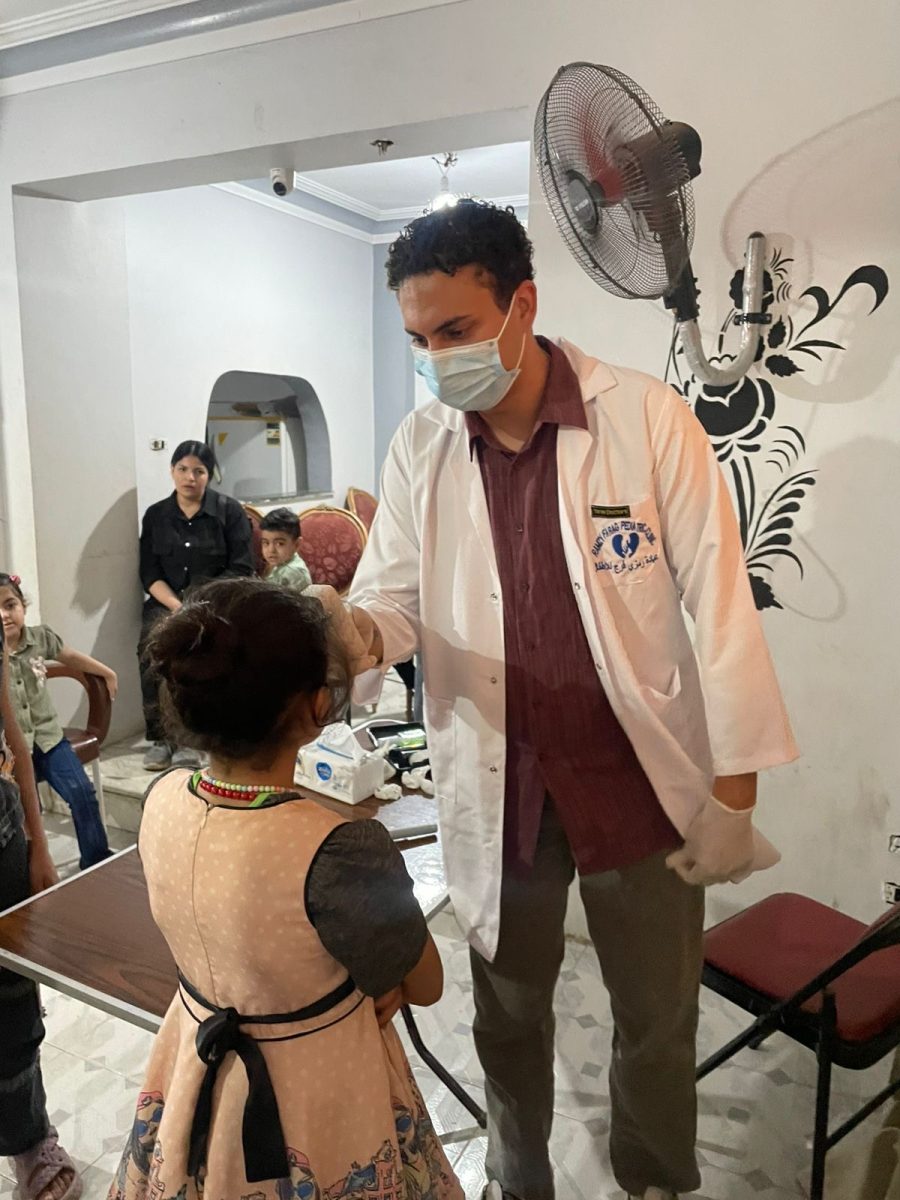
In 2023, which was my first year at Vanderbilt, I received a nonprofit funding grant from Blue Paradigm Foundation — having connected with its owner from playing basketball together — who wished to support MEVC’s transition from primary virtual care to a patient walk-in traveling model. I named the pediatric clinic Ramzy Farag Pediatric Clinic, after my grandfather. Today, there are now more than 40 partnering operating centers in Cairo — daycares, clinics, worship centers and orphanages with six volunteer doctors, four volunteer aides and two pharmacists who travel every day to each clinical location, ensuring there is enough supply in stock. The doctors will rotate throughout the week depending on their availability. One to three doctors will man a clinic at a time, and each one is committed to seeing 50 patients per day. We keep the average visit cost around $5 per treatment. To this day we have treated over 15,000 children through MEVC.
How do you ensure the services you provide remain free and accessible? How do you coordinate with your volunteer doctors to run these programs provided by the organization?
Free accessible healthcare at its core is our nonnegotiable mission. The services, consultations and tests are all paid through funds and raised donations, so the financing aspect is important in a region where healthcare is deprioritized due to financial constraints. My on-site program director communicates with all involved parties every day about the logistics of the operation. I have volunteers who are family friends and Arabic-speaking doctors based in the United States, and I also found a few recruits from doing a presentation at a meeting for a national American association of Arabic-speaking doctors. My program director also connected with doctors in Egypt and discovered people who would want to volunteer.
What are some of the greatest challenges along the way? What are some of the most meaningful success stories you have taken away from MEVC?
The greatest challenge is the truth that demand for healthcare will always exceed supply. Each volunteer doctor is only committed to seeing 50 patients a day, so the hardest part is always to see a line of 150 plus patients, knowing that families will be turned away. This truly underscores how severe the access gap is in Egypt, stemming from broader infrastructure failures. Poverty driven by national economic instabilities prevents millions of people from accessing care, which means that sustaining daily clinical operations needs consistent funding. Balancing that financial stress while being a full-time student is always going to be hard. To this day, we’ve already raised over $100,000 through MEVC. Our sources of consistent funding today consist of donations from the United States, with some individuals auto-donating monthly, Blue Paradigm Foundation donating quarterly and going through websites specifically for nonprofits seeking grants, with me submitting all related information. The websites will then refer organizations to apply for grants that align with the mission statement.
The best part has been seeing children receive care for the first time in their lives. I spent three weeks this past summer working every day in the clinic and meeting a lot of people. I met a family so poor that they literally lived in their family grave home, and it was amazing seeing the children connect with their doctors. My vision as of right now is to eventually turn MEVC into a full hospital one day or to set up a network of dedicated clinical locations with buses and vans to supply mobile clinics. I also plan to practice medicine in the United States while growing the organization continuously, where I can go to Egypt for longer periods of time after I stop practicing.
What are your thoughts on the extent of impact of student activism at the undergraduate level?
Undergraduates at Vanderbilt are far more capable of creating real impact than they often realize. I believe students often bring a sense of urgency, creativity and a willingness to challenge systems that aren’t working. This is something that is taught and emphasized all the time in Medicine, Health and Society courses — that systems can be made better. I’ve learned so much from professors and courses here that led to tangible change in my organization. One example is this course I took — Families in Turbulent Times, taught by Dr. Jaime Bruce. The focus of the course was learning about the stressors on a family that can have tangible consequences for their health. We had this project where everyone had to give a presentation about an agency promoting social change in familial settings, and this project itself opened my eyes to the many different organizations with the same goal as MEVC. It was very insightful to see multiple perspectives and different real-world applications of helping people in a classroom setting that resonated with my mission statement, and I had a lot of takeaways from these presentations for ways that my organization can grow and provide more services beyond what it is now.
I think MEVC is a great example of undergraduate student energy being paired with action, where student activism moves beyond awareness and doesn’t stop after a semester or a single fundraiser. It requires infrastructure, leadership and long-term responsibility. Undergraduates have access to institutional support, networks and mentors that can amplify impact when they are being used intentionally.
What advice or comments can you give to an undergraduate student trying to establish themselves in the nonprofit line of work?
My biggest piece of advice that I can give is to start small but think sustainably. I don’t think you need a perfect plan at the beginning, but you do need to listen to the community you’re serving and adapt efficiently as needs evolve. You must build a team early on that understands the local context, and you always need to be mindful about fundraising because no mission is sustainable without financial support. Don’t be afraid to ask for help, as mentorship, grants and partnerships are all very essential components of nonprofit work. This is a line of work that requires great resilience because you’re bound to face a lot of setbacks regarding funding and logistics, so staying grounded in the mission is what makes it possible to keep growing.
If I were to choose one piece of takeaway one must leave from this interview, it would be knowing that your potential as a Vanderbilt student is limitless. Take it from MEVC’s example; you just need a bit of strategic foresight, grit and resilience to be a changemaker and create something of your own. Most importantly, stay locked in the mission, and trust in the good things to come.