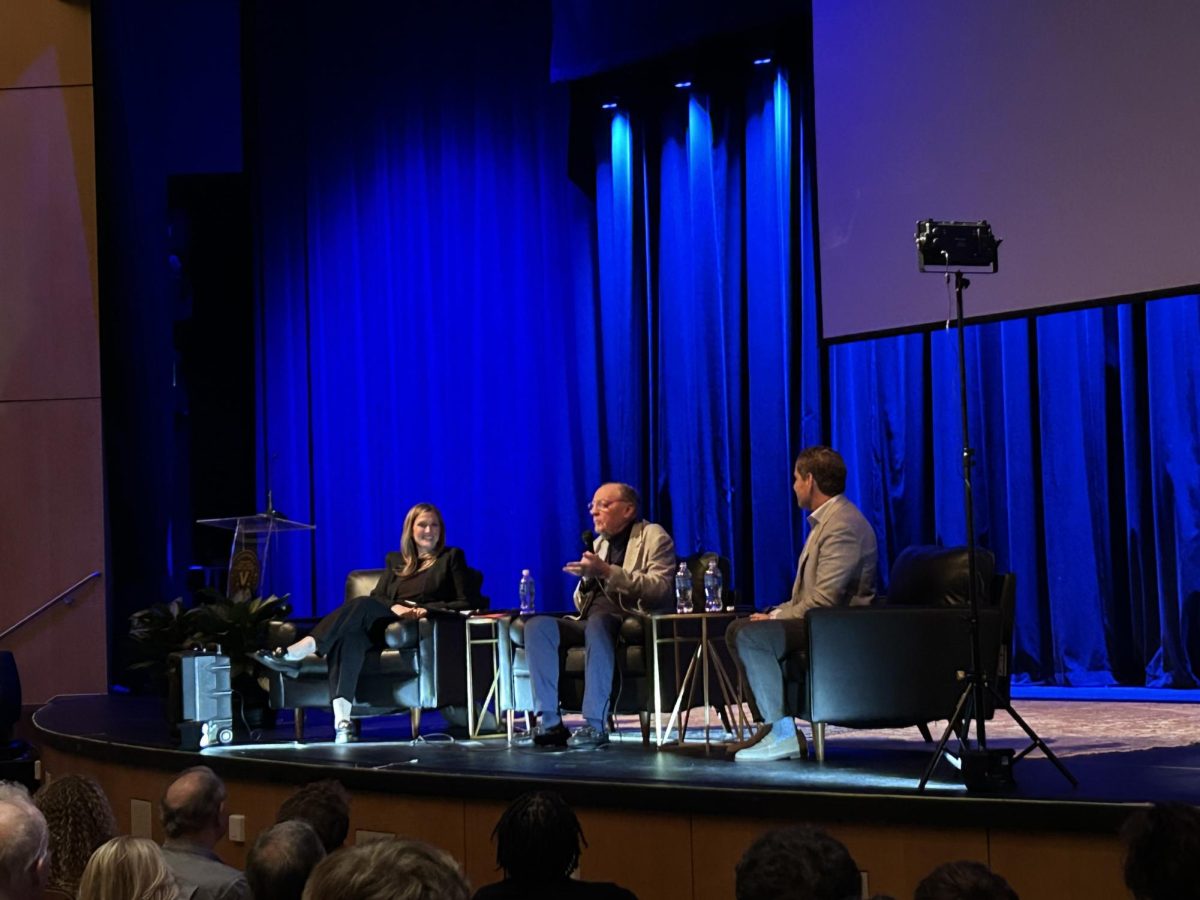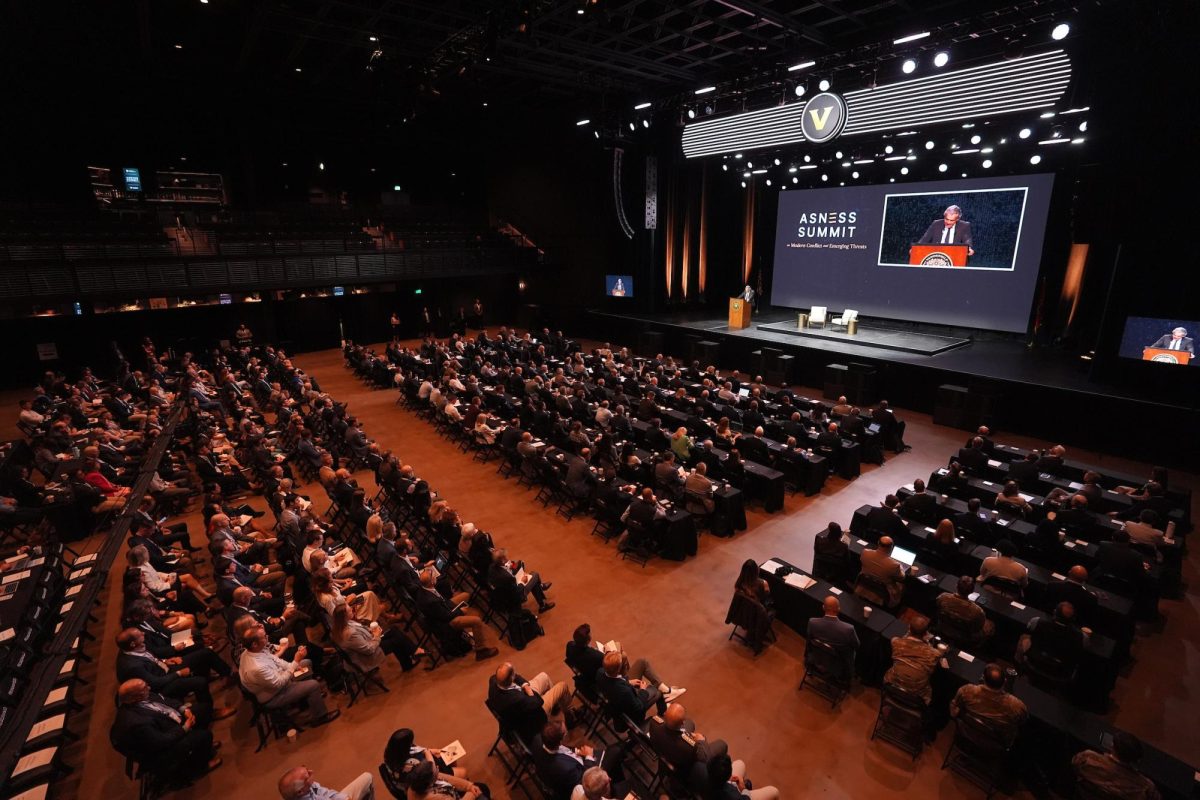


Sir Richard Moore KCMG, former chief of the United Kingdom’s Secret Intelligence Service (MI6), participated in the “Intelligence, Diplomacy and Modern Conflict” lecture Feb. 4 as part of the Institute of National Security and Dialogue Vanderbilt’s ongoing lecture series: “Modern Conflict and Emerging Threats.” The session was held in Langford Auditorium and discussed Moore’s career in national security and future implications for intelligence internationally.
Around 700 students, faculty and community members attended the lecture. Shortly before the discussion, retired general Paul Nakasone — founding director of the Institute of National Security — moderated a student roundtable with General Moore and a group of approximately 45 students in a more informal discussion on varying intelligence capabilities, integration of emerging technology and careers in intelligence fields.
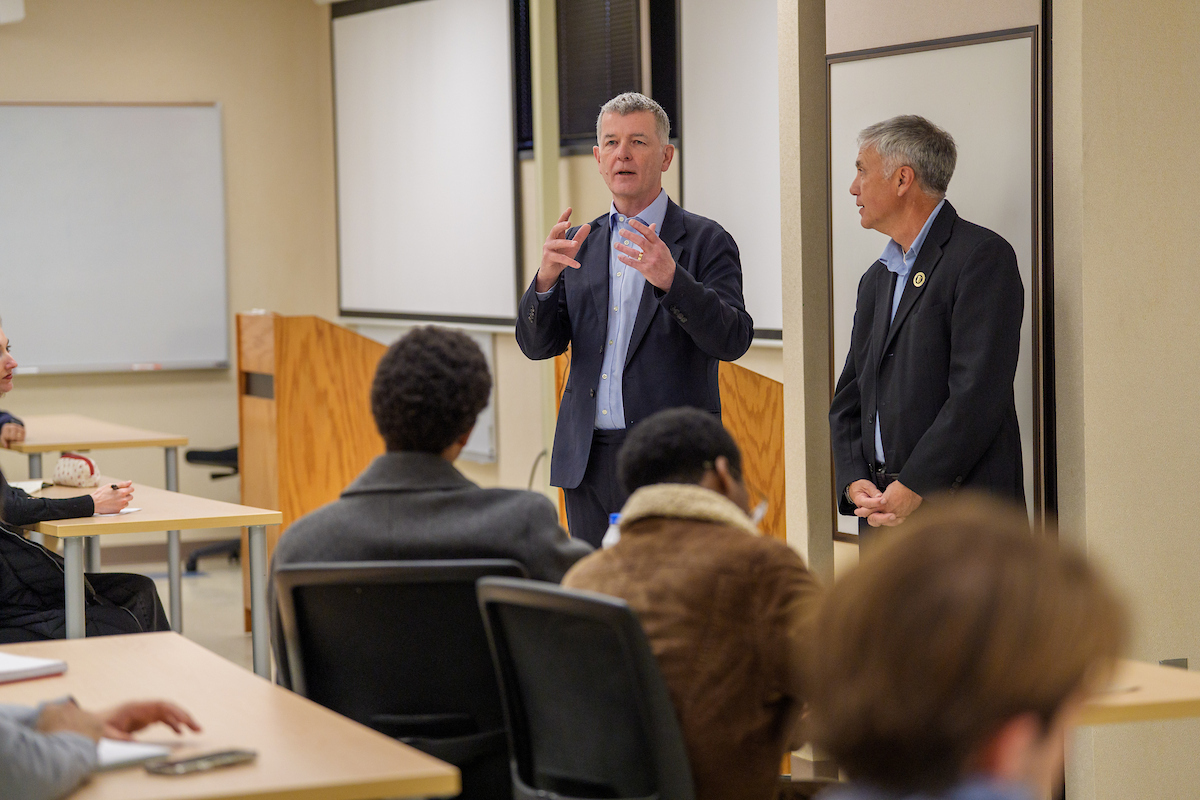
“If you’re involved in intelligence business, particularly on the human side, you are very conscious that if people are high ego, they’re very vulnerable because they don’t see you coming,” Moore said. “If you’ve got signals intelligence, which really takes you into the heart of the enemy’s communication system, it’s going to give you unparalleled, brilliant, real-time intelligence. But if you’ve also got somebody who is close to one of the senior generals in that system, they have all of that [context] of the discussion going on.”
Moore also discussed the importance of open-mindedness for students seeking a career in national security or intelligence.
“It’s a willingness to test your own assumptions and to be particularly open to different cultures and different ways of thinking about issues,” Moore said. “I think the thing that people would be surprised by is how much teamwork really counts. Even when there is one person in the field, if you’re going to meet a secret agent, there is a whole army of people around them who are supporting them.”
Following an introduction by Chancellor Daniel Diermeier, Moore joined Nakasone on stage to discuss his career in intelligence and the broader implications for the future of the field. Moore first began by describing MI6’s founding and the nature of the organization’s work, before explaining how the organization evolved under his leadership.
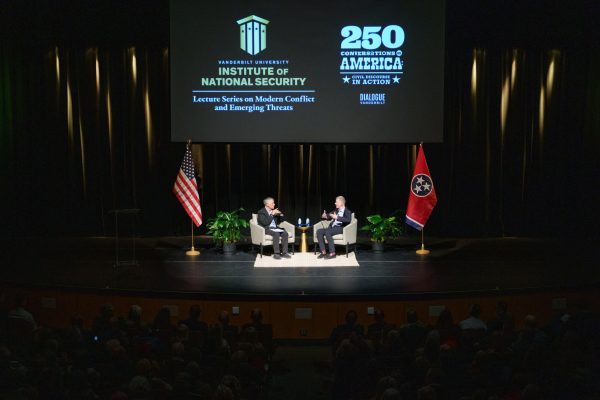
“I think we could all recognize that for a range of reasons, we needed to be a little less secretive whilst keeping hold of the secrets that we needed to preserve. And I felt that strongly that in an intelligence agency in the 21st century, in a democracy, you have to kind of earn your license to operate in a way that perhaps 50, 60 years ago, there was more deference in our society [for intelligence agencies],” Moore said. “I think sharing with the British public what we were doing and giving them a sense of the type of organization we were was important [to] attract people from groups in our society who might not necessarily see themselves as being at home in MI6.”
Moore relayed how the rapid pace of technological advancement has informed his approach to surveillance.
“If you are in China now, the combination of surveillance, gait recognition, iris recognition, [the] ability to [use] your mobile phone, the sort of degree of social control exercised through a very digital environment is astonishing, and we have to cope [with] that,” Moore said. “Of course, it’s not just in China; they have sold a lot of this technology to a number of authoritarian states. As a human agency, you come up against that top-end technology. There’s been a democratization of being able to operate at a level of scrutiny and surveillance of people operating in your patch, which wasn’t there a few years ago, and we’ve had to adapt.”
Moore also emphasized the importance of the Five Eyes alliance — an intelligence-sharing partnership between Australia, Canada, New Zealand, the United Kingdom and the United States.
“I think it’s a fundamentally powerful device, and it’s part of a broader thing where I think you and I would very clearly affirm the importance of allies and alliances and these things, even the fine line, even the fact that we all speak the same language, sort of, and we have a very strong set of shared values,” Moore said. “You do it in your own national interest. This is not a kind of sentimental contract. This works because we do like each other, that helps, that oils the wheels, but we do it because it’s in the national interest of all our countries to do it, because we gain benefit from it.”
Community Reactions
Sophomore Matthew Ye praised Moore’s insight on the role of technological advancements in the shifting landscape of surveillance and security methodologies.
“I think especially in this time and age, it’s very interesting to hear a European perspective on national security and how the United States interacts with other countries on the world stage because of Iraq,” Ye said. “I think his insight on how intelligence is changing because of new technologies is really important because, especially, [what] he was saying about increased surveillance and the rise of misinformation because of artificial intelligence, I think it’s a very pressing problem.”
Senior Nicholas Bui expressed his appreciation for Moore’s depth of knowledge and commentary on national security issues at the intersection of private industry.
“He mentioned having to work with big tech companies, even startups, to innovate and learn more about strategies for national security. I thought that was very interesting. And I liked how he was very knowledgeable, obviously, about national security,” Bui said.
First-year Caleb Pittman said he found the discussion on social unrest thought-provoking.
“It was definitely shocking to learn about weaponized social unrest and how, when the Iranian internet was shut off, pro Scottish separatist accounts were shut off,” Pittman said. “I think you kind of see a lot of that, even in America — just hatred and people trying to polarize each other. And it kind of makes me feel better that it might be just somebody that’s intentionally trying to do it from the outside.
First-year Taryn Lockhart appreciated the institute’s initiative in hosting a guest speaker from the international intelligence community.
“I thought it was super neat to bring in somebody from the intelligence community to give [their] perspective [on] how we’re different from our allies. I think it was very well done,” Lockhart said.
Nakasone praised Moore’s career and expressed gratitude for his speech at the event.
“As I listened to him tonight, he was really pressing about the opportunities and challenges of both today and tomorrow. This is someone that has experienced [a] tremendous series of events throughout his career, and being able to come here and talk at Vanderbilt was wonderful,” Nakasone said.