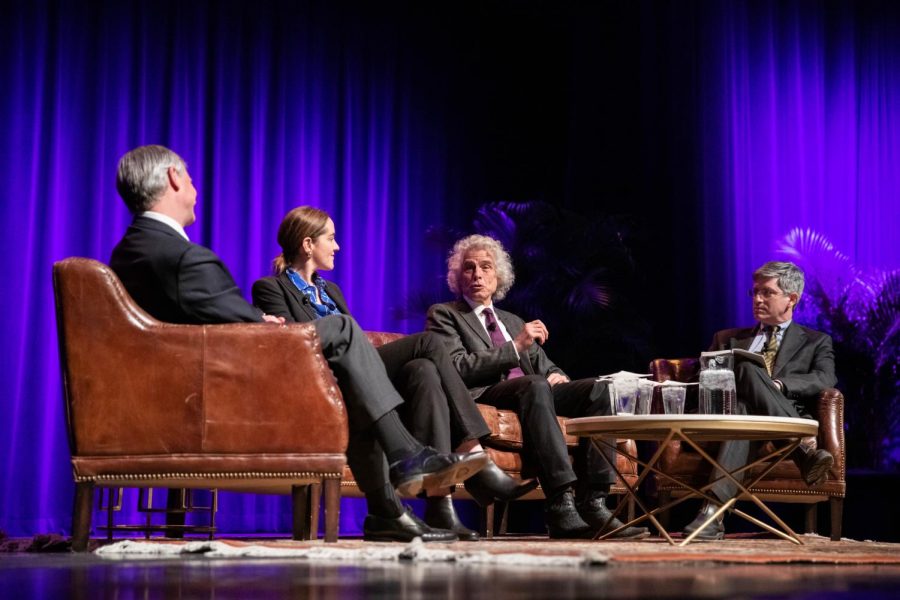

Vanderbilt welcomed Metin Hakverdi, member of the German Bundestag Social Democratic Party and coordinator of transatlantic cooperation for the German government, to Central Library Feb. 17 to discuss transatlantic relations, specifically between Germany and the United States. The event was a part of Dialogue Vanderbilt’s “250 Conversations on America: Civil Discourse in Action” lecture series, which features discussions in celebration of the nation’s 250th anniversary and in alignment with the university’s emphasis on free speech and discourse.
The event also served as the inaugural John C. Kornblum Distinguished Lecture. Kornblum, the American diplomat and businessman after whom the series was named, was a distinguished ambassador in residence and writer in residence for the Max Kade Center for European & German Studies at Vanderbilt until his passing in 2023.
During the event, Hakverdi spoke on the relationship between Europe and the United States today, touching on the ongoing war in Ukraine and the threat of Russian assault to the European security order. Hakverdi also discussed the current instability in Europe and emphasized that transatlantic relationships cannot be built solely between nations on a large scale but must be fostered on smaller levels as well.
Professor Helmut Smith, the Martha Rivers Ingram Professor of History and historian of modern Germany, summarized the main point of Hakverdi’s speech.
“What you saw was an emerging voice in Germany that is starting to chart its own path in global politics, and away from Germany’s longstanding cooperation and reliance on the United States of America,” Smith said. “If the United States has a policy called America First, it cannot surprise anyone that other major powers will eventually go the same route. This means that although there is a lot that ties the two countries together, leaders in Germany no longer feel secure in the idea that they have a close and dependable political alliance with the United States.”
Professor Thomas Schwartz, who introduced the discussion, commented on the relevance of the event given the frequency with which America’s relationship with Europe is currently featured in the news.
“This was a lecture that really appealed to people, as it is a major topic to talk about. America’s foreign policy, America’s position in the world, is undergoing a lot of change right now,” Schwartz said. “Effectively, students are going to inherit that change. Talks like Hakverdi’s are important to understanding the changes going on in the world order as a whole, and that is significant for students and their upcoming careers and futures.”
First-year Dylan Adler expressed enthusiasm for the lecture and highlighted Hakverdi’s clarity in the discussion.
“The topic of the lecture was very interesting to me, and I like to go to most, if not all, of the campus lectures,” said Adler. “This one, especially being the first of the ‘250 [Conversations on America]’, did stand out as a highlight. I thought [Hakverdi] did well at communicating an approach to something that both he and the United States might take together.”
Sophomore Jolene Chu attributed the lecture’s importance to Hakverdi’s position of influence in international relations.
“I thought it was really interesting,” Chu said. “These events are really important because it’s not very common to have exposure to experts in foreign politics like this, and it just makes us more informed citizens [who] have a better understanding of major world events.”
Professor Smith further described the connection between the lecture’s topic and the global stage today.
“For Germany and Europe, the war [in Ukraine] has existential dimensions. There is real fear that should Russia win, it will not stop. There is also a real fear that with Russian advance the whole project of Europe is endangered,” Smith said. “I think anyone who thinks of themselves as a citizen of the world follows with attention and some anxiety the shifting vicissitudes of great power conflict, as these unfold in our unquiet times.”