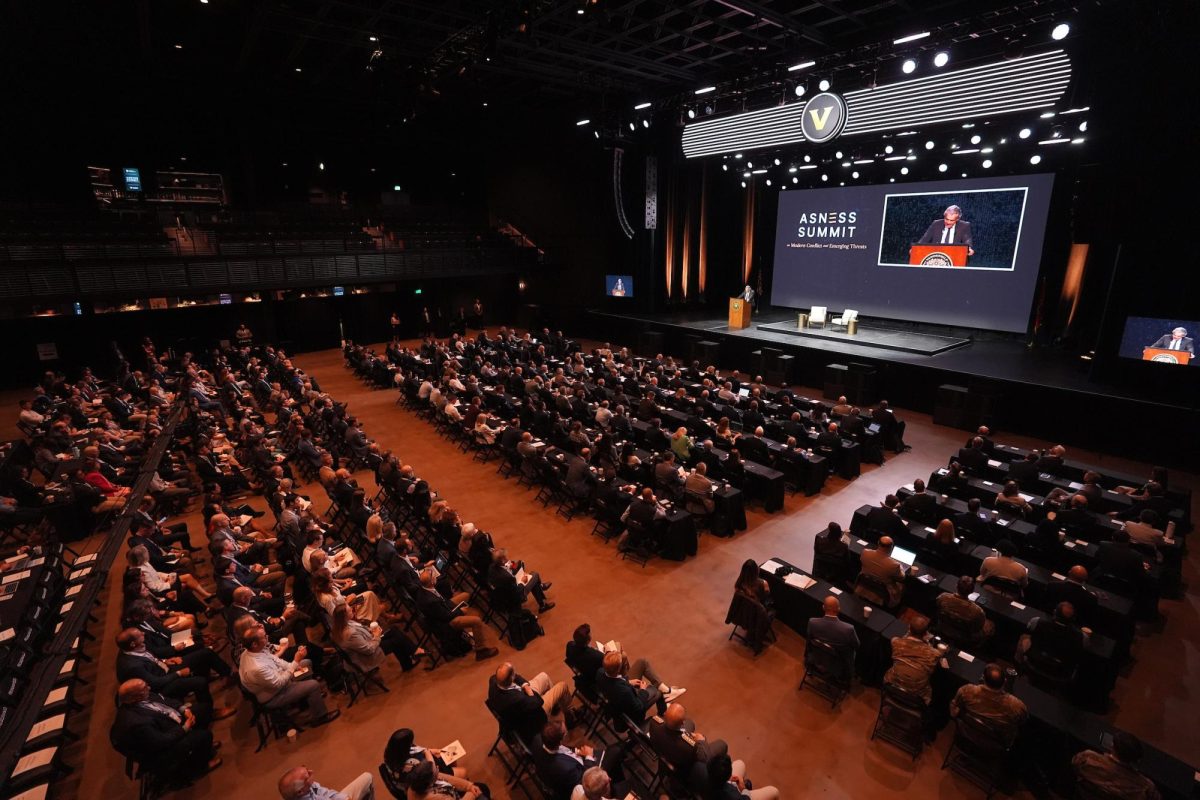


Vanderbilt’s Institute of National Security hosted the fifth annual Asness Summit on Modern Conflict and Emerging Threats April 23-24. This year’s theme, “The Shadow of War, The Illusion of Peace: National Security in the Age of Asymmetry,” centered conversation around power, diplomacy and technology dynamics in the current state of the world.
The two-day event hosted over 1,000 people at The Pinnacle, a live music venue in downtown Nashville, Tennessee.
The summit included opening remarks from Vanderbilt Chancellor Daniel Diermeier, who addressed the summit’s new name and its significance.
“This new name reflects a transformative, transformational gift from the Asness family to Vanderbilt’s Institute of National Security,” Diermeier said. “It’s an investment that strengthens the summit and significantly expands our ability to advance, research and educate the next generation of national security leaders.”
Diermeier also explained Nashville’s role in global security.
“Today, the annual global security dialogue moves from Davos to Munich and now to Nashville, where we are proud to carry the conversation forward,” Diermeier said. “The Asness Summit brings that conversation into sharper focus, centered on questions of modern conflict, intelligence, technology and the realities of persistent competition. And here in Nashville, that dialogue takes on a particular character, one that is grounded in a culture that values openness, collaboration and trust.”
The summit’s programming also included a keynote fireside chat with General Dan Caine, chairman of the Joint Chiefs of Staff. Caine provided insight on the role he believes artificial intelligence will play in national security.
“We have to be early adopters so that we are creative, innovative across the range of things we have to go do as military professionals, AI, quantum and other capabilities are tools that we have to make part of our daily lives,” Caine said. “Probably everybody in this room uses some flavor of LLM every single day. If you walk through the halls of the Pentagon, we may not see that exact answer if I pulled everybody out there. So, we have to really normalize this and become early adopters.”
Other speakers across various panels and keynote fireside chats included Dan Wang, the honorary Gina Raimondo, Gen. Paul Nakasone, associate professor Brett Benson and retired Gen. Tim Haugh.
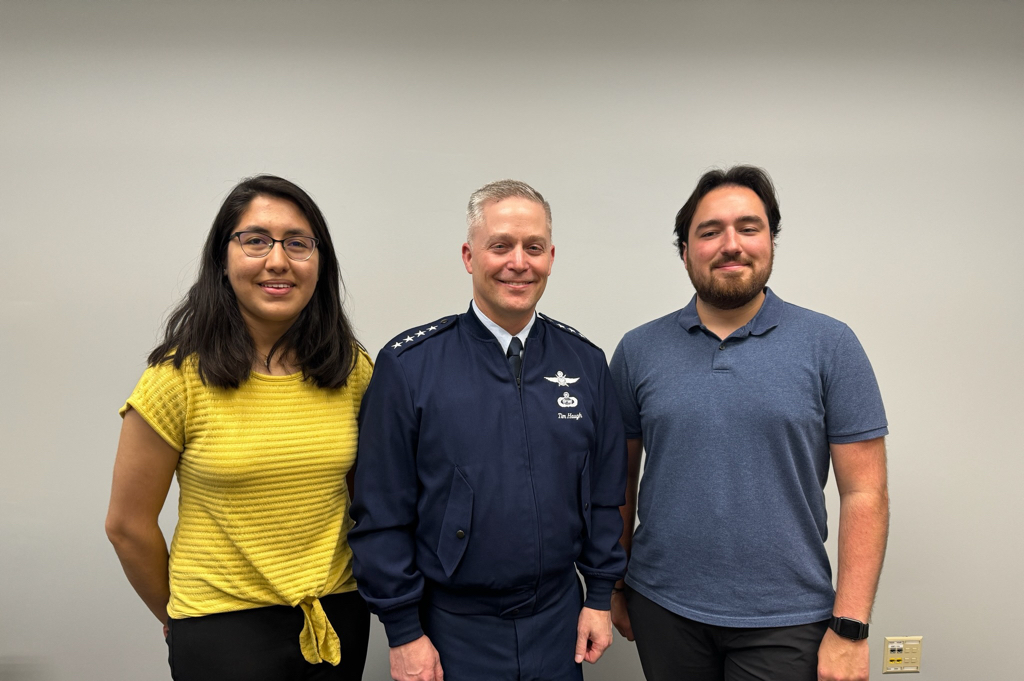
Haugh, who previously served as commander of the United States Cyber Command, director of the National Security Agency and chief of the Central Security Service, spoke on advice he would give to students who wish to pursue a career in cybersecurity.
“I think [students] better be proficient on the use of models, all of the tools, understand how to code, understand what they do well, what they don’t do well and make sure that they’re a part of the ecosystem that keeps them updated,” Haugh said. “Because this [industry] changes so fast, making sure your network and your own personal time is spent in ways that are going to bring you back the most value of understanding those changes toward those areas you’re most interested in.”
Attendee Rob Neff (DNP ’26) expressed his satisfaction with the event after the first day of programming. He specifically praised Vanderbilt for bringing dialogue and conversation to the school and the Nashville area.
“I used to live in [Washington] D.C. I’ve been to a lot of these types of events before. This is the first time I’ve ever seen an event like this outside of the D.C. metro area,” Neff said. “I think it goes to show the leadership at Vanderbilt and throughout the city of Nashville is growing and becoming more influential and is going to be a greater and larger thinking hub for the rest of the country.”
Neff discussed how the summit has been applicable to him in the nursing industry, specifically discussing how awareness of international conflict can keep nurses prepared to respond to refugee crises.
“A big aspect of [the summit] is international security, and along with security, from a nursing perspective, the big issue is refugee populations and potential refugee crises,” Neff said. “So, if we’re able to examine it more, develop and integrate and understand what the next crises are, then as a healthcare community and as nurses, we’re able to better respond and be more aware of situations that we may be going into.”
Attendee Leisel Bogan, an advisor for TechCongress and board member for MyCapitol, emphasized the collaboration the summit brings between practitioners, students, academic perspectives and those in the industry. Bogan also spoke on the opportunities for students who attend the summit.
“If I were a student, this would be an extraordinary opportunity to engage with cutting-edge leaders in so many different areas in national security,” Bogan said. “I think it’s incredibly valuable, and it opens up pathways for students to decide what they want to study in the future, areas of research they want to conduct and I think it just brings together an extraordinary network pool who do the work that students may want to go into at some point.”
Haugh spoke on the contributions that students and academic institutions can make toward solving contemporary cybersecurity issues and innovation in the industry. Haugh cited the Regional Security Operations Center at UT-Austin as a framework of low-cost talent being extracted from students who also gain experience in the cybersecurity field. Haugh also spoke on academic institutions being reimagined in terms of funding by the federal government.
“Academia is going through a transformation of research funds. As the federal government has changed its posture and how they’re leveraging, there’s opportunity and talent that can potentially address these problems and leverage that, both for how you apply AI and how you secure different segments of critical infrastructure,” Haugh said.
In a message to The Hustler, Nakasone, the director of Vanderbilt’s Institute of National Security, stated that Vanderbilt is shaping the “future of national security” and that the summit provides opportunities to students and faculty.
“Vanderbilt is helping shape the future of national security by convening the leaders, ideas and disciplines needed to address today’s most complex challenges,” Nakasone said. “The Asness Summit places the university at the center of a global dialogue that moves from World Economic Forum in Davos to the Munich Security Conference in Munich and now to Nashville — where the focus turns to modern conflict, military power and asymmetric threats. It elevates Vanderbilt as a national platform while giving our students and faculty direct access to the people and ideas shaping the future of global security.”






Andy Green • May 7, 2026 at 9:35 am CDT
Asness? Maybe come up with a name that doesn’t remind you of the word for “rear end”?