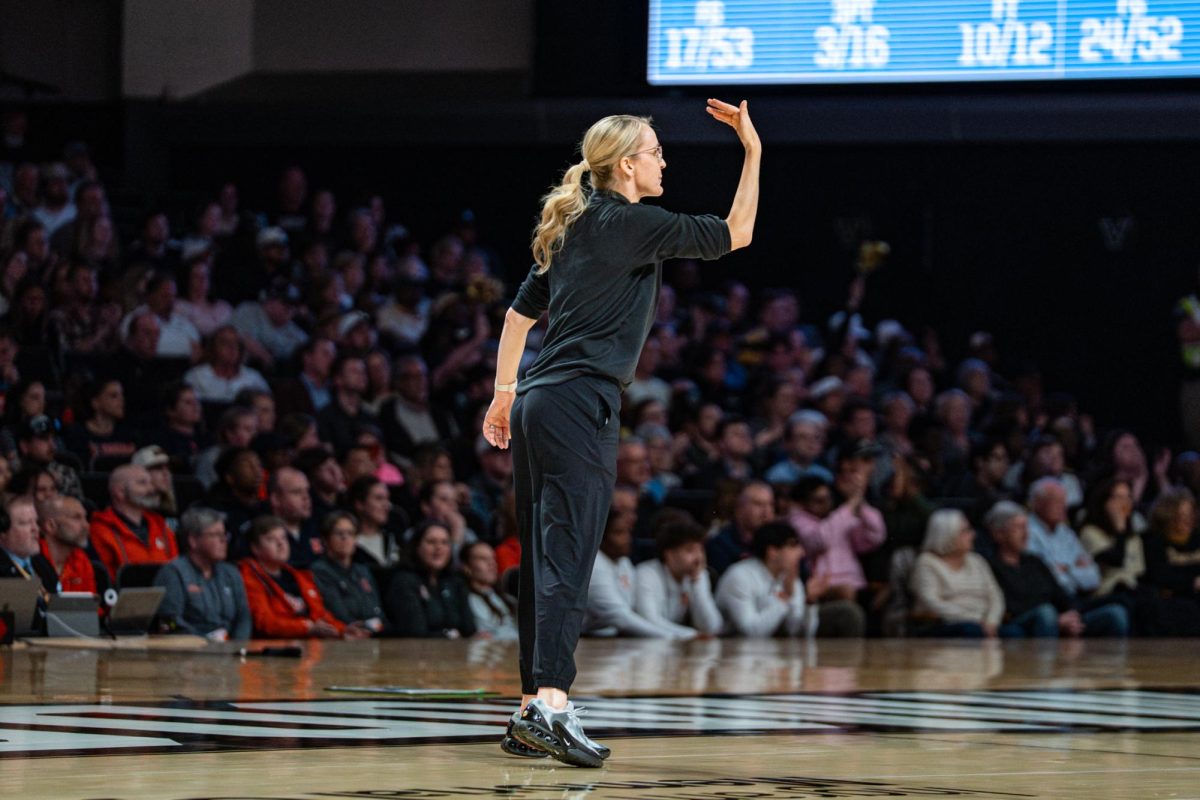

Last season, it was breaking news when Vanderbilt Women’s Basketball cracked the AP Poll in January, checking in at No. 23 for the first time since the 2013-14 season. The milestone not only served as proof of progress and validation of head coach Shea Ralph’s rebuild, but it also carried a sense of novelty. This season, the Commodores have been ranked in every AP Poll since the preseason — a signal that respect for this program is no longer an exception, but an expectation.
The Commodores are 12–0 for the first time since the 1995-96 season and just the third time in program history. They’ve scored 81 points or more in nine of their first 12 games, turning Memorial Gymnasium into a place where leads grow quickly and confidence builds with every possession.
Now, it’s No. 12 Vanderbilt — one of just three universities, alongside Iowa State and Nebraska, with undefeated men’s and women’s basketball teams. Memorial Magic is real, and right now, it’s alive on both sides of West End. But this start is about more than a ranking — it’s about who is driving it, how Vanderbilt is winning and the identity beginning to take shape along the way.
Aubrey Galvan, the engine
Few players on Vanderbilt’s roster bring energy quite like Aubrey Galvan. The 5’6 guard from Deerfield, Illinois, has quickly established herself as the Commodores’ engine, logging 33.0 minutes per game while averaging 10.3 points, 4.0 rebounds and 7.2 assists. Galvan’s calling card is her playmaking — and it’s not subtle. Behind-the-back passes, no-looks, one-handed deliveries and perfectly timed get-ahead feeds all feel like standard fare when the ball is in her hands. She sees the floor two steps ahead and isn’t afraid to try passes that most players wouldn’t even consider.
That confidence extends to her scoring as well, an area where Galvan is still finding her balance. As a first-year, she occasionally settles for shots that are good rather than great; a learning curve common for young guards, particularly ones with such a high risk, high reward style. Her efficiency numbers (36.8% from the field and 31.7% from 3-point range) reflect that ongoing adjustment, but the growth is evident from game to game. Galvan’s willingness to keep shooting, combined with her feel for the court, suggests those percentages will continue to trend upward as the season progresses.
Perhaps Galvan’s greatest impact comes in what her presence allows others to do — especially Mikayla Blakes. With a true point guard orchestrating the offense, Blakes no longer has to initiate every possession. Ralph can deploy her off the ball, forcing defenses to make tougher decisions instead of simply sending two defenders at Vanderbilt’s star scorer. Blakes’ ability to run off screens and cut with purpose creates cleaner scoring opportunities within the flow of the offense, while Galvan keeps everything organized. It’s a dynamic that makes Vanderbilt harder to guard — and a pairing that could define this team’s identity in SEC play.
How you win matters
At this point in the season, it’s less about whether Vanderbilt wins — with a nonconference strength of schedule ranked 117th nationally according to Torvik, the odds are good — and more about how the Commodores win. Early games are where habits are formed, not resumes, and over its nonconference schedule, Vanderbilt has beaten opponents by an average of 30.5 points. The margins themselves aren’t the takeaway. The process behind them is.
Offensively, that process has become clearer with each game. Over this stretch, Vanderbilt is averaging 20.8 assists per game with an assist rate of 66.7%, an indicator that advantages are being created through ball movement rather than forced possessions. The Commodores also set a program record against Texas Southern, making 18 3-pointers in a single game, a testament to both spacing and execution. They have turned the ball over on just 13.5% of their possessions while averaging 72.4 possessions per 40 minutes, pairing tempo with control. Even when shots haven’t fallen, the shot quality has remained consistent. Right now, the Black and Gold’s good shots are turning into great ones through extra passes, cuts and spacing.
The same focus has shown up on the defensive end. Vanderbilt has allowed only 0.65 points per possession, holding opponents to 35.8% shooting from the field while securing 68.8% of available defensive rebounds. Those effort and discipline metrics matter most in blowout games, when focus can slip and bad habits can form quietly. These wins weren’t about proving Vanderbilt could win — they were about proving it could win the right way, and that may be what carries the most weight once the schedule stiffens.
Playing with joy
When UConn women’s basketball won the 2025 national championship, the players said they won via “the power of friendship.” Right now, Ralph’s Vanderbilt team is playing like it understands that idea well. You can see it in the bench celebrations, in the way players sprint to pick each other up after mistakes, in the shared excitement over the extra pass as much as the shot made. This group looks connected — and dangerous because of it.

Right now, Vanderbilt is playing with joy, and it’s having fun. During the Texas Southern game, a prerecorded halftime interview with Ralph offered a glimpse into where that chemistry comes from. She spoke about the team’s travels — from a culture-filled trip to Paris that ended with a confidence-building win, to spending Thanksgiving week together in the Virgin Islands — and the shared experiences that have shaped this roster.
Those trips weren’t always easy. On the return from the Virgin Islands, a maintenance issue forced the team to sleep overnight in the airport before returning to campus, heading back to class, preparing for finals and playing again just days later.
“My team handled it like champs. They handled it better than I handled it,” Ralph said. “As a coach, as a human that has lived on this earth twice as long as they have, to see them handle that with grace, and humility and understanding — ‘hey, this is what it is and we’re going to have a good time together anyway, we don’t have any control over it’ — it was inspiring.”
Those shared moments — the long days, the delays, the lack of control — are the kinds of experiences that bind a team together, and they’re the ones that tend to resurface on the court when SEC games tighten and margins shrink.
“This year’s roster, more than anything, has been willing,” Ralph said. “To learn and grow, to be accountable, for our program, for our university, for each other on and off the basketball court.”
Joy doesn’t show up on the stat sheet, but it matters and right now, it’s woven into the way Vanderbilt plays. What this version of Vanderbilt women’s basketball will ultimately look like in SEC play remains to be seen. There will be questions to answer and holes to patch once the schedule stiffens, as there always are, and it’s in those moments that this team’s friendship and connectivity may matter most.
For now, the Commodores have taken care of what was in front of them. They have won 27 straight nonconference home games dating back to the 2022-23 season and are 40-3 at Memorial Gym against non-SEC opponents under Ralph. Those numbers speak to consistency, but they also set the stage for what comes next.
The Commodores will next face Stonehill on Dec. 28 at 2 p.m. CST in Memorial Gymnasium, before beginning conference play at Arkansas on Jan. 1, 2026.