
“It has begun.”
These were the words Vanderbilt dining hall worker Alina Filiakina heard on the morning of Feb. 24, 2022, when Russia invaded Ukraine. Bombs soon began falling on her home city of Dnipro. She was in disbelief, unsure where to go, how long the war would last or how to keep her family safe. Within hours, she was forced to confront a reality she couldn’t possibly have imagined.
After years of moving from place to place within Ukraine and in Europe, she and her husband arrived in the United States through the “Uniting for Ukraine” humanitarian program. They settled in Nashville, where Filiakina found work in Vanderbilt’s E. Bronson Ingram dining hall. She was now physically removed from the war, but certainly not untouched by it.
Distance did not suddenly end the war for Filiakina. It only changed how she experienced it. She still speaks with family members back in Ukraine who remain under immense stress as the conflict continues with no clear end in sight.
Four years later, the war has not ended but simply faded from everyday conversation. At Vanderbilt, that silence is part of the problem — an ongoing reality that is easy to overlook. It is our responsibility to recognize, challenge and reverse that shift.
As Ukraine marked four years since the war began in February, conditions for those who remained have only worsened. In the midst of a historic winter, Russia has pursued a campaign of repeated strikes on the power grid in Ukraine’s capital Kyiv, as well as most other major cities. These attacks have left millions of residents without heat and electricity for hours, even days, leaving families to endure freezing temperatures inside their own homes by sleeping in layers and boiling water on makeshift stoves. These unimaginable conditions sound like something from a bygone era, yet they are unfolding right now in the 21st century.
As these conditions persist and even worsen, they have largely faded from everyday conversation. A war that once dominated international headlines has receded from public attention, even as its consequences have arguably intensified. This shift in attention isn’t just global — it is visible on Vanderbilt’s campus.
Filiakina has found a small community of those who share similar experiences. Daria Tsarova and her mother, Oksana Tsarova, are both dining hall employees in the Rothschild dining hall from Chernivtsi, Ukraine, having immigrated in 2022. Tsarova could’ve never imagined living her seemingly normal life here, while her friends and family back home are at war.
“My mom still actively seeks to stay up to date with all the news from Ukraine,” Tsarova said. “It’s a huge stress for her, which is why she wanted to move with me to the States, to have a resemblance of a normal life.”
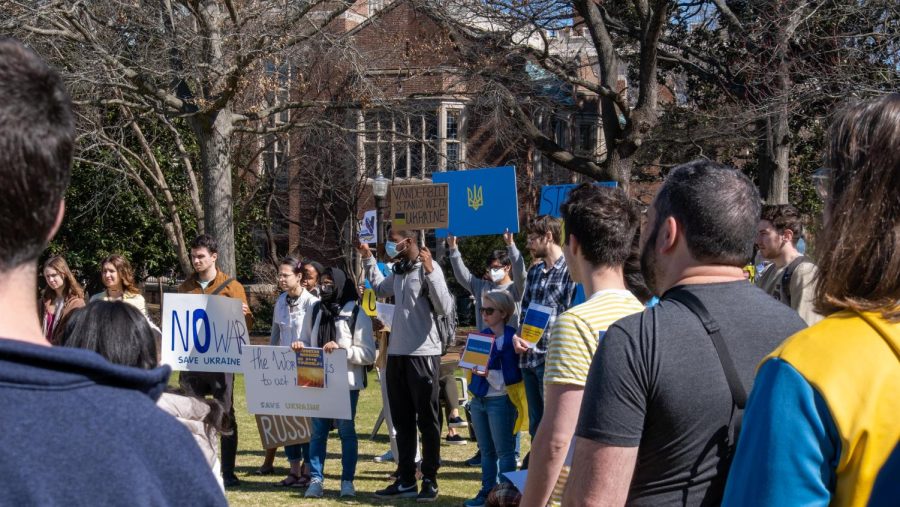
Yet stories like theirs often go completely unnoticed. For many in the United States, the war feels distant — something most scroll through once on social media rather than a lived, ongoing reality. This distance is not just geographical. It is a reflection of how easily prolonged crises fade from global attention.
As a Ukrainian-American student at Vanderbilt, I have felt this distance firsthand. While the war continues, life on campus moves forward regardless. Whenever I try to speak about the conflict, I get asked if the war is still happening, since people have stopped hearing about it on the news. Conversations move on, headlines shift, and what once felt urgent becomes background noise. It is not that people do not care — it is that they do not see it.
“Some people don’t even know where Ukraine is on a map. Everyone lives in their own bubble,” Filiakina said. “I was a little surprised when I came here, but I also understand people in America have their own issues and their own lives.”
This disconnect does not necessarily mean people have stopped caring — it is simply rooted in the way attention shifts over time. As news of the Israel-Palestine Conflict, the Iran war and other conflicts has emerged, older ones are often pushed aside for the “new fad.” The war in Ukraine never ended, it just became less talked about.
“No one in the world really understands what is going on in Ukraine, not even me,” Tsarova said.
This uncertainty is not unique to Tsarova. It reflects the reality of a war that has stretched far longer than it should have. What once felt urgent has become familiar and easier to overlook.
“The war is simply not interesting anymore. Everyday people die, and it is simply old news,” Tsarova said.
Filiakina echoed this sentiment. “The rhetoric has changed. The attitude in the U.S. changed. It feels like we are being told to just surrender to Russia, that Russia is winning,” Filiakina said.
This shift is not only reflected in headlines, it is visible right here on Vanderbilt’s campus. Many students who pass through dining halls each day are often unaware that the individuals they interact with carry experiences shaped by ongoing conflict.
That lack of awareness is not necessarily intentional, but it is significant. It highlights how easily distance can create an illusion that a crisis is removed from everyday life, even when its impact is present within the community itself.
It is easy to become engulfed in the pace of campus life. Between classes, organizations and social commitments, many students simply want to eat and move on. However, it is important to draw attention and support the people who keep Vanderbilt a well-oiled machine. Sometimes, it’s the people behind the scenes who make the university complete.
When asked to give one message to the Vanderbilt community, both women emphasized the same idea of remembrance.
“Every support is important to us, even just little words of encouragement from those around us,” Tsarova said. “It’s a very hard time for the people in Ukraine right now, but we will not surrender, we will continue to defend our country, our land, our independence and our people.”
“Please don’t forget about Ukraine, and keep us in your thoughts,” Filiakina said. “Simply the act of remembering us gives us a strong feeling of support. We are proud of our soldiers, we remember them, we support them and we live for them.”
The war in Ukraine is not as distant as it may seem. Its impact is present in our community, carried quietly in the lives of people on this campus every day.
Note: This interview was conducted in Russian Feb. 22-23, 2026, and translated into English. Some quotes may deviate from their original content.