

Coming off a historic 10-2 campaign with the most regular season victories in program history, No. 14 Vanderbilt now shifts its focus to the ReliaQuest Bowl against No. 23 Iowa. The Commodores are playing in a Florida bowl game for the first time since the 1955 Gator Bowl, when Vanderbilt beat Auburn 25-13 in its first-ever bowl. Last season, the Commodores beat Georgia Tech in the Birmingham Bowl, 35-27.
Now, Vanderbilt has a chance to build on its momentum and start a bowl-game winning streak while simultaneously delivering one final statement to the College Football Playoff committee. The Hawkeyes represent an unfamiliar matchup, as the programs have never faced each other. The matchup is Vanderbilt’s first game against a Big Ten team since its 2019 loss to Purdue, and its first ever bowl game against a Big Ten school. The Hawkeyes finished fifth in their conference this year, largely due to an extremely talented defense. Some of Iowa’s strongest performances came in a pair of close home losses to No. 1 Indiana and No. 5 Oregon. Those results highlighted Iowa’s defensive strength and competitive ability despite offensive limitations.
Here are three matchups to watch on Wednesday.
Diego Pavia vs. Iowa’s defensive front
When discussing what makes Vanderbilt’s offense click —scoring 45 points in each of its last three games and being held under 30 just twice all season — the conversation begins with Diego Pavia. The Heisman Finalist runner-up put up eye-catching numbers this season, throwing for 3,192 yards and 27 touchdowns. He was also the Commodores’ leading rusher, scrambling for 826 yards and nine touchdowns on the ground.
“He’s got a good yards per carry on him,” Iowa head coach Kirk Ferentz said. “But where it really gets scary is if you chart the yards per carry on scrambles, it’s times two basically.”
Pavia’s overall ability to extend plays, misdirect defenders and keep defenses off balance will test Iowa defensive coordinator Phil Parker’s game plan. Limiting the signal caller’s improvisation will be key if the Hawkeyes hope to slow down Vanderbilt’s offense.
Iowa’s defense poses a significant challenge for Pavia and the Commodores, though. The Hawkeyes have allowed just 158.2 passing yards per game and 112.4 rushing yards per game this season. They rank top 10 nationally in both total defense and scoring defense and have consistently limited explosive plays. Continuing that trend will be essential to keeping Pavia and his offense one-dimensional.
Eli Stowers’ absence vs. next-man-up mentality
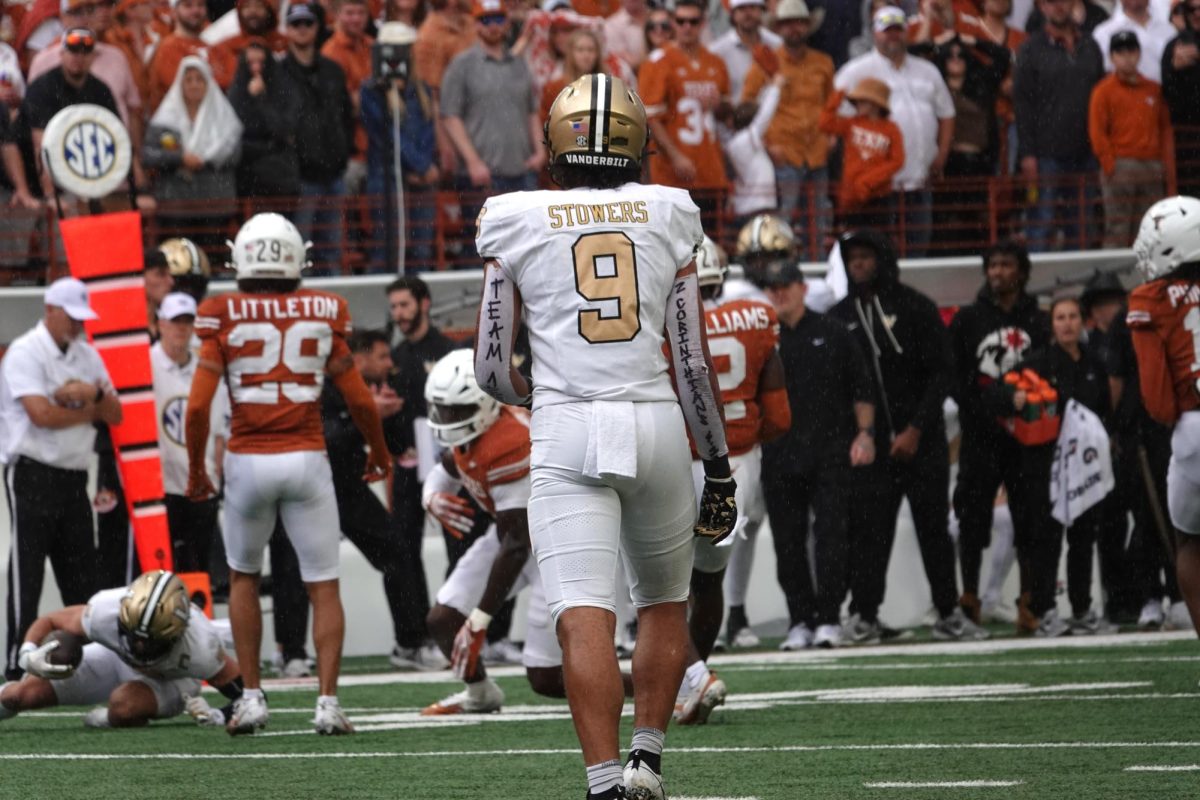
Eli Stowers, Vanderbilt’s John Mackey Award winning tight end, has been Pavia’s primary target in the middle of the field all season, but he will be opting out of the bowl to prepare for the 2026 NFL draft The Denton, Texas, native led all SEC tight ends with 62 receptions for 769 yards and 4 touchdowns. With Stowers unavailable, production must be replaced collectively rather than individually.
Not far behind Stowers in production this season were Junior Sherrill, who finished with 661 yards and 7 touchdowns, and Tre Richardson, who totaled 679 yards and 6 touchdowns. Those three accounted for 148 of Vanderbilt’s 254 completions this season. They also have 17 out of Vanderbilt’s 28 receiving touchdowns.
While it’s not unusual for a team’s top three pass-catchers to dominate the workload, Stowers isn’t your typical tight end. He lined up both inline and in the slot, giving Pavia a reliable option over the middle of the field. Replacing that versatility will be the real challenge. Vanderbilt’s primary slot receiver is senior Richie Hoskins, who ranks fourth on the team in both receptions and receiving yards, with 26 catches for 305 yards. The pass catcher that will most directly benefit from Stowers’ absence is tight end Cole Spence, who tallied 13 receptions and 202 yards this season. If Vanderbilt is to maintain its offensive balance, contributions from Spence and Hoskins will be critical.
Iowa’s offensive inefficiency vs Vanderbilt’s third-down defense
Iowa delivered one of its best offensive games against USC, racing out to an early 21-7 lead. From there, things started to falter, and the team wouldn’t score again. The problem was a stagnant offense that couldn’t take advantage of a strong defensive performance that limited the Trojans 5-of-10 on third down. Iowa’s overall conversion rate for the game was 4-10. A common thread in the Hawkeyes’ close losses to Iowa State, Oregon and Indiana was that they failed to convert over 50% of their third-down attempts. Iowa’s overall third down efficiency this season is 64-for-149, converting 42.95% of the time. For reference, Vanderbilt has converted 53.23% of its offensive third down attempts.
Vanderbilt ranks No. 105 in defensive third down percentage, allowing opponents to convert 42.6% of the time. This cost Vanderbilt in the 34-31 loss to Texas, when the Commodores allowed the Longhorns to convert 7-of-11 third down attempts. This hasn’t been a major problem, as Vanderbilt consistently performed well on third down against other strong SEC opponents, holding South Carolina to 4-of-12, LSU to 5-of-11, and Missouri to 5-of-16. That said, Vanderbilts defensive third down conversion rate is 14th in the SEC. Iowa has been able to stay close in games against quality opponents but hasn’t been able to pull away. Converting on third down and keeping drives going will be crucial.
Vanderbilt will look secure in its first-ever 11-win season Wednesday, Dec. 31, at 11 a.m. CDT at Raymond James Stadium in Tampa, Florida.