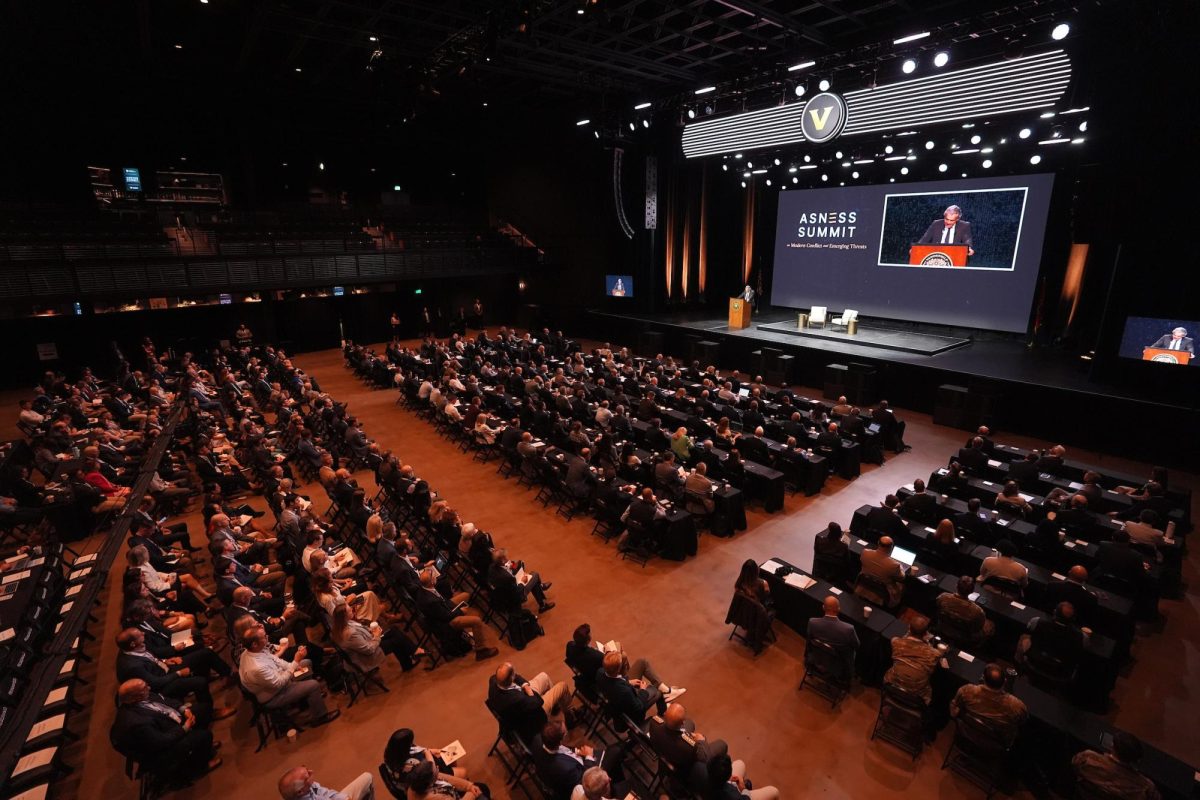


The Vanderbilt Institute of National Security hosted retired Master Gunnery Sergeant Scott Stalker for a fireside chat with retired General Paul Nakasone followed by a Q&A and book signing on Nov. 7. The event was held in the Kissam Multipurpose room and aimed to educate students on the fundamentals of authentic leadership, including preparation, character and trust.
Stalker, a Marine Corps veteran with leadership experience in cyberspace, intelligence and special operations, served as the Command Senior Enlisted Leader for the Defense Intelligence Agency, National Security Agency, United States Cyber Command and U.S. Space Command.
Nakasone opened the discussion by asking Stalker about his time in the Marine Corps. Stalker said that taking advantage of every opportunity he was presented with helped him have a successful career.
“[What] set the framework for my career was [taking advantage of] every opportunity, [even if] you don’t know what it’s going to lead to,” Stalker said. “I never thought in a million years I would have an opportunity to serve at the National Security Agency in a significant leadership position in Cyber Command and then Space Command. I mean, it didn’t even exist when I first got there.”
Stalker then discussed his book, “Left of Leadership,” which explores his career and what he believes to be the fundamentals of leadership.
“And certainly, it’s not [that] if you do these things, now you’re instantly a leader, but it focuses on the basics and fundamentals,” Stalker said. “And what I tried to do throughout [the book] is [to] share personal stories that are really, I guess you can say intrusive, share my ups and downs along the way [and] how those things [can] become learning points and allow you to become that leader.”
Stalker then addressed what he believes are the fundamentals of leadership, particularly for midshipmen and cadets in the military.
“I believe you’ve got to have a strong mindset, and you’ve got to have a good vision. What is your vision?” Stalker said. “How are you going to have accountability for yourself, and then your team and then really [be] able to communicate it effectively?”
Stalker said that leadership in the business world is primarily concerned with profit and often does not provide leadership training for managerial positions.
“If [businesses] don’t see the value of leadership, what’s going to happen is, not only are you going to take someone who’s technically savvy and incredible at what they do and put them in a role that they’re not prepared for, but you’re likely going to harm their self-worth and their self-image of themselves,” Stalker said.
Stalker said that successful leaders are humble and inquisitive. He encouraged attendees to adopt these traits and ask questions so that they will learn.
“I think you’ve got to be very humble, especially in today’s world, and I just found myself asking a lot of questions,” Stalker said. “You know, I didn’t eat breakfast this morning. I tried to socialize with many of you and just ask questions because if you’re not inquisitive, I don’t know how you’re going to learn.”
The event concluded with a Q&A session with the audience. Stalker was asked what advice he would give to undergraduates seeking a career in intelligence and advised students to be inquisitive and think outside the box.
“Don’t let the rules set in. Think differently and uniquely because I think that’s going to be our strategic advantage, and so we need you to be inquisitive. We need you to take on other roles,” Stalker said. “What makes a great intelligence officer is someone that’s been exposed to the other elements, right? So, if you’ve been with the ground forces in the army or at sea, or, you know, whatever the case may be, it’s being exposed to those things.”
In an interview with The Hustler following the event, Stalker said the event allowed him to share his expertise and help future leaders and give back.
“To me, this event means being able to take all of my experience, and knowledge and wisdom and talk to the future leaders of America, of the world,” Stalker said. “It was an inspiring opportunity to be with General Paul Nakasone, to serve with him [at the NSA] and then to come back [for this event]. I think our role and our responsibility is to give back to others.”
Student reactions
Senior Gavin Markoff said he appreciated hearing from a high-ranked member of the military on his perspective on leadership.
“I thought the event was great. To get, not just a senior officer, but an NCL (non-commissioned leader), someone closer to the ground and his perspectives on leadership. I thought it was a really practical, no-nonsense look at what it means to be a leader,” Markoff said.
Junior Xiaodi Sajo said he learned a lot from the event and that it served as a reminder of the importance of love and character.
“It was great to hear a great person talking about leadership. He reminded me a lot about the importance of love and the importance of character and how simple flaws in [one’s] character that doesn’t seem to affect anything in the business world might actually matter a lot,” Sajo said.
Junior Carolina Kelly said she learned a lot about how character and leadership are related and that empowering others, instead of just skill, makes a good leader.
“I gained a lot of insights [about how] your character matters a lot in [terms of] how far you’re going to go as well as [in] leadership,” Kelly said. “I think something that also really spoke to me was [that] just knowing the [skills for] how to do something or how to carry out a plan doesn’t always mean that you can manage it or empower others to be greater for themselves.”
Sophomore Truman Hill said he enjoyed the discussion on how personality traits inform great leaders.
“I certainly think the overall character [of the event] reflects a lot of what I’ve heard before on how there’s sort of universal personality traits that help you succeed at just about anything,” Hill said. “I do have a personal interest in intelligence, so it’s very interesting to me in that regard. Overall, I think it was a good experience.”