

The realms of science and spirituality may often seem to be at odds. However, the 2019 Icelandic documentary “The Seer and the Unseen” finds a way to connect these two realms through the involvement of the natural world and the human impact on both.
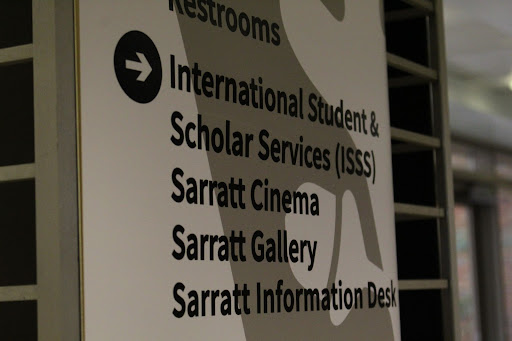
As part of the International Lens film series, held at Sarratt Cinema by the cinema and media arts (CMA) department, “The Seer and the Unseen” by Sara Dosa was screened for an audience on Sept. 18. The film introduced the audience to the Icelandic tradition of elves, or “hidden folk,” and their dominion over Iceland’s unique natural landscape. It followed an Icelandic woman and her work to protect the beautiful nature of Iceland that the elves supposedly call home. It explores how the similarly invisible worlds of money and spirituality can guide us in different ways when interacting with the natural world, and which one holds more respect for the Earth.
“[American students] don’t usually get the chance to see international films,” Caitlin Nitschke, a senior CMA student, said. “We always have a conversation at the end about the film. It’s a good opportunity for both students and faculty.”
CMA professor Johnathan Waters programmed this film as part of his co-exploration into the world of geological filmmaking in tandem with earth and environmental sciences professor Lily Claiborne. Together, they teach a class on the subject that embarks to locations across the geological world, including Iceland this semester. Both faculty members saw this film as an example of narrative filmmaking with geologic landscapes and processes as the focal point of the story.
“When I watch this film, I’m struck by how much it is about the geology of Iceland,” Claiborne said. “Iceland is a unique place in terms of its geology that makes it unlike any other place on this planet.”
When asked about the less scientific side of this film, primarily the connection to the spiritual world of elves, Claiborne still found interest in the story despite its deviation from pure science.
“I’m struck by the capacity for imagination that these people hold. As a geologist, imagination is one of the most important ways of thinking that I do,” Claiborne said.
Waters and Claiborne’s joint course, while unique, is one of many examples of programs and classes that transcend the boundaries of one specific field. “The Seer and the Unseen” ties in with this theme of escaping traditional barriers to think with an open mind. The natural world and the scientific processes that create it could be seen as part of a more mystical story. This mirrors the goals of the College of Arts and Science and Vanderbilt as a whole in its endeavor to form interdisciplinary connections.
“Students at Vanderbilt are very good at overachieving and taking many different majors and minors across all kinds of fields, and so the reason that classes like this are so impactful is that they allow students who are already all over the place to come together in a context where they get to go completely out of their comfort zone,” senior Luke Balmer said. “Because these courses are so often at very interesting and novel intersections, everyone comes to the class as a novice, and that’s very powerful.”
“The Seer and the Unseen” is an excellent example of how exploring different cultures through both arts and science can yield powerful new insights into how students see the broader world. Whether it be scientifically proven processes or hidden elves responsible for the beauty of nature, this film shows that being a good steward of the environment and standing up for its protection is necessary in Iceland and all around the world.