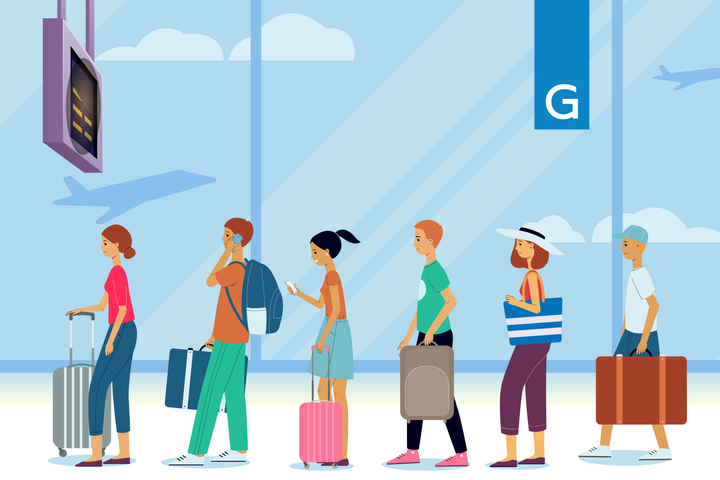

It’s the start of break, and the dorms are closed. As we rush to the airport, we get stuck in a crowded terminal, waiting in long Transportation Security Administration lines to verify our identity and screen our baggage. This is a routine process for Vanderbilt students who depend on air travel. However, several important issues and concerns lie beneath this routine experience.
First and foremost, TSA’s facial recognition causes security concerns. Before you and your carry-on baggage go through the screening process, TSA will ask for your government-issued ID and take a photo of you. Although TSA states that participation in the facial comparison technology is optional and relies on signs and officer advisement to inform passengers, most people are unaware of their right to decline a facial scan. In a survey conducted by Algorithmic Justice League on hundreds of travelers, they found that “99 percent indicated that they were not told verbally by TSA officers of the opportunity to opt out” and “nearly three out of four respondents indicated that they did not receive a notice about the use of face scans.” It is clear that TSA failed to inform them of their right to opt out, and travelers had their photos taken without their explicit consent.
In the wake of mass surveillance and data collection, intrusions on individual privacy have become normalized. Data collection, such as facial scans, is concerning because it allows government agencies to gather and store personal information, posing risks of misuse and surveillance. Many individuals are often unaware of their rights within a complex legal framework, compounded by government agencies’ failure to inform them of their rights. To counter this, individuals need to assert their right to opt out of unnecessary data collection.
Exercising your rights can begin with small actions. When the TSA officer asks for your ID, simply inform the officer that you do not consent to the photo scan. If you have a valid ID, they can identify you. More importantly, you will not be penalized or at any disadvantage because of this action, as TSA claims that the alternative identity verification process “will not take longer, and travelers will not lose their place in line for security screening.”
The other main issue is TSA PreCheck. Every time you stand in the long line waiting for TSA screening, you probably notice that there is another line for TSA PreCheck. TSA PreCheck is a program that allows travelers to pay a membership fee—ranging from $76.75 to $85.00 depending on the provider—and undergo a background check in exchange for expedited security screening. By paying the membership fee, passengers are entitled to a faster screening process without having to remove electronics or take off shoes or jackets.
Despite the membership fee being low compared to the cost of plane tickets, it still barred people from accessing faster security screening, especially for low-income students who receive financial aid to cover travel expenses.
As a public agency, TSA is expected to provide security screening without discrimination, according to its civil rights policies. However, TSA PreCheck offers a faster, less intensive screening process for passengers who pay a fee and meet eligibility requirements. Those passengers undergo screening with less inconvenience and discomfort.
The discrimination based on the ability to pay not only violates government agencies’ mission to deliver equal service but also further intensifies economic inequalities in the U.S. At this rate, with public agencies complicit in driving economic inequalities, public goods become increasingly inaccessible to disadvantaged and marginalized people, and exclusive to rich people. If we let this trend continue, the result will be detrimental.
If airport security is truly a public service, it should be structured accordingly. TSA security screening should apply the same standards and procedures to all travelers, rather than offering different experiences based on the ability to pay. If we want fairness in public services, then we should question this system and reevaluate our participation. By declining enrollment or letting memberships lapse, we make a small but meaningful contribution to push back against discrimination.
For Vanderbilt students traveling by air, these are real issues and concerns at the airport. As travelers, we can address them by refusing facial recognition scans and reconsidering participation in TSA PreCheck. That way, we make a small yet meaningful contribution to protecting travelers’ privacy and maintaining fairness.