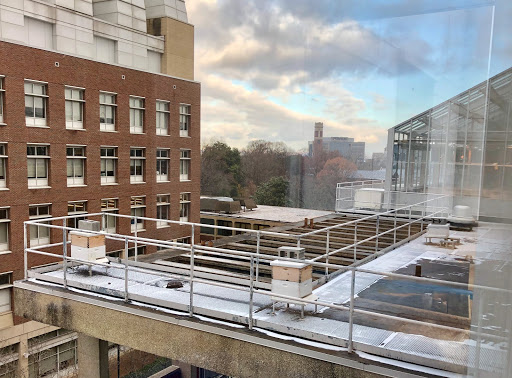


Every so often, students eating in Rand Hall might look out the window and see people wearing beekeeping suits on the roof. Or, if beekeepers aren’t there, students still may see two white boxes right outside the upstairs window: the beehives.
VanderBees is a Campus Dining initiative that seeks to improve sustainability by bringing more pollinators to campus. Specifically, the program has placed two beehives on the rooftop of Rand Hall, along with a pollinator garden. Behind the scenes, master gardener Kip Bennett leads the charge — but he doesn’t do it alone. He is joined by two Vanderbilt students who are passionate about the VanderBees project.
Senior Galen Roy and sophomore Anna Benner, fellows of the Menus of Change University Research Collaborative, both help Bennett bring the vision of VanderBees to life. The groundwork for the garden was completed over the summer, and the two students got involved shortly after their arrival on campus for the school year.
“I’ve talked about it to my family a lot. All summer, I was like, ‘I’m going to get to go beekeep when I get back to school,’” Benner said. “And with Kip sending me videos, I showed the video to everyone at home. I was like, ‘Look, I want to get to hang out with these bees.’ And I was so ecstatic.”
Bees are important pollinators, keeping ecosystems healthy for humans and other animals; in fact, one in every three bites of food people eat is created with a reliance on pollinators, and honey bees pollinate 80% of flowering plants. Benner discussed how rewarding it has been to work so closely with such an important creature that has been embedded into the Vanderbilt community.
“My dream is to make the biggest environmental difference. So, I think [it’s] soul-fulfilling, feeling like I’m actually doing something in college,” Benner said. “Sometimes, I feel like I’m not helping with the greater problem of climate change in the world. So, [it is rewarding] getting to do something to make Vandy more sustainable.”
Prior to working with the bees, Roy worked with Bennett, helping to manage the hydroponic tower gardens in the dining halls. She began to get involved with the bees when Bennett first started working on the hives and invited her to help.
“The garden that’s up there on Rand, I do a lot with that,” Roy said. “Like weeding and taking care of it pretty much so that the bees have flowers and things to pollinate.”
Every few weeks, Bennett checks the hives with Roy and Benner to help. So far, there have been challenges with mites infesting the hives, which have prevented the crew from checking on the hives often due to the increased irritability of the bees during treatment. However, there’s another major challenge approaching quickly.
“[The bee hives] were started a little bit late, and so, right now, it’s sort of going to be fingers crossed [they] make it through the winter,” Roy said. “Right now, there’s two hives, there’s two queen bees, two whole situations. Kip’s still deciding if he’s going to combine them into one hive for the winter because that can make the chances of survival better.”
Working with bees on the Rand rooftop affects more than just the small garden’s footprint, and it affects more than just bees. The initiative is part of a broader sustainability push across campus, one that both Roy and Benner have been involved in.
“I’m only up on the roof, but the bees, you know, fly across campus, and they go across [and] pollinate different flowers and flower gardens,” Roy said. “It helps take care of a lot of those, as well.”
Benner expanded on how the project goes beyond beekeeping. As MCURC fellows, both students hope to incorporate the work into a broader passion for protecting the environment.
“I love the beekeeping, but I think that’s just one facet,” Benner said. “It’s a great entry to get people passionate about the environment because they’re so cool and unique.”
They also both celebrated the elimination of single-use plastic flatware from Rand Hall — a milestone that was reached multiple times in recent years, only to have the change reversed shortly after.
The VanderBees have been a learning experience for Benner and Roy, but they do not plan to end it any time soon. Both students expressed their wishes to have their own bees after graduation and to continue contributing to a sustainable ecosystem.
“I also always thought that, at some point, I would have a farm and have bees,” Roy said. “So, this has been a fun learning experience for me because I’m learning through Kip, and, you know, in 10 years when I want to have my own bees, I can call him up and say, ‘hey, what do you do about this?’”
Even more, Benner and Roy both hope to work in or are studying topics related to the intersection of human and planetary health.
The two hope for greater awareness around bees and the initiative on campus. Greater awareness is important for people to understand the reasoning behind the initiative and why having more bees on campus can be a positive change. Benner said she hopes to use social media to spread the VanderBees message to more students — despite her personal unfamiliarity with social media. Similarly, Roy discussed how people’s understanding of bees can change.
“I had some people — back when I was telling them [about the project] before [Vanderbilt] had done it — say, ‘Oh, God, I don’t want more bees around us,’” Roy said. “But I don’t think that’s a big issue. I mean, these bees are so non-aggressive.”
Student-led sustainability efforts have been placed at the forefront of attention this year, and if the Rand bees are able to survive through the winter, students may be able to look for hyperlocal Vanderbilt honey, and their walk to class might get a little brighter.