
Not long ago, artificial intelligence in the classroom was taboo. In 2023, professors warned against using ChatGPT, insisting it would ruin learning. Now, the pendulum has swung the other way. Vanderbilt has launched its own AI platform called Amplify, and the new College of Connected Computing is creating a Generative AI minor that will be arriving next semester. Some professors even allow AI during practice exams. The shift has been dizzying, and nowhere is it more obvious than in classes like Systematic Inquiry for Human and Organizational Development. I was shocked when the professor handed out a detailed rulebook spelling out exactly when and how AI could be used, something that would have been unimaginable just two years ago.
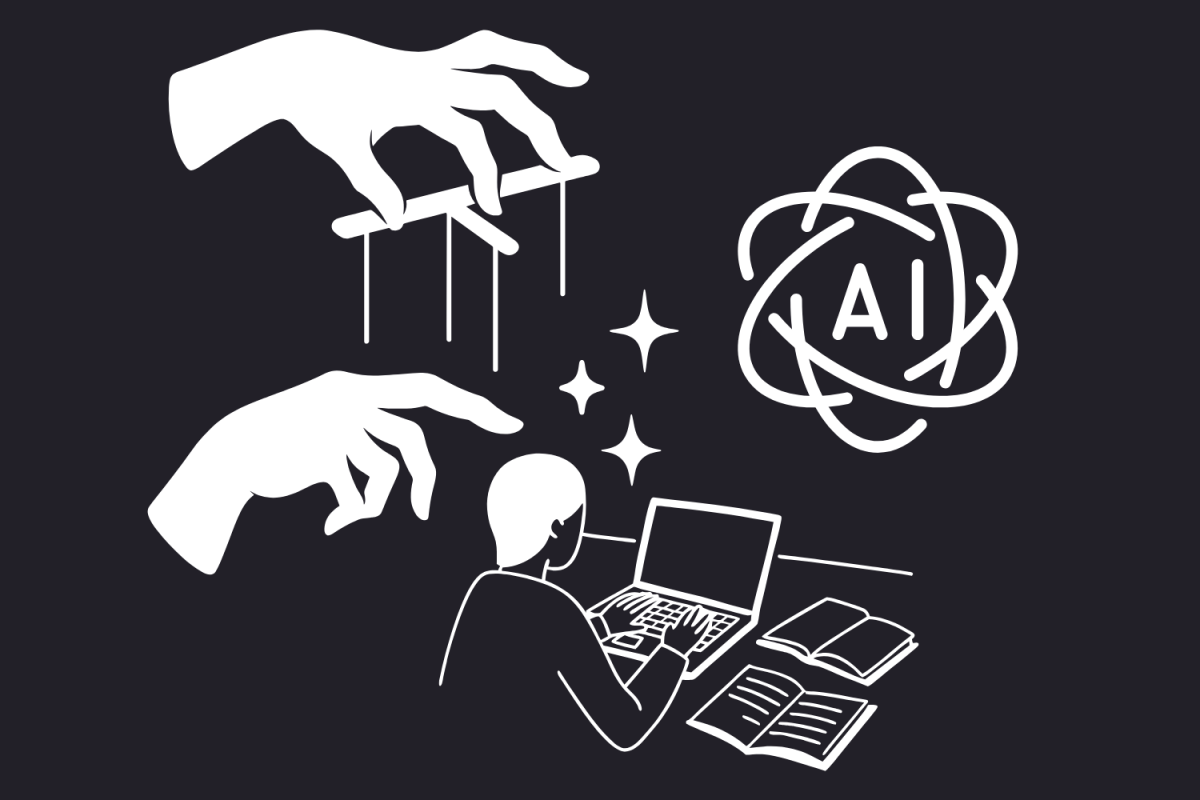
The rules may reassure professors, but for students, the story is different. Many of us have shifted from seeing AI as a “helper” to treating it as the main source of answers. For some, AI is the first stop for practice problems, essays and even study guides. It isn’t just a tool in the background anymore; it’s the default. And that shift raises a more unsettling question: If AI becomes the brain we lean on, what will happen to our own?
The danger is that dependence creeps in quietly. At first, AI can seem like a harmless tool that helps explain concepts or brainstorm essay topics. But soon enough, students skip the struggle altogether. Why wrestle with dense readings when AI can summarize them instantly? Why think through a data set when AI can spit out the analysis? The problem isn’t just that AI gives us wrong answers (though it often does). The problem is that we stop developing the critical habits of reading closely, analyzing carefully and questioning results for ourselves.
Education has always been about the productive struggle. The late-night hours when nothing clicks, the revision that forces you to sharpen your argument and the mistakes that teach you more than success ever could. If AI removes this friction, college risks becoming less about learning and more about managing machines. Even if students walk away with polished assignments, they miss out on the deeper skills that those assignments were meant to teach.
Additionally, AI doesn’t land evenly across campus. Some students use it because they lack prior preparation, while others lean on it simply to save time. Those who already have strong critical thinking skills can treat AI as an enhancer, for example, using it to brainstorm counterarguments or refine word choice after they’ve already drafted an essay or to check their own data analysis against a second run. Those still developing these skills, however, risk treating it as a crutch. On top of that, the difference between free tools and paid premium models raises a new question: Who gets the “better” AI tutor? Far from leveling the playing field, AI may quietly reinforce privilege in education.
There’s also a cultural danger in how students perceive AI. When it becomes the “main character” in our studying, we begin to see learning as optional. We start to believe mastery is something you outsource, not something you earn. And when universities institutionalize that mindset by creating majors around AI and encouraging its use in exams, they reinforce the idea that the human brain is just a backup processor, no longer essential.
Even authority itself begins to shift. Where students once trusted professors and textbooks as the foundation of knowledge, many now turn to AI first and only check course materials afterward. The danger lies in trust migrating away from human expertise toward machines that can only remix what others have created.
Of course, defenders of AI will argue that education shouldn’t ignore workplace realities. In many industries, efficiency is prized above struggle, and AI is already embedded in daily tasks. If universities refuse to teach students how to navigate this new reality, are they preparing them for irrelevance? That question has merit, but it misses something deeper. College has never been solely about job preparation; it has been about cultivating independent thinkers. Efficiency may be the logic of the workplace, but struggle is the logic of learning.
Vanderbilt deserves credit for building Amplify, a platform meant to integrate AI directly into the classroom. Professors even walked us through how to use it, showing features like summarizing readings and organizing citations. In practice, though, it often feels clunky. It responds slowly and is not nearly as smooth as the commercial AI tools most of us already know.
Still, there is value in being exposed to it. Wrestling with Amplify may not always improve our work at the moment, but it does teach us how to handle emerging technologies, skills that employers will expect us to have. The larger question is where we draw the line. If Amplify remains a helper that speeds up routine tasks while leaving the actual thinking to us, it adds efficiency without undercutting education. If tools like Amplify become the main actor, we risk hollowing out resilience and independence of thought.
Because in the end, the danger isn’t that AI will change who we become as learners. It’s that it will replace our ability to be learners at all.