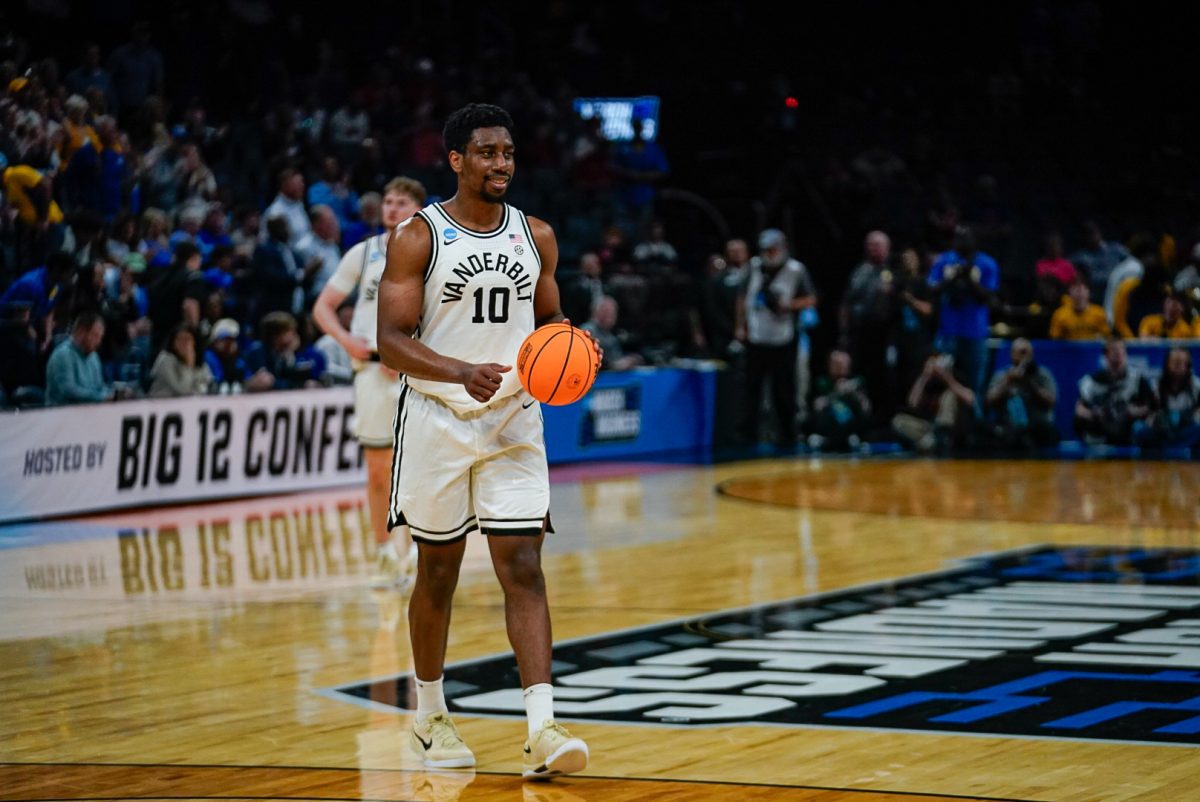


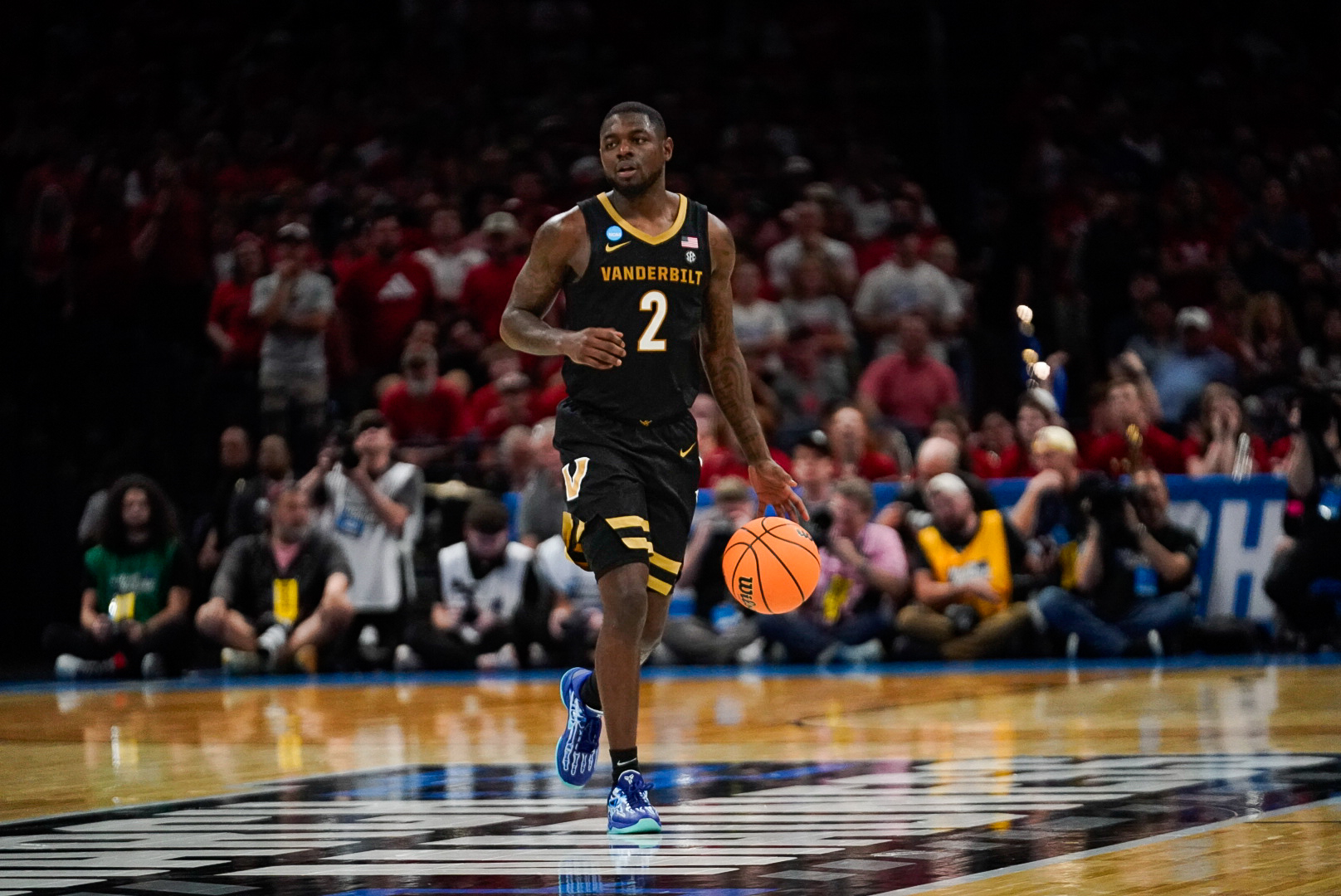
For most draft prospects, the road to professional basketball follows a straight line. For Duke Miles, however, his journey has been anything but that. After finishing his college career with stints at Troy, High Point, Oklahoma and capping it off with Vanderbilt, Miles enters the NBA draft as one of college basketball’s most experienced guards — a player whose skill set has been shaped by years of adaptation to new systems as well as growth in his own ability to run an offense.
Miles’ draft outlook is nothing short of intriguing, with a lack of consensus among big boards on where the veteran guard will fall. On one hand, places like Bleacher Report see him as a legitimate second-round player, ranked 43rd overall, while other sites such as ESPN have him ranked well outside of the first two rounds as the No. 83 prospect. The wide range of rankings fuels the main debate about Miles. Is his proven production on the court a big enough upside to outweigh front offices’ concerns of age? Let’s look at why GMs would want to take a chance on Miles.
Miles by the numbers
In a league shifting towards positionless players, where big men are developing guard skill sets from youth, guards are taller than they’ve ever been. What separates smaller guards in the ever-changing NBA is their elusiveness and ability to throw taller defenders off balance.
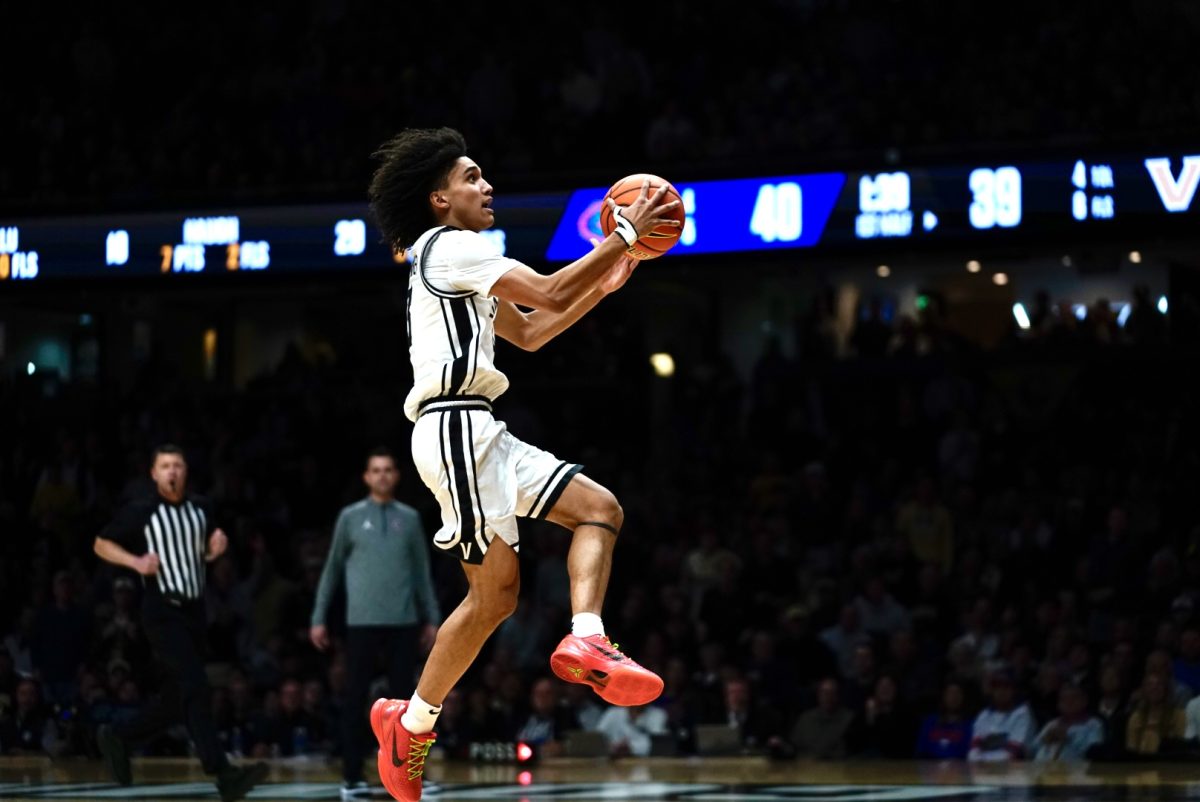
One thing that Duke Miles is consistently praised for is his ability to do just that. In college, he stood out for his difficult-to-manage play style, throwing off defenders on pick-and-rolls while scoring around 45% of his mid-range pull-up twos, like isolation specialists in the NBA such as Jalen Brunson. On the season, Miles averaged 16.1 ppg on 43.5 from the field, putting him among some of the most consistent guards in the league. Miles also stood out on the defensive front, posting an average of 2.8 steals per game, ranking him as one of the best on-ball defenders in college basketball.
For Miles, one of the most unique aspects of his game is consistently showing up in big games.
Miles consistently shifted the needle in big games for Vanderbilt, averaging 3.8 steals per game against ranked opponents. Miles not only affected the game statistically but also through his drive to push his teammates. Head coach Mark Byington has given credit to Miles throughout the season for his ability to push past mistakes and focus on the next minutes ahead on the court, which has fed into his on-court mentality.
One of Duke Miles’ main criticisms is his size. Standing at 6’2 and 180 pounds, the Alabama native’s size definitely is highlighted on scouting reports.
In the NBA, guards are taller than they’ve ever been. With the league shifting towards a more positionless game, where big men are developing guard skill sets from youth, the average height of guards has increased to 6’4 and is growing. While guards like Jalen Brunson, standing at 6’2, have proven to still be effective in the NBA, top-prospect guards in the draft change this narrative. Lottery projected players such as Darryn Peterson, Keaton Wagler and Mikel Brown Jr. have an average height with shoes of 6’5, one of the tallest guard classes. Miles will have to continue to rely on his speed off the dribble to throw these guards off their defensive rhythm in contests.
Player comp
Watching Duke Miles on court this season, it is evident that he has carved out his draft value through decision-making and defensive efforts. Entering the league as an older but more experienced guard, I would compare him most to TJ McConnell.
The University of Arizona graduate entered the 2015 draft as an elite floor general with a strong defensive presence, who was often criticized for being undersized at 6’1. McConnell went undrafted and signed with the 76ers, where he developed as a highly dependable backup guard by relying on pressuring opposing guards off the bench, most recently for the Indiana Pacers. In the 2025-26 season, McConnell averaged 9.4 ppg along with 5.1 assists off the bench, while consistently scoring double digits against good competition.
Miles, similar to McConnell, comes out of college with a relentless motor. Both have relied on the ability to affect the game through effort and anticipation rather than pure force and size. Both guards have also shown a high understanding of pace control and offensive organization even without having the ball. Miles, however, is seen to be the more aggressive scorer, as he builds more of his play style off mid-range shots.
The McConnell comparison, however, is less about play style and more about a career pathway: an older and undersized guard lacking hype coming into the league and making a name for himself. Through his understanding of the game combined with overall grit, McConnell’s effort proved more valuable than his pre-draft potential.
Best fits
One area where McConnell and Miles relate is in their lack of excitement entering the draft. Both guards were successful in creating a name for themselves in college, but fell on recruiting boards as draft night neared. McConnell went undrafted and had to do one of the most challenging things entering the league as an older player: wait. However, with the 76ers having a lack of a star guard, McConnell got his chance through increased minutes and playing alongside a talented mid-season grab in Ish Smith.
McConnell, along with other older, underappreciated guards, tells the same story: an opportunity is all someone needs to succeed. For Miles, if undrafted, he will have the opportunity to have a hand in where he may best fit to develop and see minutes in NBA contests.
As far as best fits go, the first team that jumps out is the Indiana Pacers. The Pacers do not have a pick in the 2026 Draft, due to previous trades. The team has a tendency to target second-round talent as development pieces, and with a point guard in Tyrese Haliburton, Miles would have the opportunity to develop under a guard who has mastered controlling the pace and scoring downhill, while working alongside TJ McConnell. The Pacers are also known for being able to attack in waves, with their bench averaging 41.5 ppg. Miles could fit in as another crucial bench piece with a better basketball IQ than most guards in the draft.
I could also see Miles staying in the state of Tennessee and working with the Memphis Grizzlies, who share a similar identity to his own. The Grizzlies as a franchise have been known for recruiting guys who share a similar defensive tenacity, as well as players who embrace their roles. Miles checks all these boxes, and while the Grizzlies don’t necessarily need another star guard, they are a team looking to build depth with players that can understand their roles and impact the game even without the ball.
Another interesting possibility for Miles is the Washington Wizards, who have been at the front of draft talks with the No.1 overall pick in this year’s draft along with late-round picks in the No. 51 and No. 60 picks. Miles was invited to a closed workout for the team in late May, which makes this an interesting scenario as the Wizards are currently trying to rebuild their roster with a lottery pick and recent signings of Trae Young and Anthony Davis. Acquiring an older guard on this team would provide more stable lineups, which are incredibly valuable for a team that has room to experiment with player placement in rotation.
Other teams to look out for are the San Antonio Spurs and the Miami Heat, who have history in developing deep benches around star players, and picking out overlooked players that have become key rotation contributors.
Draft projections
Because of Miles’ unpredictable placement on big boards, it is extremely difficult to tell whether or not he will start his career on a roster as an undrafted free agent, or if he even has the potential of being grabbed as a late second-round pick. After an outstanding senior season with the ’Dores, I believe Miles could potentially be seen as a post-draft pick by teams trying to build long-term guard depth, such as the Grizzlies or the Pacers, who rely heavily on veteran guards, or the Wizards, who are trying to build the next young superteam.
Another option for Miles, if he goes unsigned, is signing a two-way deal and developing in the G League before getting NBA minutes.
Miles was invited to the G League combine, where in his five-on-five scrimmage, he posted a mediocre performance of 7 points on 2-for-4 shooting along with three assists and a steal.
Miles’ fate will either be determined June 23-24 at the Draft, which takes place at Barclays Center in Brooklyn, New York, or in the coming months.