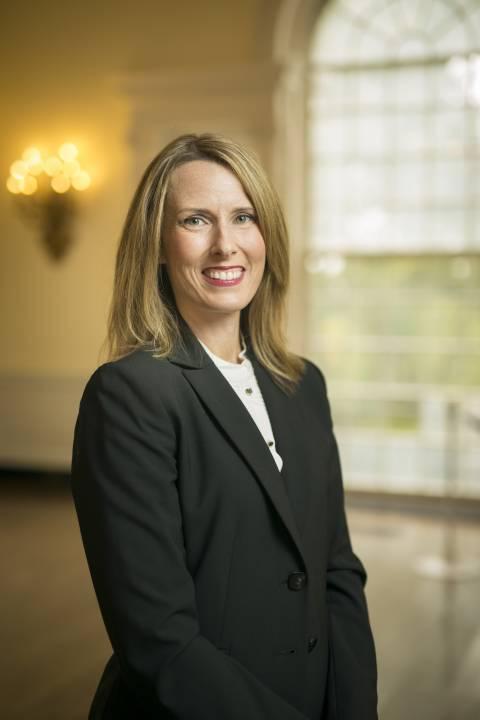

As a college softball player, Terrah Foster Akard learned self-discipline, teamwork and collaboration. Now, Akard uses those same skills as a pediatric palliative care researcher. Her research focuses on ways to improve coping and adjustment for children with life-threatening illnesses.
Akard grew up in Mount Juliet, Tennessee, about half an hour east of Vanderbilt University. As a child, she looked up to her older brother and strived to be like him. Her favorite subject in school was science, and she wanted to do something related to healthcare when she grew up.
“I definitely always had a calling or… a passion for children with life-threatening illnesses,” Akard said. “I just didn’t know exactly how that was going to play out in a career.”
When deciding where to go to college, Akard’s main goal was to play Division 1 softball. She chose to attend Jacksonville State University in Alabama on an athletic scholarship.
For Akard, being a student athlete defined her undergraduate experience. Playing Division 1 softball demanded large amounts of Akard’s time, but also gave her lifelong skills.
“To me, on top of just playing ball and being an athlete and wanting to win, there were a lot of underlying life skills that I was learning,” Akard said. “I wasn’t going to go on to play professional ball, like what the guys do. But those underlying skills are lifelong.”
“I WASN’T GOING TO GO ON TO PLAY PROFESSIONAL BALL, LIKE WHAT THE GUYS DO. BUT THOSE UNDERLYING SKILLS ARE LIFELONG.”
During the softball season, Akard often missed half of her classes. Despite her frequent absences, she still found herself getting A’s in her biology classes.
“I was just kind of drawn to (biology), but the problem with that is that I couldn’t see a career in biology,” Akard said.
Akard considered a bachelor’s in degree in nursing, but decided against it because pursuing that would prevent her from graduating in four years. Akard decided to major in biology.
After being rejected from several Physician’s Assistant programs, Akard was unsure of what she wanted to do after graduation. A friend told her about the Vanderbilt School of Nursing’s master’s program. Akard decided to get her Master of Science in Nursing and become a pediatric nurse practitioner.
After getting her master’s degree, Akard returned to Mount Juliet to work in pediatric primary care. Akard describes this first job as a solid foundation for the rest of her career.
“I originally went to nursing school to work with children with life-threatening illnesses,” Akard said. “I loved seeing 20-30 patients a day (in primary care), but I wanted to do something where I could have that creativity to think of a question, develop a study to answer it, and then disseminate that knowledge to have greater impact.”
Akard returned to Vanderbilt to get her PhD and become a researcher. She liked the idea of being able to answer her own questions.
“You could pick your topic that you were excited about, and you could dream up your own questions, and that ability to be creative was really appealing to me,” Akard said. “I just thought that might be something I could be content with life-wise.”
“THERE MAY BE BARRIERS AND CHALLENGES ALONG THE WAY, BUT IF SOMEONE HAS A PASSION FOR (HEALTHCARE), THEY CAN BE FOCUSED AND SHOOT FOR THEIR GOALS AND ATTAIN IT.”
Currently, Akard is in her third year of a four-year study that looks at how to improve coping and adjustment for children with life-threatening illnesses. She recruits children and their families through Facebook advertising. The study uses web-based legacy intervention: the participants use a program that guides them to create an electronic scrapbook of their lives.
Akard cherishes the opportunity to help children and families going through serious illnesses, but she also values mentoring and guiding her students.
“Kind of like when i played college ball, if I can instill those underlying lifelong lessons into (my students’) lives, that has lifelong impact that’s way beyond any study that I’m ever going to do,” Akard said.
Akard encourages students who want to go into healthcare to “shoot high” and reach for their goals.
“There may be barriers and challenges along the way, but if someone has a passion for (healthcare), they can be focused and shoot for their goals and attain it,” Akard said.
Many people told Akard that she wouldn’t be able to have the career she wanted and play softball in college. Instead of taking that criticism to heart, Akard worked hard and attained the lifelong skills that she still uses today as a nursing researcher.