
Vanderbilt Men’s Basketball (26-8, 11-7 SEC) secured a bid to the NCAA tournament as a No. 5-seed — its highest seed placement since 2012. Now, the No. 5 Commodores will travel to Oklahoma City to face the No. 12-seed McNeese Cowboys of the Southland Conference (28-5, 19-3 SLC) in the Round of 64.
The Commodores enter the tournament with strong momentum from their SEC tournament run, where they earned key wins over in-state rival Tennessee and top-seeded Florida before falling to Arkansas in the finals. In his second year as head coach, Mark Byington has led his team to a 10-7 record in Quad 1 games and a 7-1 mark in Quad 2, helping them climb to No. 12 in KenPom rankings and No. 13 in the NET. After facing the 13th strongest schedule in Division I and competing in the conference with the most March Madness bids — with ten SEC teams in the tournament — the battle-tested Commodores take on a dangerous mid-major team in their first challenge of the Big Dance.
Standing in the way of Vanderbilt’s first NCAA tournament win since 2012 are the SLC Champions, making their third March Madness appearance in a row. This McNeese squad may not have the resume of Vanderbilt, going 0-2 in Quad 1 play and facing the 201st-ranked strength of schedule in the nation, but the Cowboys know how to win. Head coach Bill Armstrong has taken over after head coach Will Wade’s departure to North Carolina State last offseason and is riding on a 10-game win streak capped off by a dominant 76-59 victory over Stephen F. Austin in the conference championship game.
The Cowboys are no strangers to upsets at this stage, sending No. 5 Clemson home last year in the round of 64 for their school’s first-ever tournament win before losing to Purdue in the second round. Still, this is not the same McNeese squad as last year, nor the same Vanderbilt group fans are used to seeing. The two squads are returning only 30.5% and 35.6% of minutes played from the 2024-2025 rosters, respectively. The new-look McNeese Cowboys will look to capitalize on their third-consecutive trip to the dance, while the Commodores will try to avoid another first-round exit after St. Mary’s sent them home last spring.
Pressure? What pressure?
Unlike many popular Cinderella picks, the Cowboys do not excel from high-volume 3-point shooting or efficient half-court offense. Instead, McNeese uses its quickness and physicality to create chaos among opposing offenses, forcing turnovers on roughly a quarter of opponents’ possessions, the highest rate in Division I. They also rank first nationally in defensive steal percentage (15.3%) and fourth in defensive block percentage (15.8%). With the 91st-ranked offense and a 49th-ranked defense in KenPom, McNeese establishes a clear defensive identity.
On top of its ability to force turnovers, McNeese often pushes teams late into the shot clock by applying full-court pressure, which drags opponents out of their offensive rhythm from the jump. Their defensive possessions last an average of 19.2 seconds, which is dead last in all Division I basketball. The key to picking apart McNeese’s strong help-defensive rotations is shooting from outside the arc. 46.8% of opponents’ field goal attempts against McNeese are from deep, one of the highest rates in the nation, a vulnerability Vanderbilt can take advantage of as an above-average 3-point shooting team (35.5%). If the Commodore backcourt can handle the pressure and get into their sets, they should have no problem finding shooters on the perimeter.
The difference-makers
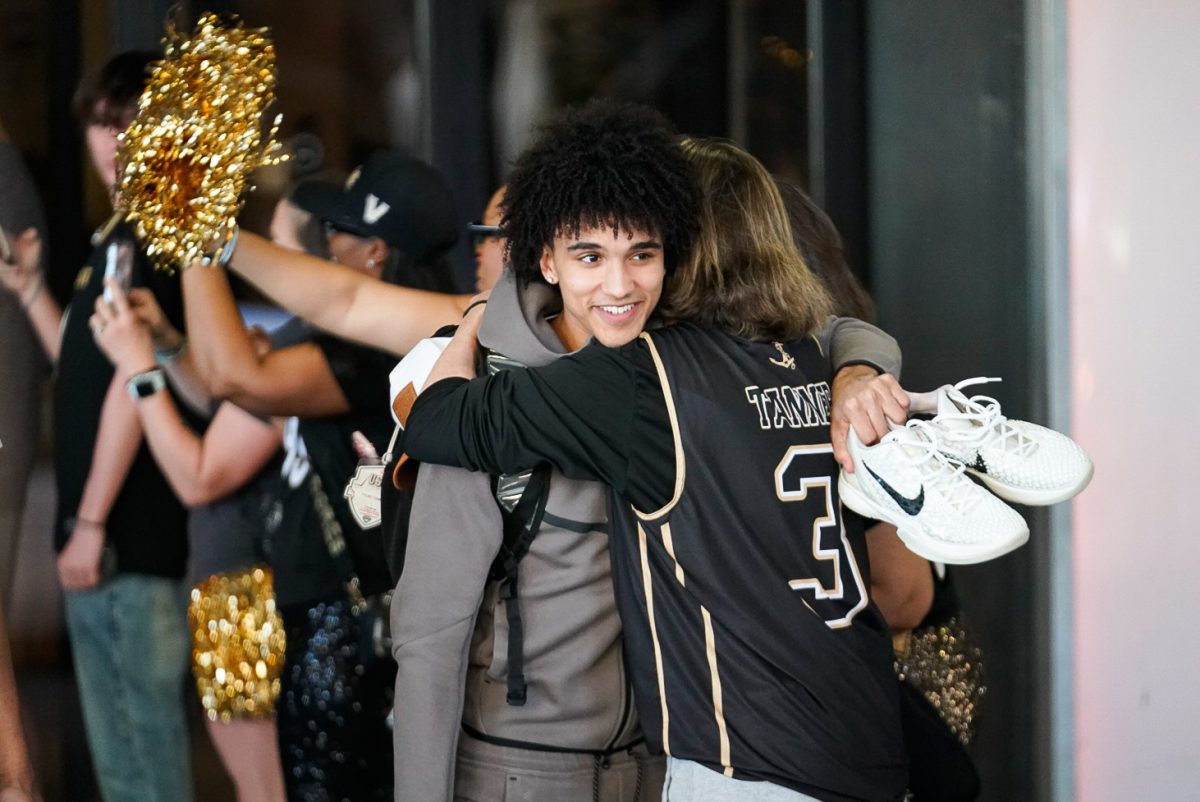
Vanderbilt’s backcourt has been its offensive engine the entire season, headlined by sophomore NBA prospect Tyler Tanner (19.2 ppg) and veteran senior Duke Miles (16.4 ppg). The Commodores’ high-level guard-play — a unit that has totaled 108 points, 34 assists and only 9 turnovers over the last three contests — will be instrumental to making sure McNeese’s pressure does not dictate the game. If Tanner and Miles can break the first layer of full-court pressure, expect frequent kicks to Tyler Nickel (40% from 3-point range), who hit five triples in the SEC championship, and AK Okereke (38% from deep).
On the other side, McNeese’s versatile Garwey Dual can play multiple positions and will likely use his 6’5 frame to apply pressure alongside junior guard Tayshawn Archie, who swiped five steals in their Southland Championship game victory. The Cowboys’ main offensive threat is 6’4 senior guard Larry Johnson (17.5 ppg), who takes 33.2% of his team’s shots, the 16th highest mark in Division I. In addition to Johnson’s dominance on the ball, other scorers such as Javohn Garcia, who exploded for 31 points in his last game and hit five 3-pointers (35.8 % from long-distance), can make the Commodores pay if they are careless with the ball.
In the frontcourt, Vanderbilt will need to keep an eye on 6’10 senior forward Jerrell Colbert, who anchors the defense down low and blocks 9.7% of shots that come his way. Vanderbilt’s big men, Devin McGlockton and Jalen Washington, will need to match the physical play they showcased after facing offensive rebounding juggernauts Tennessee and Florida. McNeese compensates for its 31% 3-point shooting by grabbing 35% of their misses, meaning limiting second chance opportunities is key to not letting any streaky Cowboys shooters catch fire from behind the arc.
The formula for an upset and how to spoil it
The blueprint for a McNeese upset was revealed last year in its victory over No. 5 Clemson. The Cowboys raced to a 31-13 first-half lead after the Clemson Tigers shot a stunning 1-of-15 from deep in the first half. If McNeese wants to take down the Commodores, they will have to follow a similar script: force early turnovers, build a lead and take advantage of their slow pace (246th-ranked in Division 1) to limit Vanderbilt’s chances of mounting a comeback.
This tale has been all too familiar this season for the Commodores. Two of Vanderbilt’s losses to lower-ranked opponents, Missouri and Oklahoma, followed a similar formula — a 21-point deficit followed by a flash of momentum that came up just short.
For Vanderbilt, the answer starts with protecting the ball. Even though the Cowboys force turnovers at the highest rate in the country, their 201st-ranked strength of schedule has not matched them up against an NBA-caliber ball handler such as Tanner, and the ‘Dores commit turnovers on 13.3% of their possessions, the 11th lowest in the country. The second clear swing factor could be Vanderbilt’s ability to make open 3s. McNeese relies heavily on help defense to stop opponents, which leaves gaps around the 3-point line for shooters to exploit. If Vanderbilt can maintain its above-average 3-point shooting (35.5%), it should be able to take advantage of the Cowboys’ defensive weakness.
On paper, No. 5 Vanderbilt has more impressive metrics, is playing their best basketball at the right time and seems to have sound answers to all of McNeese’s strengths. However, anything can happen in March.
Vanderbilt will tip off against McNeese at Paycom Center in Oklahoma City, Oklahoma, March 19 at 2:15 p.m. CDT.