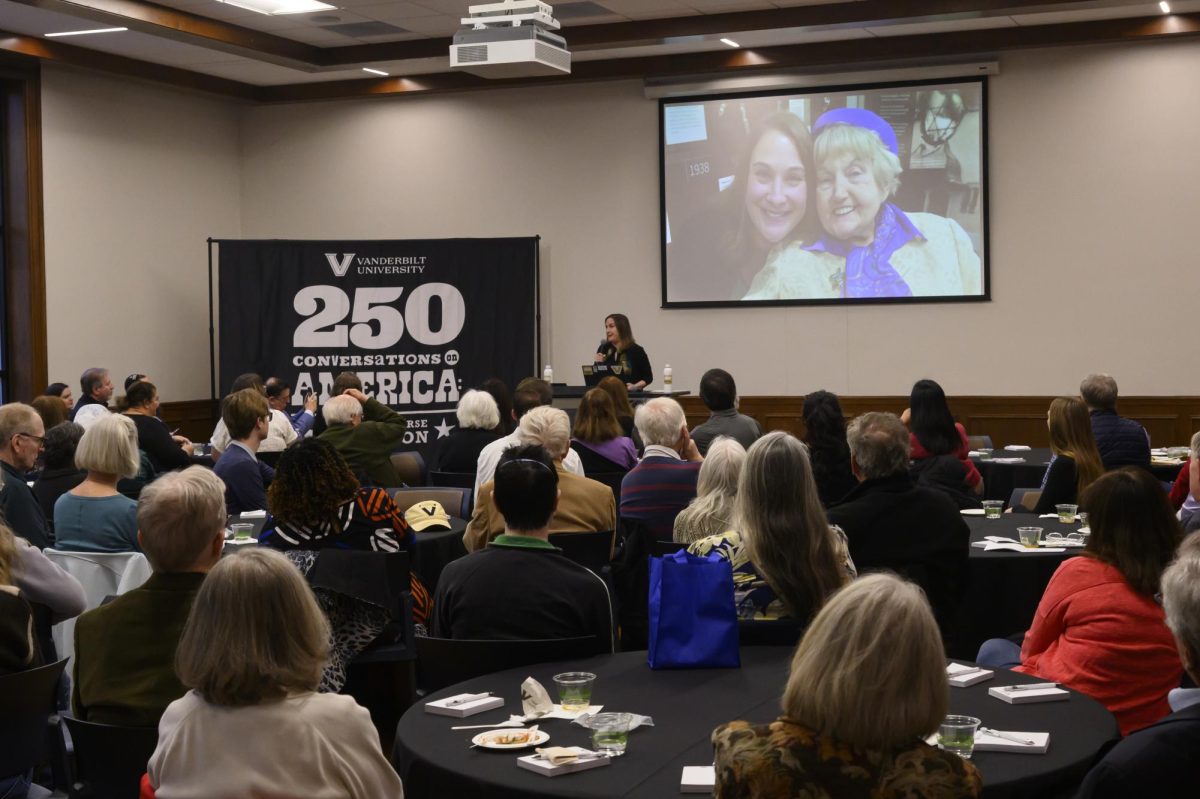

Vanderbilt University and the Tennessee Holocaust Commission held a presentation Feb. 20 about the Holocaust featuring guest speakers Dr. Alex Kor and Stacy Gallin, who has a doctorate in medical humanities. The presentation is part of the “250 Conversations on America” lecture series and included a historical overview from Gallin on how professional medicine enabled the Holocaust, followed by a personal story from Kor about his mother’s experiences with the Holocaust.
Gallin began by stating the three things she believes are essential for gaining insight into the Holocaust: understanding the stories of both the survivors and the perpetrators, seeking the relevance of what happened and asking questions.
“[Asking questions] is so important for everything that we do today because we get so much information, and it’s filtered in so many different ways. But it’s not all accurate, right?” Gallin said. “And particularly when I talk to young people, they need to know that. So it’s not just about us learning from people. It’s about us making sense of what is the information that we’re getting.”
As an example of a topic that must be questioned, Gallin cited “the myth of Nazi doctors,” the idea that the German doctors who participated in euthanasia and medical experiments were all either insane, incompetent or coerced into committing the crimes they did.
“German medicine in the 20s, 30s and 40s was the best in the world. These were not uneducated people. These were not bad doctors. They were good at what they did, [and] they were well respected people,” Gallin said. “In fact, Germany was the only country in the ’20s to teach medical ethics. They had mandatory medical ethics training in their curriculum. It just wasn’t medical ethics like we know medical ethics. It was a different kind of medical ethics. Most who participated did it because they genuinely believed it was the right thing to do.”
According to Gallin, the ethics doctors shared in Nazi Germany were steeped in eugenicist ideology, which sought to support the fitness of society, or the Volk, often at the cost of individual people. Gallin explained this as the cause for why, despite the existence of the Hippocratic Oath, which obligates doctors to do no harm to their patients, doctors felt justified in taking the lives of people who they deemed unfit to reproduce.
“The individual didn’t matter. Only the Volk mattered,” Gallin said. “So when you look at this, and you look at the union of science, medicine, law, politics, media — all of these systems of power — sending the message that certain people were worth more to society than others goes back to where we started in eugenics and accepted scientific theory that targeted marginalized people.”
Gallin explained that all of this could be easily avoided if people treated each other with basic, human respect. Gallin illustrated this point by quoting the testimony of Dr. Andrew Ivy, the doctor testifying for the prosecution at the Doctors’ Trial (part of the Nuremberg Trials, which followed the Second World War), who said that if doctors had refused to participate in the mass killing of sick people, then the Holocaust would not have occurred at all.
“We will never know what would have happened if the German medical community had said, ‘No. We will not kill disabled people. That’s not what we do.’ Because there’s always a time to say, no,” Gallin said. “There’s always a time to ask questions. There’s always a place to have your voice heard. Your voice matters. It always matters.”
With her discussion of individual voices, Gallin turned it over to Kor, who discussed the life of his mother, Eva Mozes Kor, who survived the Holocaust and went on to controversially forgive the doctors who experimented on her and her twin sister, Miriam.
Born Eva Moses in Transylvania, she and sister were the only Jewish children in their village. In 1944, their family was deported to Auschwitz, where they were separated from their parents and subjected to twin experiments by Josef Mengele. Their parents and other sisters were killed. Liberated in 1945, the twins eventually immigrated to Israel.
“From 1945 to 1950, Eva in particular had nightmares,” Kor said. “As soon as they got to Israel, Eva’s nightmares stopped, and she [was] in a kibbutz with all boys and girls, all from the Holocaust, ages 14, 15 and 16. Once asked, ‘how was living in the Kibbutz, Eva?’ She said, ‘Oh, this was the best time of my life, because I learned how to say I love you in 10 languages.’”
After surviving Auschwitz, Eva later married fellow survivor Michael Kor and settled in Terre Haute, Indiana. She founded CANDLES to locate other twins subjected to experiments. After her twin Miriam died from health complications caused by those experiments, Eva sought answers from former Nazi doctor Hans Münch. In 1995, at Auschwitz’s liberation anniversary, she publicly forgave him — in her name only — and thanked him for documenting the truth.
“My mom knew at the time that she had given [Münch] a gift. She had no idea until months later that she had given herself a gift,” Kor said. “She no longer had a chip on her shoulder. She no longer really despised and even hated her parents cause they didn’t save the family. She was no longer a victim.”
Senior Evan Nayee said that he was especially intrigued by the lecture because of his interest in medicine, policy and ethics.
“It was impactful to hear from Dr. Kor about his mother’s experience and how she ended up forgiving the Nazi physicians who tormented her, which she clearly faced backlash for and which I think many people even today would struggle to do if put through such atrocities,” Nayee said.
Senior Tao-Tao He said he was moved by the lectures, which he said taught him two important lessons.
“The first is that I think holding true to the principle of seeing all people equally, and treating all people equally and treating every human being as a human being is really important,” said He. “And the second one is just practicing love and forgiveness. I was really inspired by Dr. Kor’s story and how I’d imagine it would be like such an impossible thing to do. His mother did it, and I was really inspired by that. I think we can use more love and forgiveness in our lives.”






Steve Caldwell • Mar 2, 2026 at 10:19 am CST
Thank you for the most interesting article.
Thank you to the Vanderbilt Hustler for making this program’s message available to the readers. Well done.