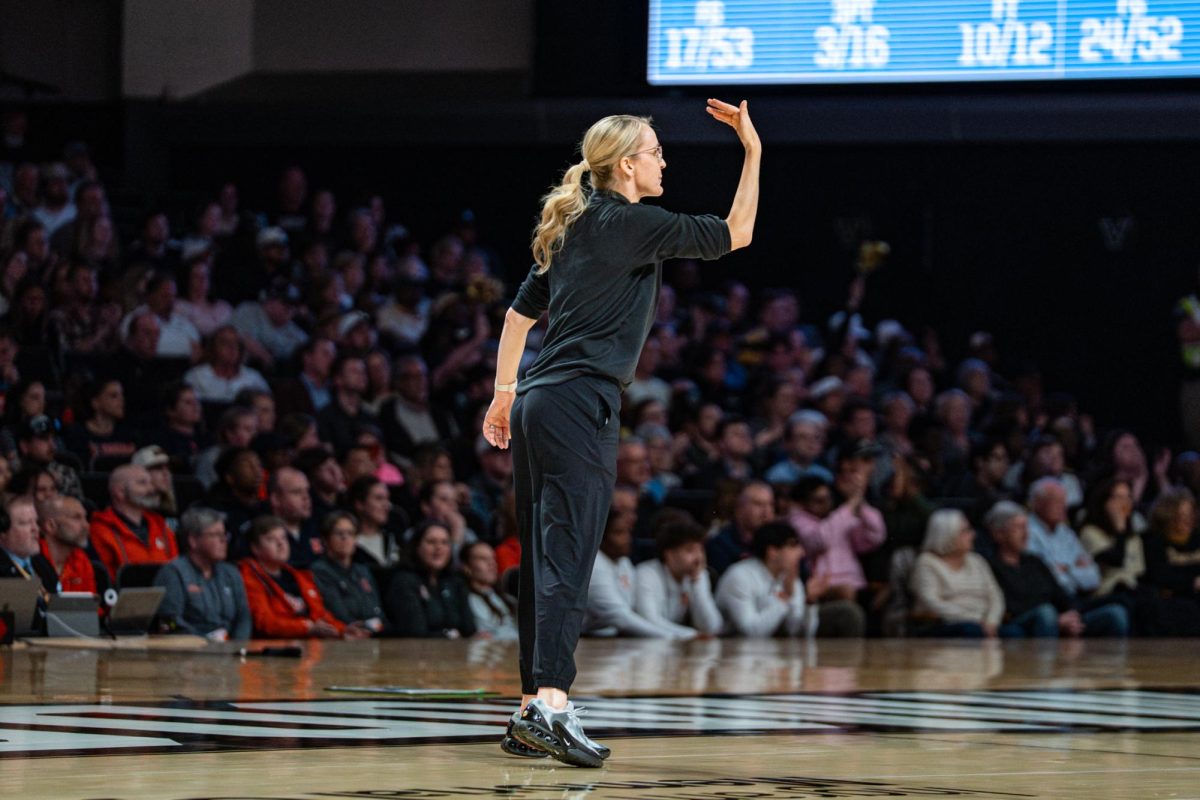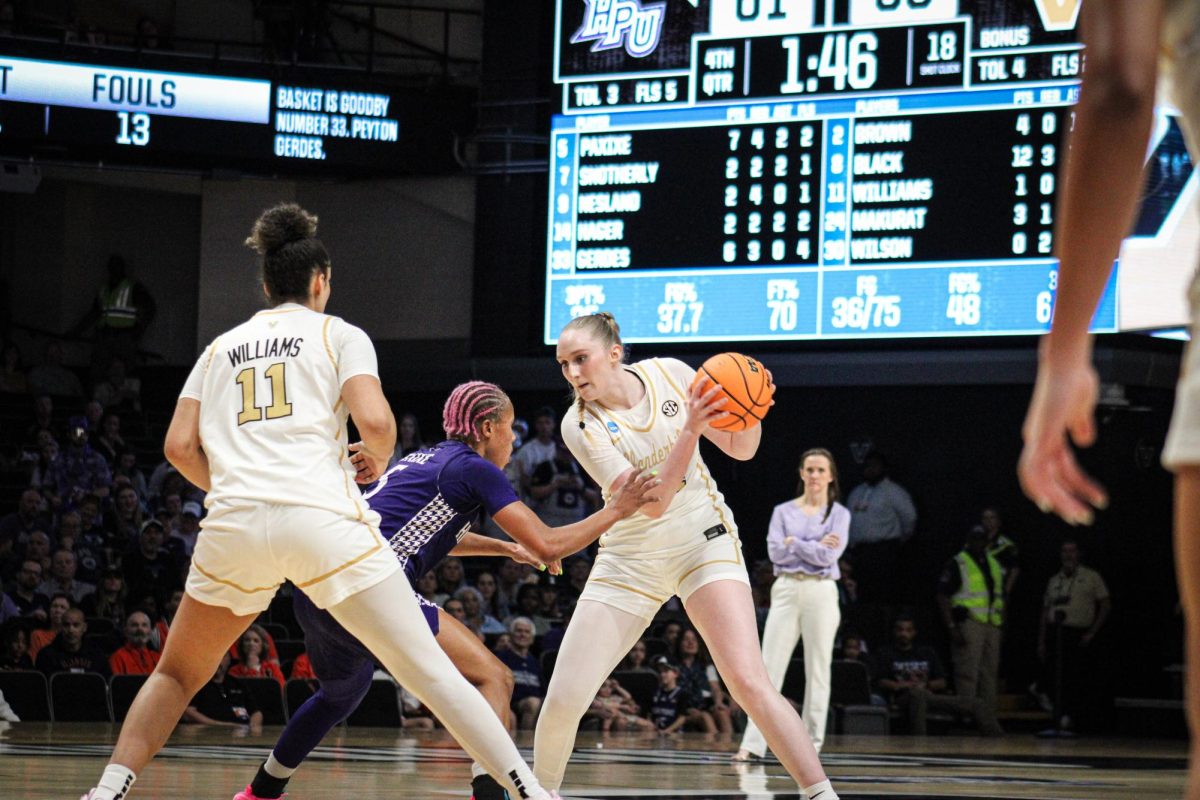


Vanderbilt Women’s Basketball dominated its nonconference schedule, improving to 13-0 on the season and jumping to No. 12 in the most recent AP Poll. The Black and Gold also sit in fifth place among SEC teams — behind Alabama, Texas, Georgia and LSU, which are all also perfect through non-conference play.
What has made head coach Shea Ralph’s squad so good this early in the season? What will sustain their success entering the grueling challenge that is SEC play? The Hustler took a deep dive into some of the statistics behind Vanderbilt’s performances to give a better sense of just how good the Commodores have been and what could be their weaknesses headed into the second half of the season.
Adjusted efficiency and tempo
Vanderbilt has one of the best adjusted offensive efficiencies and tempos in the nation.
In basketball analytics, adjusted offensive efficiency, often called AdjOE, measures how many points a team scores per 100 possessions. The “adjusted” factors reflect performance against an average opponent. In effect, the adjustment removes, or at least mitigates, the variability that comes with playing a strong or weak defense, allowing analysis of how often an offense would score if they played against an average team. The Commodores are ranked No. 9 according to Bart Torvik — the women’s equivalent of the notable KenPom rankings — with an AdjOE of 114.1, meaning that out of 100 possessions the ‘Dores would be expected to score just over 114 points. This is encouraging given that Vanderbilt lost two of its leading scorers last season in Iyana Moore and Khamil Pierre — who transferred to Notre Dame and NC State, respectively. Furthermore, the Commodores’ AdjOE ranks fourth among SEC teams with only South Carolina (123.9), Texas (123.0) and LSU (122.7) holding higher efficiency rankings.
Part of what makes the Commodores so efficient is four of its starting five: Mikayla Blakes, Aubrey Galvan, Justine Pissott and Sacha Washington. This group has above average output in two key statistical offensive efficiency categories: points over replacement per adjusted game at that usage and offensive ratings. PPRG! estimates how many more points a player scores than a replaceable bench player — essentially assessing a player’s value to its team compared to a league-average substitute. The ORTG of a player measures their efficiency by indicating the number of points scored per 100 possessions, essentially a player’s contribution to the team’s AdjOE.
Blakes not only leads her team in both metrics but is also among the best in the nation in these statistical categories — indicating that she is one of the most efficient offensive players in the women’s game right now. Blakes holds a PRPG rating of 7.2 (No. 11 in the nation and No. 2 in the conference) and an ORTG rating of 124.4. Although Blakes is not ranked among the nation’s best on ORTG, Pissott is, with an astounding 131.6 rating (No. 15 in the SEC and No. 40 in the nation). The senior also holds a PRPG rating of 4.4 while shooting a blistering .447 from beyond the arc. Also contributing to the Dores’ efficiency is first-year Galvan who holds ratings of 3.7 and 109.9, and Washington, who holds ratings of 3.4 and 1207.8, respectively.
Minute splits
Perhaps one fallacy of the Commodores could be their minute splits. Among a relatively easy nonconference schedule, their bench is getting less minutes than many other SEC programs who played more Quad 1 games than the Black and Gold thus far. Vanderbilt’s typical starting five — Blakes, Pissott, Galvan, Washington and Ndjakalenga Mwenentanda — have all played at least 48% of the teams total minutes. This is even more skewed when you look at the Commodores’ big three in Blakes (78.3%), Pissott (66.7%) and Galvan (81.5%).
Vanderbilt does have some notable contributors off the bench, including Jada Brown and Aiyana Mitchell (51.3% and 42.4% of minutes, respectively). After these two, however, the numbers drop significantly, with the next player in line, Aga Makurat, receiving just 29% of minutes. Some of the tallest players on the roster in Trinity Wilson and Aliyah Del Rosario also receive just 2.1% and 15.2% of minutes, respectively.
This could pose a schematic challenge for Ralph and Co. down the stretch in SEC play, since many of the SEC’s best teams have a more evenly distributed share of minutes across a larger number of players. Vanderbilt’s offense is centered on quick transition offense and defense, a style which has been successful when playing against teams that primarily play slower. Vanderbilt will need to lean on other players to give it quality minutes against quicker conference opponents who play a similar style.
Finally, Washington has been known to get into foul trouble down the stretch of big games; the Commodores will need to get minutes from more bigs. If Mitchell is for some reason unable to give them those, the Dores might have to turn to small ball in a conference that is becoming increasingly bigger. How will Ralph’s main group of players fare when facing a similar style with bigger post presences? Only time will tell.
Lost on the glass
Vanderbilt’s inherent star power and offensive dominance have compensated for its inconsistencies in the rebounding department. Ralph will likely place a stronger emphasis on the glass as conference play approaches. The rosters Vanderbilt previously faced lacked the height and physicality commonly showcased in the SEC.
Defensive rebounding percentage measures the portion of available defensive rebounds a team secures. DRB% is calculated by dividing the team’s defensive rebounds by the sum of its defensive rebounds and the opponent’s offensive rebounds. According to Torvik, the Commodores are ranked No. 164 (68.6%) nationally in DRB%. For a team ranked No. 12 in the nation, this mark is alarming. Furthermore, the Black and Gold rank No. 13 in the SEC in total rebounds per game (40.1), 11 fewer boards than LSU (51.1).
The Commodores have thrived running their offense through Blakes and Galvan in a guard-heavy lineup. Ralph’s starting five consists of four guards and just one forward in Washington. The graduate leads the team in rebounds, averaging 6.9 per game, despite standing at just 6’2. Washington and her fellow starters will undergo tougher tests against in-conference programs with traditional centers. The SEC not only consists of personnel with more size and physicality, but the conference features dominant post-play Vanderbilt is not accustomed to facing.
Vanderbilt’s only true center — Aalyah Del Rosario — hasn’t logged many meaningful minutes this season. The 6’6 junior is averaging 1.6 rebounds in the 11 games she has played, seeing just 7.0 minutes per contest. Ralph may turn to Rosario to provide some height if Vanderbilt continues to be outmatched on the glass. Other SEC teams will look to exploit this weakness, forcing Vanderbilt to abandon its small ball lineup. Ralph needs to emphasize fundamentals like boxing out and crashing the boards to boost the team’s defensive rebounding percentage, ultimately reducing opponents’ second chance opportunities. Securing defensive rebounds will be requisite for the Commodores if they hope to keep their winning-streak alive.
Playmaking pays off
Contrary to its rebounding struggles, Vanderbilt has excelled in assist production and overall ball movement. The addition of Galvan provides Ralph with an elite playmaker who consistently makes pro-level passes. The first-year point guard is ranked No. 10 nationally in assists per game (7.2) and No. 3 in the SEC. Her strong contributions have led to Vanderbilt being No. 2 in the SEC in assists per game (21.31). Galvan’s arrival has allowed Blakes to play more off the ball, resulting in cleaner looks.
Last season, Jordyn Oliver led the team in this category with just 3.6 assists per game. Galvan has doubled that metric, and her high-level play has been central to Vanderbilt’s offensive success. Ralph’s backcourt of Galvan and Blakes not only features two highly skilled guards but highlights the dynamic between two players who complement each other extraordinarily well.
Vanderbilt ranks No. 8 in the country in assist-to-turnover ratio (1.76), No. 3 in the SEC behind Texas (2.07) and Kentucky (1.81). This ratio reflects the Commodores’ smart decision making and offensive efficiency. Clean passes prevent fast break points for the opponents, allowing Vanderbilt to maintain control of possession. Galvan herself ranks No. 14 in assist-to-turnover ratio (3.1), further demonstrating how she has improved Vanderbilt’s ball control. The Deerfield, Illinois, native has minimized mistakes while consistently creating opportunities for her teammates. Galvan and her fellow Commodores’ playmaking abilities and unselfishness are key reasons the team remains undefeated heading into January.
Vanderbilt will begin SEC play Jan. 1 at Arkansas in Fayetteville at 1 p.m. CST.