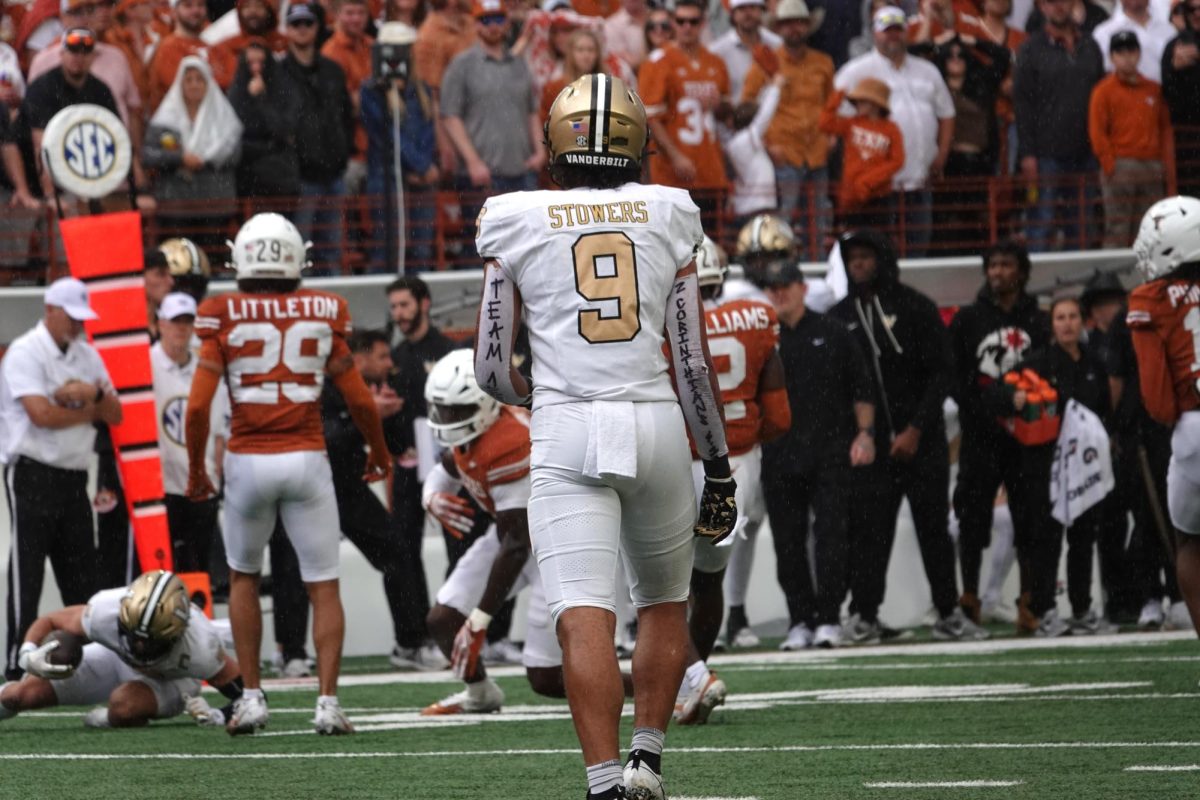


After a narrow victory against Missouri, Vanderbilt Football traveled to Austin to face No. 20 Texas. For most of the game, the home team dominated, scoring on six of its nine possessions. Vanderbilt did not give up, though, surging back in the final minutes with a 21-0 run, but it was unable to erase the 24-point deficit it faced at the end of the third quarter, ultimately falling 34-31.
From the opening kickoff, Texas dominated in the trenches and attacked Vanderbilt’s secondary, forcing the Commodores to deviate from their usual style. However, adjustments were made, and Vanderbilt’s passing attack came alive down the stretch.
The game’s stats show what put Texas on top in this matchup. They also show some positives and reflection points Vanderbilt can take with it despite the loss.
Bullseye
Coming into this matchup, Texas only converted 38% of its third-down attempts, while Vanderbilt ranked eighth in the nation with a 50.70% conversion rate. Vanderbilt allowed Texas to convert on 7-of-11 third downs, all of which came through the passing game, where Longhorn quarterback Arch Manning delivered composed, accurate strikes against the Commodores’ secondary.
Vanderbilt’s pass defense struggled as a whole, allowing the talented Texas receiving corps to accumulate 328 yards as a unit on the day. Every matchup in the passing game favored the Longhorns, as Manning delivered completions to an astounding eight different pass-catchers. The freedom of having many options made Texas’s offense explosive and helped it flip the switch on its previous lack of third-down success.
As the game went on, Vanderbilt was impressive on third down, as well, making 7-of-13 tries, six of which came in the second half. It also converted on its two fourth-down attempts — both of which came in the final minutes of the game — as Diego Pavia delivered some game-extending completions.
Horned down
This season, the Commodores have been incredibly effective at getting into their opponents’ backfield to disrupt the run game and pressure the quarterback. They sack their opponents 2.6 times a game on average and put up 6.75 tackles-for-loss per outing. Against Texas, the Commodore defensive line was stifled, though. Manning went untouched on the day, and the team recorded just one tackle-for-loss. In turn, the Longhorn offense had more time and space to make big plays, and Manning became more confident in the pocket as the game wore on.
On the flipside, Texas was able to constantly pester Pavia, breaking through the Commodores’ offensive line and chasing him around the pocket. Pavia, who had only been sacked seven times all year heading into this game, was brought down a whopping six times against the Longhorns. This included a strip sack on Vanderbilt’s first possession that allowed Texas to get an advantageous field position and take an early two-score lead.
The Lone Star
Coming into this season, Vanderbilt’s Eli Stowers was projected to be the premier tight end in college football. NFL mock drafts slated him as a first-round pick, and he was in the pre-season watchlists for many national awards. Compared to these lofty expectations, Stowers’ 2025 campaign has been disappointing, as he was yet to hit the 50-yard mark in SEC play coming into the Texas game.
In Austin, though, Stowers exploded for a career-high 146 receiving yards on 7 receptions. This included two touchdown scores, with one of them being a 67-yard breakaway touchdown that kick-started the Commodores’ fourth-quarter comeback efforts. The Texas native was incredibly effective at attacking the middle of the field, especially as the Longhorns’ defense began to drop in as they built their lead. Utilizing the space he was given, Stowers torched Texas’s linebackers and put up a performance that reminded the college football world that he is one of the best at his position.
Hold ‘em
Even though, at times, it felt like Texas was running toward a blowout victory, Vanderbilt punched back to make the game a one possession loss. While losing should not be considered acceptable for the No. 9 team in the country, it is impressive that the Commodores were able to cover the (+3.5) point spread placed against them.
In Pavia’s tenure as Vanderbilt’s quarterback since the start of 2024, the Commodores have gone 16-6 against the spread. In a world where sports betting is legal in most states, the money and math involved in creating betting odds for football games are enormous. Hence, a team being this successful against Las Vegas, as Vanderbilt has been the past two seasons, shows how the program continues to literally defy the odds put against it and often has big results on the field.
Texas shootout
While the box score tells a lot about a football game, some factors are just not quantifiable. When a team is down by three scores to begin the fourth quarter — as the Commodores were against Texas — they often give up. But with its back against the wall, Vanderbilt got more aggressive and nearly came back to win the game. The heart that the team showed is not reflected in numbers but is a telling sign that Vanderbilt will continue to be competitive in any situation.
Vanderbilt Football will return home to FirstBank Stadium to take on the Auburn Tigers on Nov. 8 at 3 p.m. CST.