

“No one is above the law.”
These six words encapsulate a fundamental principle of our democracy: the rule of law. As defined by the Constitutional Accountability Center, abiding by the rule of law in the United States requires holding all branches of government, as well as the leaders abiding therein, “accountable to the text and history of the Constitution and federal statutes.” In other words, a government with the rule of law requires all individuals, regardless of political power or status, to be subject to the same legal constraints and consequences.
This foundational principle originated in the Magna Carta of 1215, which placed systemic checks on the formerly unconstrained authority of King John, a tyrant who arbitrarily deprived individuals of their liberty and property without due process. Once established, the rule of law became a guiding principle of democracy for the Founding Fathers as they formulated the United States Constitution.
The rule of law is the foundation of our republic; when we desecrate the rule of law, we cave to disorder and the destruction of our democracy. Removing accountability under the rule of law for the office of the presidency is the most dangerous step in this direction.
“For the true Idea of a Republic, is ‘an Empire of Laws and not of Men,’” John Adams said in a letter he wrote in 1776.
“There should be one rule of justice for rich and poor, for the favorite at court, and the countryman at the plough,” Samuel Adams said in a section of his famous pamphlet entitled “A State of the Rights of the Colonists.”
And unlike King George III of England, “The President of the United States would be liable to be impeached, tried, and, upon conviction of treason, bribery, or other high crimes or misdemeanors, removed from office; and would afterwards be liable to prosecution and punishment in the ordinary course of law,” according to Alexander Hamilton’s Federalist Paper No. 69.
It is clear from the complex system of checks and balances established in our Constitution — and from their own remarks — that the Founding Fathers firmly believed in equal application of the law to all people, regardless of political power, wealth or affiliation with any particular branch of government.
Yet, the phrase “rule of law” is never explicitly mentioned anywhere in the text of the Constitution itself. And although the Article VI Supremacy Clause establishes the Constitution as the supreme law of the land, there is no section of the Constitution that outlines clear consequences for disregarding the rule of law in a universal manner.
Nearly two years ago, the Supreme Court deviated from centuries of constitutional norms surrounding the rule of law, ruling in Trump v. United States that the president has “absolute immunity from criminal prosecution for actions within his conclusive and preclusive constitutional authority” and “presumptive immunity from prosecution for all his official acts.”
As Justice Sonia Sotomayor stated in her dissent, this ruling had “no firm grounding in constitutional text, history, or precedent.” After all, the Constitution itself functions on the premise that all persons must follow it equally.
However, the Trump v. United States ruling established a dangerous standard: that there are circumstances in which a president could be exempt from the rule of law.
Justice Ketanji Brown Jackson argued in her dissent that, because of the Court’s decision, any president would now receive immunity “even for unquestionably and intentionally egregious criminal behavior,” so long as that behavior was carried out in an official capacity. This means that, even when an official action taken by a president clearly violates criminal law, prosecutorial consequences are removed.
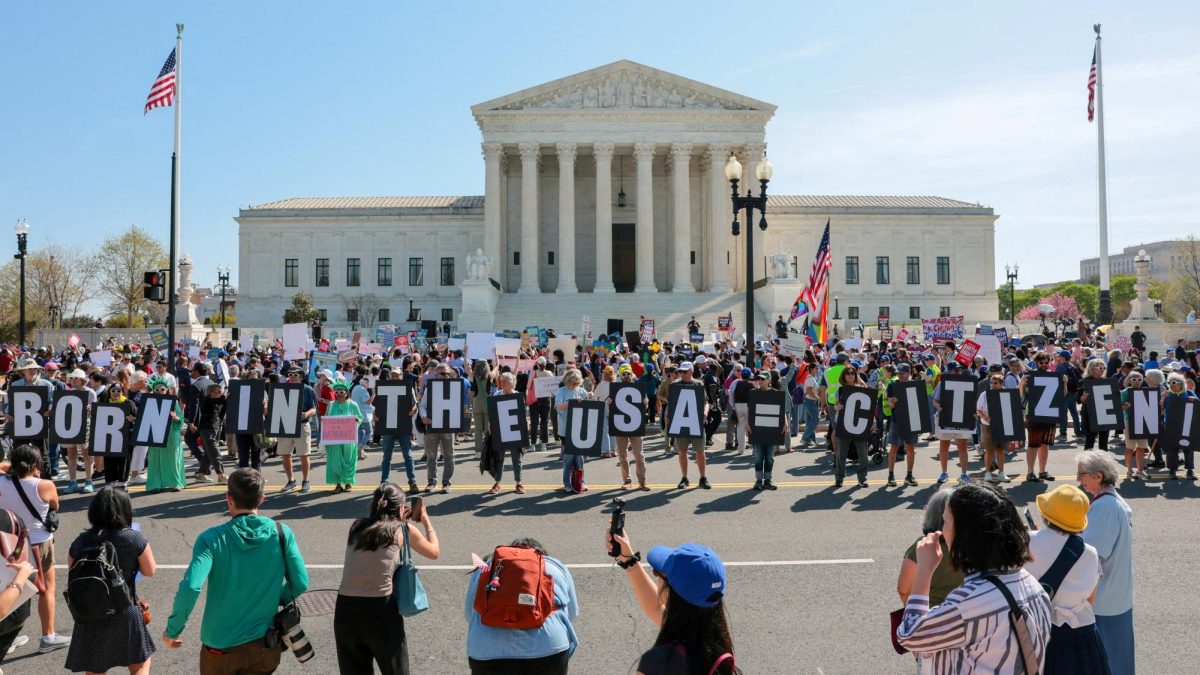
During President Donald Trump’s second term, we have seen the lasting implications of the 2024 Supreme Court decision in creating leeway for presidential disregard of the Constitution. In January 2025, Trump signed Executive Order 14160 attempting to unilaterally remove birthright citizenship protections for the children of immigrants and individuals temporarily in the United States. Although the Supreme Court in Trump v. Barbara recently struck down the executive order as a direct violation of the 14th Amendment, the attempt itself still signaled a stark deviation from what ought to be a deep presidential respect for the Constitution.
The Trump administration has furthermore undermined constitutional norms and principles by accelerating mass deportations and detentions without due process, restricting access to the White House for AP News in contravention of First Amendment free press rights and unlawfully deploying National Guard troops in violation of the Posse Comitatus Act. By removing criminal accountability in an official capacity, the Trump v. United States decision paved the way for these abuses of executive authority.
And because the Trump v. United States ruling serves as stare decisis — binding precedent — presidential accountability has been damaged far beyond just the Trump administration, corrupting the integrity of our democracy for generations to come.
There are two ways to undo such a decision. The first is to overturn the ruling in another Supreme Court case. The second is to pass a constitutional amendment pursuant to Article V of the U.S. Constitution, either by proposal through a two-thirds joint resolution by both houses of Congress with ratification by three-fourths of the state legislatures, or alternatively through a proposal and ratification process conducted via state convention.
A potential constitutional amendment could read as follows: No person in the United States, regardless of political power, elected or appointed authority, socioeconomic status or familial relation, shall be exempt from equal application of the rule of law in a personal or official capacity. All persons in the United States shall be held accountable under the Constitution as the supreme law of the land and all laws passed by Congress.
The result? A lack of public trust in the government.
A Pew Research survey conducted in 2025 found that only 17% of Americans believe that the government would “do what is right” either “just about always” (2%) or “most of the time” (15%). Accountability is critical to restoring trust in the government’s ability to “do what is right.”
If we are to be a government “of Laws” and not “of Men,” as Adams once claimed, then we must take a stand and enshrine equal application of the rule of law into our Constitution. It is only by doing the arduous work of codifying such a core democratic principle into our nation’s highest document that we can thoroughly ensure accountability for America’s highest offices and the continuation of one of our most essential democratic principles.