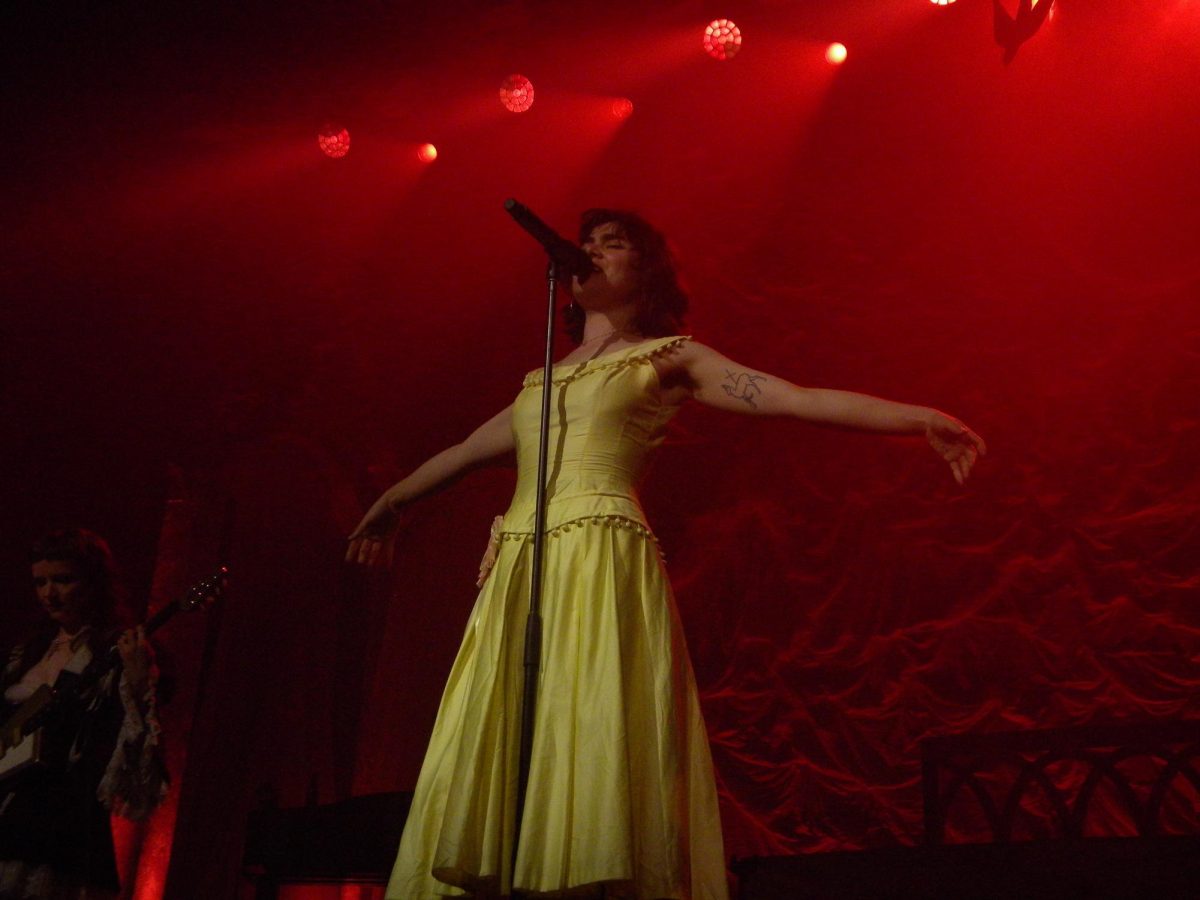


I discovered Peter McPoland the way most of us discover music these days: an algorithm. An afternoon Spotify “Daylist” full of Two Door Cinema Club and Del Water Gap also spat out McPoland’s hit “Digital Silence”. His Spotify page paints a similar picture. He’s featured on both the “Indie Rock Hits” and “Feel-Good Indie Rock” playlists, and his image gallery is dark and angsty, silhouetted with crimson stage lights. This is the vibe I expected when I arrived at Brooklyn Bowl Feb. 22. I was surprised to see the opener was a pair of folksy men in baseball caps, armed with a steel resonator guitar and a banjo. Meet DUG — an Irish-Americana folk duo that started the night with a dark kickdrum beat on their song “Big Sundown.”

DUG continued to delight, performing songs like “Wheel of Fortune” and “Jubilee”. In between tracks, they explained their origins: Lorkin O’Reilly, on guitar, was born in Edinburgh before moving to upstate New York; he returned to Dublin in 2022. Banjoist Jonny Pickett is a California native who lit out for Ireland near the same time.
Their transatlantic blend of styles took me back to my childhood in Southern Appalachia—to barn dances where my aunt played the fiddle so long her fingers blistered, and the caller struggled to be heard over the music and cheers. Much of Appalachian music came from Irish and Scottish immigrants, after all. DUG captured the spirit of a community gathering in a room full of people who had never met and would likely never see each other again. Music has this effect, but so does frustration, and DUG used this to their advantage for the unreleased track “Promoter Man,” in which they shouted grievances against the music industry. The crowd responded with loud boos, especially when they mentioned the expensive “service fees” often charged by online ticket sellers.
They ended their set with a cover of “Cumberland Gap,” a well-known Appalachian folk song, and encouraged the crowd to dance in circles and with partners. They left the crowd with delightful, nostalgic energy and as the room brightened, I wondered how McPoland might follow this.

My question was answered when McPoland walked on stage with his band, but instead of standing next to their instruments, they arranged themselves around a single microphone like the members of Queen in the Bohemian Rhapsody music video. They performed an acoustic cover of “Dead Air,” acapella save for McPoland’s guitar. He followed with “Speed of the Sound (of you)” and “What Do You Do To Me?”, the latter of which was exactly the indie rock I was expecting.

This would be the spectrum of the night: on the one hand, acoustic folk ballads, and on the other, electric guitar-shredding rock. McPoland addressed this early in the show, saying he’d completely changed the setlist from the rest of the tour to better fit who he is as an artist. He mentioned the more acoustic music he’d enjoyed growing up, and that this would be his sound going forward.
“I’m coming back,” he declared, and the crowd cheered.
McPoland followed with tracks “Slow Down” and “Mary Anne” before performing a near-seizure-inducing rendition of “Blue” on a white electric guitar as the room exploded with strobe lights. He talked about city skylines, and how they influenced his song “Shit Show”; he mentioned playing John Prine’s first album on his tour bus and watching the countryside go by. He covered a John Prine song next, “Bruised Orange (Chain of Sorrow)”, with bassist Landon Lainey. This was an unrehearsed affair — they kept skipping lines and singing out of sync — but they laughed it off.

The final act of the night included hit “Romeo & Juliet” (the original version, as McPoland described it, was “300 bpm faster than it is now”), an acapella foursome version of “Swing Low, Sweet Chariot,” my introduction “Digital Silence” and fittingly, “Last Looks”. There was no encore.

Peter McPoland’s show was not what I expected it to be, but in doing so, he separated himself from the legions of indie rock hopefuls into new territory. Maybe I’m biased, but I found his new, older style more emotional, relatable and appreciable (though I love an occasional cathartic rager of a song). That night at Brooklyn Bowl felt like a synthesis of old and new — and I, personally, can’t wait to see what he does with both.