
My phone flooded with texts from my Hispanic friends at Vanderbilt and surrounding universities.
Their main concern: “How will the current violence in Mexico affect the perception of Latinos here in the United States in an overly polarized country?”
I don’t know. Fighting for a place in a country that subjectively opposes diversity is difficult. Any negative event involving Latinos, in this case Mexicans, will only drive this hatred.
Mexico’s military, in collaboration with U.S. intelligence, killed its most wanted person, Nemesio Ruben Oseguera Cervantes, aka “El Mencho,” Feb. 22. Cervantes was the leader of the Jalisco New Generation Cartel, one of Mexico’s most powerful and dangerous cartels, based in western Jalisco, a Mexican state.
The CJNG has been connected to extreme drug-trafficking operations between countries, most notably trafficking mass amounts of fentanyl into the United States.
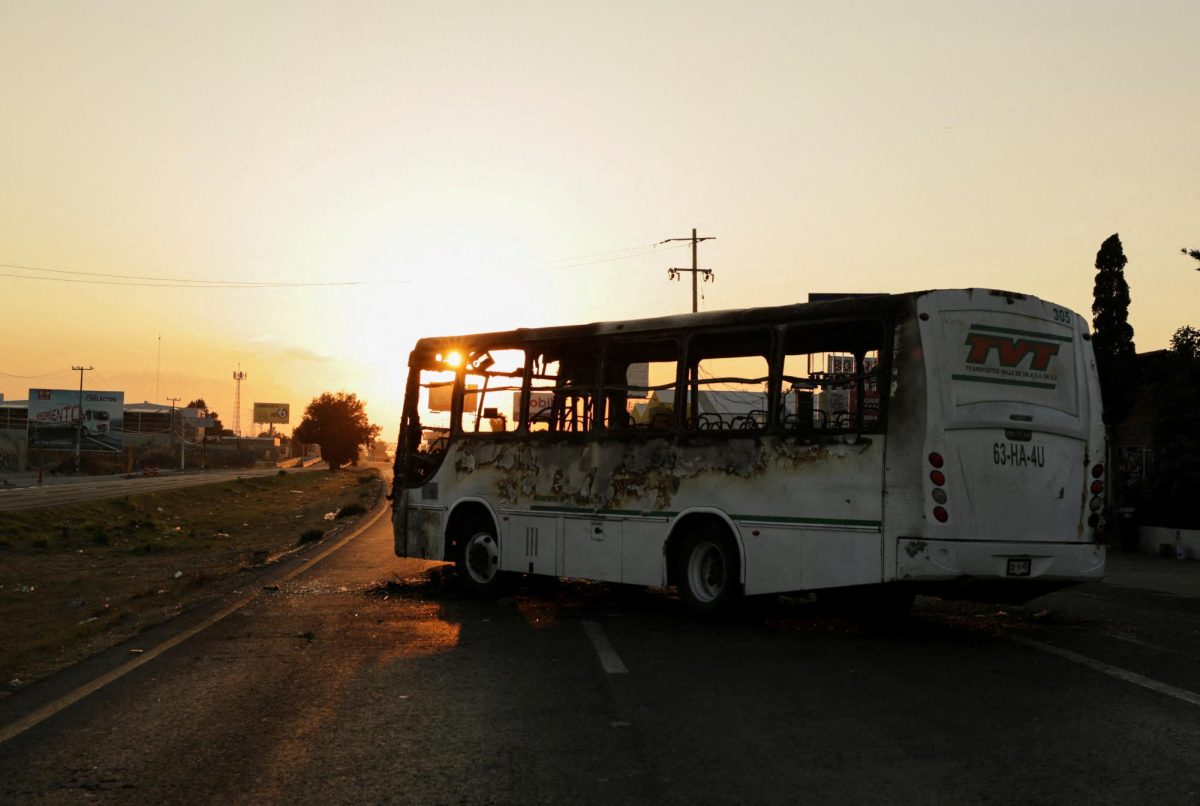
On the ground in beautiful Mexico, innocent citizens are paying the price for this event. At least 20 states have seen civil unrest since Cervantes’ death. This has been most notable in Jalisco, Michoacán and Guerrero, among many other states.
My family is from Michoacán, so this hit close to home.
Torched cars, destroyed businesses and a sense of community, quickly disrupted. What about my grandparents? My roots? Imagine what civilians are feeling: sheltering in place, making neighborhoods feel like ghost towns. All in efforts to protect innocent families from corrupt operations within Mexico.
Jesus Ruiz, Caribbean studies professor, agrees with this point. Although a dangerous leader is now gone, the poorest and most vulnerable will suffer the most.
“The removal of ‘bad actors’ has never resolved the deeper structural problems of violence,” Ruiz said. “Removing ‘El Mencho’ will set the stage for probably another cycle of violence that, almost always, falls hardest on Mexico’s poorest communities.”
This attack came after President Donald Trump consistently pressured the Mexican government to put an end on drug crimes, threatening military strikes with Mexico’s permission. Mexico’s president, Claudia Sheinbaum, has openly rejected U.S. intervention.
Arturo Sarukhán, former ambassador of Mexico to the United States, mentioned how this capture will ease a bit of tension between Mexico and United States but demonstrates flaws between political leaders when tackling crime.
“It’s going to be harder for Trump to continue having his cake and eating it too, which is providing glowing references to Sheinbaum while at the same time saying she’s afraid to take on organized crime,” Sarukhán said.
In a message to The Hustler, Edward Wright-Rios, Vanderbilt history professor and department chair, shared a similar point to Sarukhán, stating how pressure most likely directly affected the Mexican’s government timeline in executing this operation.
“The current U.S. administration is much more willing to encroach on other nations’ sovereignty and to threaten unilateral action,” Wright-Rios said. “This raid may well have been Mexico’s attempt to please the Trump administration. Of course, they will never say this publicly.”
I want to make myself entirely clear: I do not support Mexican cartels and drug trafficking into the United States. I’m sure my fellow Vanderbilt Hispanic community can agree. However, in evaluating how to best approach a war on drugs, greater factors must be considered before acting.
Ultimately, our political leaders have the utmost responsibility to protect and serve their constituents.
Dramatic uses of violence will not put a stop on the drug trafficking crisis in Mexico. History shows us that it has no real positive impact on the situation at hand, nor the greater community.
For example, Joaquín Guzmán-Loera, notoriously known as “El Chapo,” was one of Mexico’s most dangerous and powerful drug lords, leading the Sinaloa Cartel. Guzmán-Loera was known for smuggling mass amounts of cocaine, methamphetamine, marijuana and heroin into not only the United States, but also Europe.
Further, in the late 20th century, Pablo Escobar, Colombia’s most powerful drug lord, was known for smuggling large quantities of cocaine into the United States. Escobar was the founder and leader of the Medellín Cartel. At its peak, the cartel smuggled 80 tons of cocaine per month into the United States. In 1993, with support from the United States intelligence, Colombian police killed Escobar.
Three years after capturing El Chapo, the Sinaloa Cartel remains a dangerous force in Mexico. In addition, the production of coca, the raw material of cocaine, soared by 17%. Mexico also saw an 18% increase in homicides in the first nine months of 2018.
Further, to date, Colombia is still one of the largest producers of cocaine, and the United States remains the largest consumer of the drug. The war on drugs clearly continues.
Whether it be Guzmán-Loera, Escobar or Cervantes, it is clear that short victories do not address systemic issues. Our leaders are performing in political theater, attempting to be the protagonist in solving a corrupt plot. However, all three instances carry the same aftereffect on the country and the world, with or without its leader.
Lesley Gill, Vanderbilt anthropology professor, detailed how the U.S. approach on the drug war is more about targeting certain groups rather than wholly tackling the issue.
“The so-called ‘war on drugs’ that the United States has been waging at home and abroad since the time of [Nixon] is less about drugs than targeting groups that the government doesn’t like,” Gill said. “It is a way to justify intervention for all kinds of reasons under the guise of fighting drugs.”
Although president Richard Nixon inaugurated a war on drugs in 1971, this has been an ongoing battle for over a century. Since World War II, no politician has openly brought forward a plan to challenge the war on drugs systemically.
Wright-Rios depicted it perfectly, with Ruiz offering a similar perspective. Our political leaders love to paint the picture that externally handling situations is enough to show proper advancements on the war on drugs. That’s just not realistic.
“Our media tends to put these events into a simple ‘good guys vs. bad guys’ framing that isn’t an accurate reflection of realities on the ground,” Wright-Rios said.
Everything is clear. Vanderbilt professionals in Latin American studies prove it. Why can’t our lawmakers realize that?
In a message to The Hustler, the Mexican American Student Association recognized the violence in Mexico but reminded the greater Hispanic community at Vanderbilt to stay true to its roots. Moments of violence by one group of individuals do not define an entire community.
“Mexico is a nation rich in history, culture and resilience; moments of crisis do not define Mexicans and Mexican Americans. We stand in solidarity with those affected and aim to foster dialogue and support for students and staff in our community,” the statement reads.
Vanderbilt, this is a frightful time for much of the Mexican community on campus. Given our tiny population, it is sometimes hard to find a community during times of political violence. It is times like these that you must be willing to put aside differences to come together as one community.
Your professors stand with you; your school stands with you; your resilience as a Mexican American drives you. Carry it with you, always.
We are one Vanderbilt.
¡Viva la Raza!