


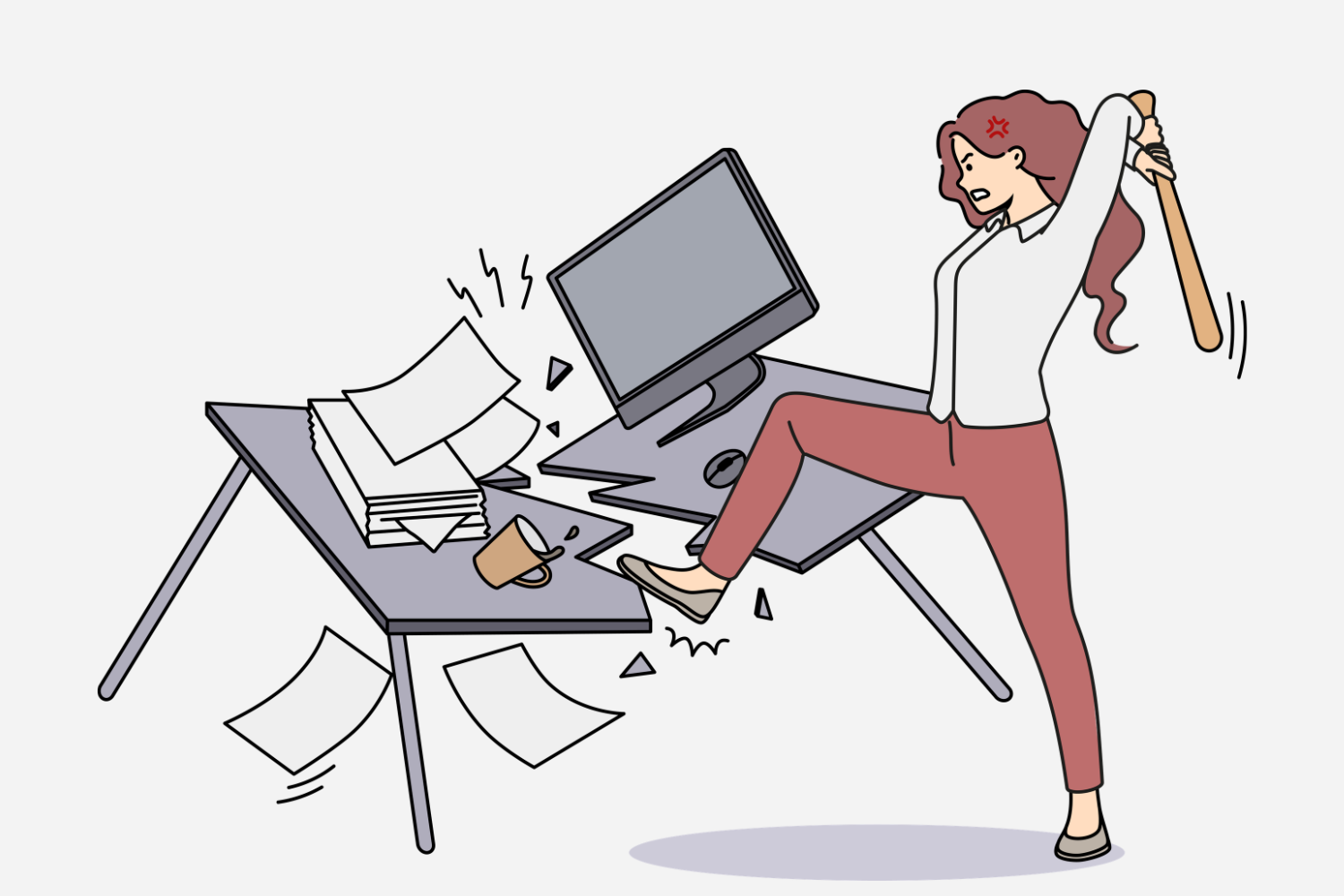
There is no method of undermining a woman more socially acceptable than criticizing her tone.
We do it constantly, and we do it under the cover of professionalism. When women speak with certainty, they’re “abrasive.” When they push back, they’re “difficult.” When they refuse to tone down their authority, they’re “aggressive.” But coincidentally, the same behaviors, when performed by men, are called “outstanding leadership.”
The truth is that the “aggressive woman” is not a personality type, despite what certain people may want you to think. It is a mold, a construct. And the power of that construct doesn’t lie in how often women are actually aggressive, but in how quickly that label is slapped onto them when they violate social expectations. The moment a woman takes up too much space, speaks too directly or stops performing the kind of restraint that is demanded of her: boom. We’ve got just the adjective for her.
I first started to notice this phenomenon when I inevitably became a victim of it. In middle school debate, I was constantly told that my tone in rounds was too aggressive, that I was disrespectful to my opponents. Middle-aged white men judging my rounds would leer at me with a pitiful frown and hit me with, “Honey, I think you should try smiling more.” I was 12. Never mind the inappropriate nature of the comments; they didn’t even make any sense! The whole point of the activity was quite literally to debate, not to smile or “be inviting.” It was utterly baffling to me.
That confusion only intensified when I started to notice that other opponents of mine would meet me with equal, if not more, aggression, and receive praise instead of criticism. And what set those individuals apart? Surprise, surprise: They were men.
These days, I am constantly getting déjà vu to middle school debate. Every now and then I feel 12 again. Except I’m 19, and now, the domain is college mock trial. The most persistent comment that I get from judges, and even peers, is about my aggression. I’ve been told that my style in the courtroom is anywhere from unprofessional to abrasive to downright sloppy. And look, I’ve never denied that my style of speaking and arguing is bold. But what keeps nagging at me is the fact that, if I were a man, not only would I not be penalized for my assertiveness; but I would almost certainly be rewarded for it. This isn’t even a conjecture; it’s something I’ve seen play out countless times in rounds. Judges will admire and outscore a man who is even vaguely sure of himself. But a woman with even a fraction of that surety, well, it seems she’s exhibiting some excessive disdain.
At this point, the familiar rebuttal usually appears: “Maybe you genuinely do have a tone issue. Ever thought about that?”
Well, sure. No one is arguing that professionalism means being hostile or disrespectful. But that response rests on a false assumption: that our standards for professionalism are neutral to begin with.
They aren’t.
What we think of as “professional” communication has been shaped by norms historically associated with men — directness, assertiveness, even confrontation — while still expecting women to remain agreeable. When women adopt those same behaviors that signal competence in men, they come off as rule violations.
Recent research supports the lived experiences of women like me. In fact, my experience in mock trial is something that plays out in real courtrooms around the country. In a 2018 study, researchers found that female attorneys exhibiting anger and passion were seen by juries as significantly less effective than their more passive female counterparts. For men, the exact opposite was true and passion was more effective. In short, aggressiveness is a gamble that men statistically should take, but one that women simply are not allowed to.
The word “aggressive” in and of itself is especially revealing of this discrepancy. In professional contexts, it rarely means “violent” or “hostile.” It means certain. It means unrelenting. These are precisely the qualities that are desirable when negotiating terms or giving closing arguments — until it is a woman that exhibits them.
I would be remiss not to mention the disproportionate allegations of aggression faced by women of color in particular. In her groundbreaking article, “Demarginalizing the Intersection of Race and Sex: A Black Feminist Critique of Antidiscrimination Doctrine, Feminist Theory and Antiracist Politics,” Professor Kimberle Crenshaw critiques the tendency to approach discrimination from a single “axis” (in this case, race or sex). The reality is that the two are interconnected, and in fact, according to Crenshaw, people who analyze cases of discrimination often focus on the most privileged members of the group they are examining. Applying this framework to sexism, people may view the experiences of women through the lens of the most privileged of those women. But women aren’t monoliths, and it is absolutely the case that women of color deal with the compounding of biases against their sex and their race.
If this sounds like overthinking to you, you’re probably experiencing the same denial I initially was. It isn’t lost on me that the phrase “They only call me aggressive because I’m a woman!” almost seems like a punchline. Because if someone pulls out the sex card or (can you imagine!) the sex and the race card, well, it simply must mean that they are incapable of taking criticism. These problems don’t exist anymore, haven’t you heard?
There are times I wonder whether it is better to simply be silent than face that kind of reception at all. But that is exactly the effect that the dismissal of women’s complaints is meant to have. It allows institutions, whether corporate, academic or even social, to maintain the fictitious belief that our society has overcome sexism, and that it simply isn’t problematic enough nowadays to speak about. But if that were truly the case, then the outcomes we observed would be even. They would reflect an even playing field with an even winner’s circle. But it’s simply undeniable that they don’t.
So, it seems that the women of today have two options: capitulate and self-monitor in hopes of better outcomes or defy norms and face the consequences. It’s a decision I have to make as a female competitor in mock trial. It’s one I’ll have to make in my future career. It’s one that, as the next generation of leaders attending Vanderbilt, us women will most likely have to make repeatedly in all aspects of our lives. But that’s not something we have to simply accept. Acknowledging this oppressive phenomenon is a good place to start. And whatever choice we make thereafter, it should be deliberate. More importantly, it should be informed and true to ourselves.
Calling a woman aggressive is not an astute observation. It’s a social critique. And it’s ironic that everyone claims to want and encourage confident women while simultaneously disciplining the behaviors that actually signal confidence. This is not to say that women should be exempt from critique, nor that gender explains away every professional conflict. But we shouldn’t forget that professionalism is not neutral, and pretending otherwise only entrenches inequality deeper. Disciplining the aggressive woman allows institutions to preserve their power structures while making a mockery out of those who speak up. And the more we dismiss women who call out the pattern, the more we prove exactly why it needs to be called out in the first place.







Ann Yingling • Mar 23, 2026 at 9:43 pm CDT
Incredibly well said. I faced this way back in 1960 although I have to say that that my stay advantage gave me an opportunity to at least participate, where the years in high school and before women were expected to be silent. My family discouraged me from attending law school because they were so concerned that it would encourage my outspokenness which didn’t really come from self-confidence, but came from having studied and from knowing what was actually true or correct. My daughter suffered through years of being called “ feminine Nazi” because she was assertive and outspoken. She is 42. It is a shame that in all this time we have made so little progress in insisting on what is fair
And correct and true.