

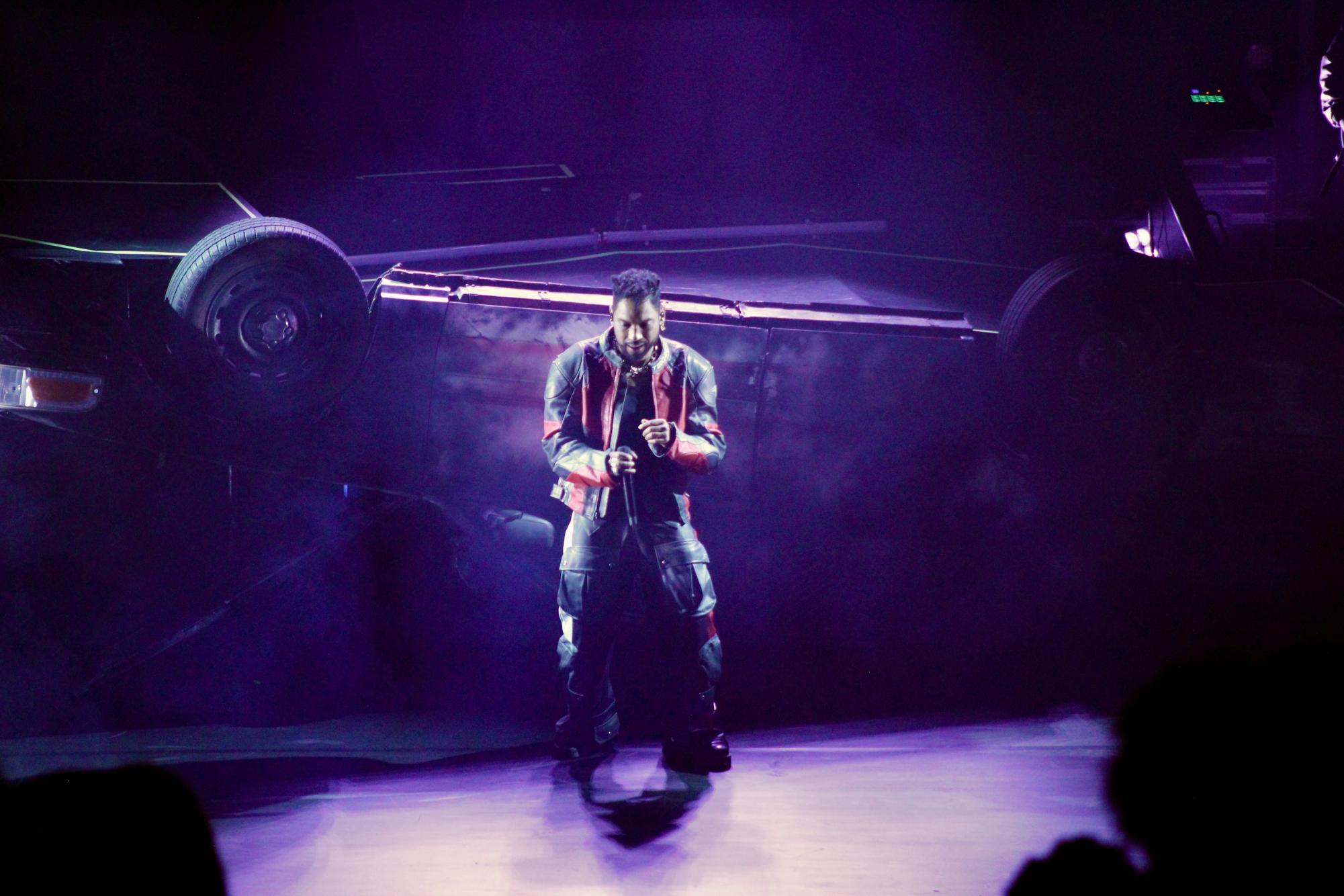
“How many drinks would it take you to leave with me?”
The question hadn’t even finished echoing through the arena before the crowd erupted. In an instant, I was on my feet, phone raised, my body leaning forward as if pulled by the gravity of Miguel’s voice.
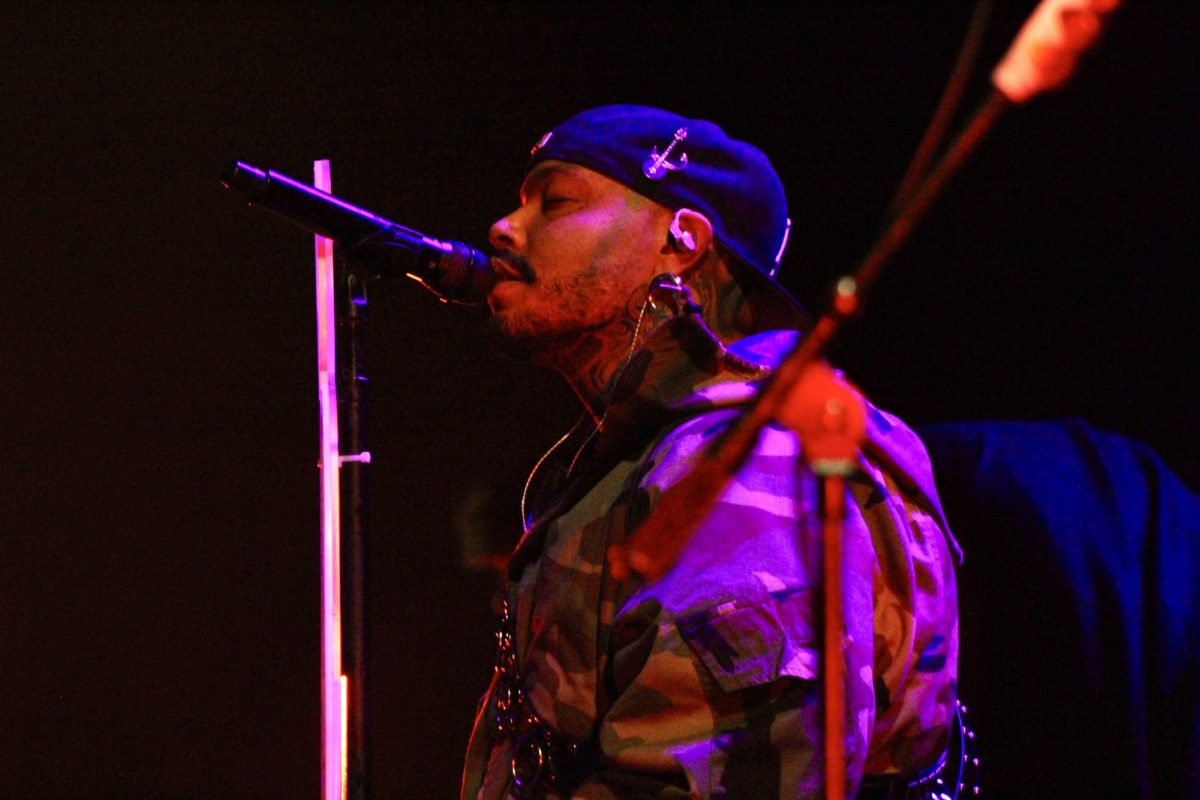
Fitted in a black tank top and a red‑and‑black leather tracksuit, he moved with the confidence of an artist who has spent more than a decade contributing to the sound of modern R&B.
Before diving into the chaos and emotion of the night, it’s worth remembering who Miguel is — a Grammy-winning singer whose blend of R&B, rock and alternative soul has made him one of the most genre‑bending artists of his generation. Since breaking through in the early 2010s with hits like “Adorn,” “Sure Thing” and “How Many Drinks?,” he’s built a reputation for performances that are equal parts sensual, political and deeply personal.
Before Miguel even stepped foot on stage, the night had a slow, steady build to it. Walking into the venue, the first thing I noticed was the long brown benches, the kind that look like they’ve held a lot of shows and a lot of people over the years. By 7:30 pm CST, the speakers were cycling through Kanye and The Weeknd, and the crowd was settling in.
When Jean Dawson came out as the opener, the excitement started to boil over. Once he shouted out, “my brother Miguel,” I finally understood: Miguel brought his friend on tour to give him a platform to impress. It was nice to see him get that space to perform his own songs before the main set even started.
While the stage crew reset after Dawson’s set, I ended up talking to a woman who had been following Miguel since 2009. She told me this was her fifth time seeing him live, and the way she talked about his music made it clear why people were willing to wait through anything to see him. Her favorite song was “What’s Normal Anyway,” a track she said she’s always carried with her.
“It’s the one that makes me feel the most understood,” she said.
Hearing that made the anticipation in the room feel even heavier, like everyone was waiting for someone who had shaped a part of their life.
Once Miguel was deep into the set, the stage itself became something you couldn’t look away from. Behind him, a massive three‑dimensional head floated over the stage that was so detailed and so lifelike that it only took me a moment to realize that it was modeled after his own face.
The stage felt like a scene paused in some alternate reality. A flipped car sat right in the center, and Miguel climbed onto it like it was just another part of the choreography. Around him was another car propped up.
The lighting kept shifting constantly: deep reds, then sudden greens, then blues that washed over the cars and made the metal glow. Every so often, huge white flashes would hit, bright enough that the crowd lit up for a second. The colors changed the mood of the stage every time they switched, and it made the setup feel alive, like the scene was breathing with him.
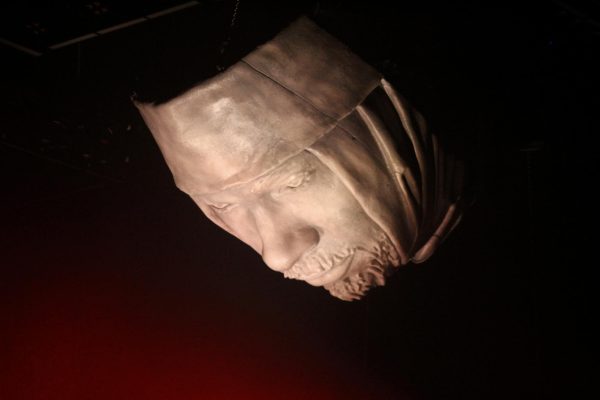
Miguel slipped offstage for a moment, and that’s when the giant three‑dimensional face appeared again above the stage. It had been appearing and disappearing throughout the night, almost like it was speaking to the crowd whenever it showed up.
The voice coming from it was calm but heavy, almost like it was trying to get everyone’s attention before Miguel came back out. It was one of those moments where the arena goes quiet because nobody knows what’s about to happen next.
Then Miguel walked back onstage, and he didn’t waste a second.
He went straight into talking about ICE, about families being torn apart, about people being killed in their own homes. His tone was sharp, frustrated, almost disbelieving. It sounded like a person genuinely tired of watching the same things happen over and over again.
Right after that, he pulled the audience into it. He started the “ICE out” chant. The lights kept shifting: red, green, blue, then huge white flashes, and the stage felt like it was pulsing with the chant.
Then he grabbed his guitar and eased into the next song. The first line he settled into was: “I ride for you / yeah I ride for you.”
His tone softened immediately, still intense, but warmer, more protective. And before the music fully took over, he said, “All that matters is that we look out for each other.” After everything he’d just talked about, it landed like the heart of the whole moment.
Somewhere in the middle of the chants, the floating face, the guitar and the heaviness of his words, I started paying attention to my own reaction. I’ve never considered myself a deep‑cut Miguel fan. I’ve always known the big songs, the ones that lived on the radio and soundtracked the early 2010s for pretty much everyone. But hearing them live, one after another, I realized just how many of his tracks I actually knew by heart. It caught me off guard.
There was something about the way he performed them on this CAOS Tour that brought that whole era rushing back. The early‑2010s vibe, the warmth, the R&B glow, the mix of softness and edge, it’s something people keep saying music doesn’t have anymore. But in that room, with the lights shifting and the crowd singing every word, it felt like it was right there again.
It made me realize how much his music has been sitting in the background of my life without me even noticing. And judging by the crowd reaction, I wasn’t the only one having that moment.
Walking out into the cold Nashville air, I kept thinking about how Miguel moved through so many different moods in one night: protest, romance, nostalgia, tension and softness. The CAOS Tour didn’t smooth any of it out; it let every shift sit exactly as it was. The mix of it all stayed with me as the crowd spilled out onto the street.