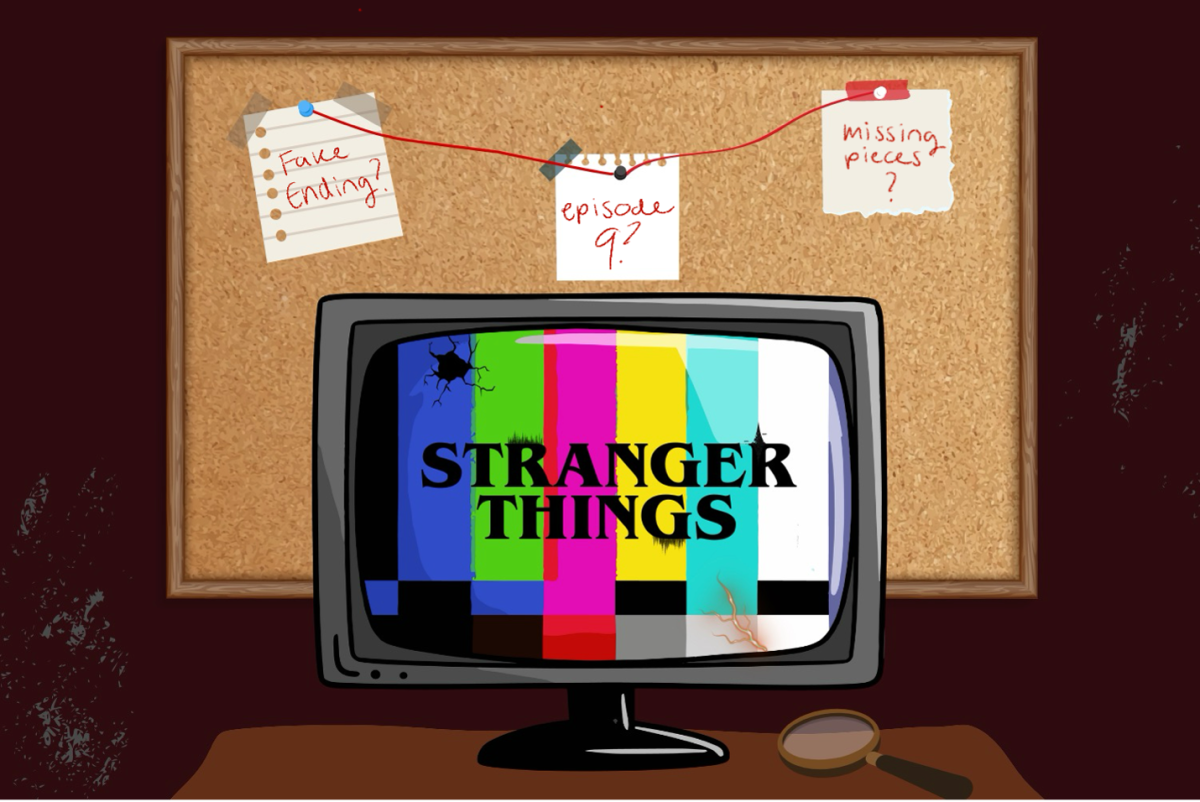

I was one of the many people who fell victim to believing in “conformity gate.” If you don’t know what that is, consider yourself lucky. I, on the other hand, was not so fortunate; my hopes were royally dashed Jan. 7 when I opened Netflix to see that a newest episode of “Stranger Things” had not been released.
Prior to this disappointing realization, I had been consuming a substantial number of online theories about the possibility of a new episode. All of the theories I encountered were grounded in careful reasoning based on the released episodes. Whether through the script’s writing, the lighting or color of a scene, the music or the actors’ body language, a ninth episode seemed entirely plausible. Because the finale felt so incoherent, many fans theorized that the Duffer Brothers were intentionally manipulating the audience, suggesting that the show’s main villain was not just deceiving the characters but the viewers themselves. The idea was that the eighth episode was deliberately bad in order to function as an illusion, a narrative trick meant to mislead audiences before revealing a true ending. This “conformity gate” theory essentially claimed that the eighth episode of “Stranger Things” was a “fake ending.” Many fans firmly believed a ninth episode would be released, arguing that the eighth episode was so unsatisfying that it had to be part of the ongoing plot.
Unfortunately, no new episode was released, leaving devoted fans disappointed. Like many of them, I was shocked. As someone who admires movies, television and the film industry as a whole, I consider myself observant when watching media; I often pick up on plot twists before they happen and can anticipate where a story might go.
However, recent movies and television in general have felt somewhat bleak in their plotlines and themes conveyed through directorial choices. Lately, I’ve been frustrated with shows and movies that fail to deliver on the stories they set up, leaving characters and plots underdeveloped and audiences unsatisfied. The eighth episode of “Stranger Things” felt exactly like that: rushed and full of gaping plot holes. The Duffer Brothers’ finale was uneven, sloppy and disconnected from the story that had been carefully built over previous seasons. Key plot threads were ignored, character motivations were muddled and the pacing threw off the central plot. The episode practically invited fans to question whether it was truly the end. As a result, the theory of a ninth episode didn’t feel like a shot in the dark; it felt like the logical conclusion of sloppy storytelling.
While fans’ speculation about “Stranger Things” might have seemed excessive to some, it was actually an example of critical engagement with media. According to the National Association for Media Literacy Education, media literacy is “the ability to access, analyze, evaluate, create and act using all forms of communication.” By analyzing narrative choices, character behavior, visual cues and tonal inconsistencies, fans were practicing this kind of critical thinking. The difference between thoughtful analysis and blind speculation is context, and in the case of “Stranger Things,” the Duffer Brothers’ disjointed finale created a context in which speculation was not only reasonable but necessary to make sense of the story.
Studies of online media consumption found that speculation is a central part of how audiences engage with shows, particularly for viewers who watch after the initial release. These viewers rely on speculation to interpret narrative gaps and to connect with broader fan communities, demonstrating that theorizing plot twists is not only normal but a vital part of modern media engagement. Fans’ reactions to the “Stranger Things” finale fit directly into this pattern.
The backlash to “Stranger Things” Season 5 was not the result of overzealous or media-illiterate fans but of writing that invited and then failed to resolve its own narrative promises. The Duffer Brothers planted deliberate ambiguities, visual cues and unresolved character arcs that reasonably suggested the existence of a ninth episode or an alternative ending. Fans did what modern audiences are increasingly conditioned to do: analyze, interpret and connect narrative dots. Research on digital media literacy shows that audiences are not passive consumers but active evaluators of content, trained to question gaps and inconsistencies. As one study argues, “efforts to promote digital media literacy can improve respondents’ ability to correctly evaluate the accuracy of online content across issues,” demonstrating that critical interpretation is now a learned and encouraged behavior. In this context, fan theories were not wild speculations, but logical extensions of the story the Duffers themselves constructed. When the finale failed to deliver, the problem was not that viewers expected too much; it was that the writing promised more than it delivered.
Ultimately, “conformity gate” was never really about whether a ninth episode existed. It was about trust: trust that creators will honor the stories they build and the audiences who invest in them. When fans turned to theories, they weren’t searching for plot twists but for coherence, meaning and payoff that the finale failed to provide. In an era where audiences are more attentive and willing to engage critically than ever before, sloppy storytelling is no longer something viewers accept. If anything, the “Stranger Things” backlash proves that fans are ready for more ambitious, careful and respectful narratives than some creators are willing to deliver. The real failure of the finale wasn’t that it confused audiences but that it underestimated them.