

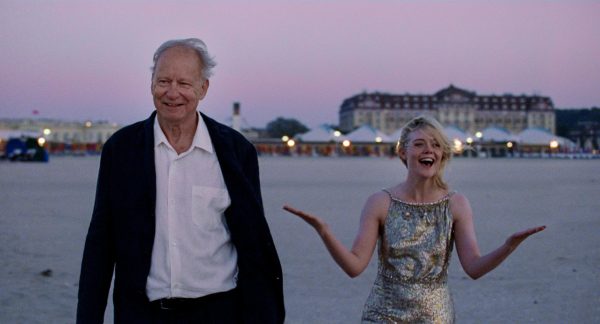
The film follows a Norwegian family consisting of two sisters, Nora (Renate Reinsve) and Agnes (Inga Ibsdotter Lilleaas), as they try to connect with their father, Gustav (Stellan Skarsgäd), a former director trying to return to filmmaking. When Nora denies her father’s request for her to be the lead in the film, he turns to Rachel Kemp (Elle Fanning), a Hollywood star to feature in the film. The film is raw and dramatic, unfolding the tension between the family as they pursue their different areas of arts.

In an exclusive roundtable, The Hustler joined other student journalists to discuss the process of creating a film like “Sentimental Value” with Joachim Trier and Eskil Vogt.
The house as a character
“Sentimental Value” uses the family’s childhood home to tell a deeper story and amplify the interpersonal relationships that each character has with one another. Joachim and Trier feature multiple scenes of the house throughout history, from World War II to the birth of the first sister and the breakdown of the parents’ marriage.
“The house is a witness of the twentieth century … we [decided to] trace every decade to the twentieth century until recent time,” Trier said.
The house and the set design in general are used as additional tools to create more space for the story and to engage the audience further. For example, Nora and Agnes have contrastingly different views of their childhood, which the two play with.

“To be a bit philosophical brings into the play the ambivalence of memory. [As human beings], cognitively. We put memories into place … [and] the house carries the memories, and they all have different stories and perceptions of the same space,” Trier said.
“Also, the house wasn’t only nostalgic. It’s also a burden, a relief to give up that house,” Vogt said. “What is a home? Is it a place? Is it a state of mind? Is it relations between people? It’s not a house, it’s more than that.”
Trier and Vogt’s process of making their films
Trier and Vogt’s creative partnership can be linked back to their first film they did together in 2005, “Reprise,” and their award-winning film, “The Worst Person in the World,” released in 2021. The two discussed how they work together, not just as co-workers but as friends.
“A lot of people have their screenplays sent by producers and they take them on as a director. With us, we start from scratch every time. We have a feeling of where we are at in life, so we share some personal material in all our works,” Trier said.
With the two being friends, there’s a flexibility in how they work which is different to others in the industry who may simply view each other as co-workers. The pair can balance being professional and casual with one another as they talk about films they have recently watched to draw inspiration in their own screenplays.
“We were in [my writing] room together all the time, for ten months, and the last two I write and send them to Joachim every day, and then we meet and discuss it. That has been a process since our second feature,” Vogt said.
The financial restriction on the arts
The movie imitates life with Gustav’s character trying to gain financing in a world that has vastly adapted to accommodate streaming services such as Netflix. Trier and Vogt are candid with how art is portrayed as a creative outlet, which, unlike others, requires a lot more money and reception to advance forward in the world.
“The financial structure of making movies is a battle. Being a filmmaker is like being a mixture of a poet and a military general,” Trier said. “You got to kind of have a strange mindset of battling and having to fight to get what you want but at the same time keeping sensitive to the actors and to the material.”
The pair wanted to portray the beauty of watching and making films as well as the larger impact that it has on audiences.
“There is a sense that things that are unable to be said in [society] can be presented to us through the medium of film,” Trier said.
“You can go to the movie theatre, alone or with friends, and be with strangers in the dark, which can turn into something very personal,” Trier said. “There’s a possibility of empathy with people who are very different from yourself, and, in this day and age, it is tremendously important.”
The Belcourt Theatre is currently having showings of “Sentimental Value” until Dec. 11, so be sure to catch it before it leaves!