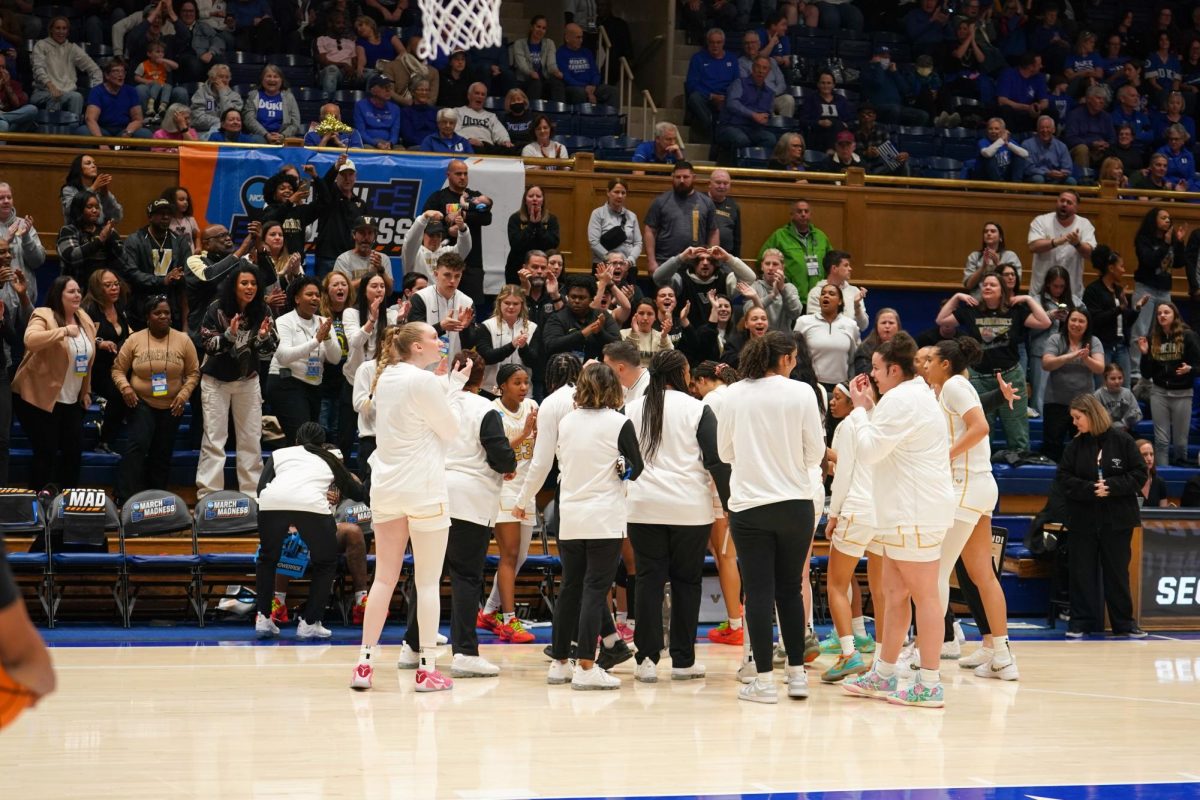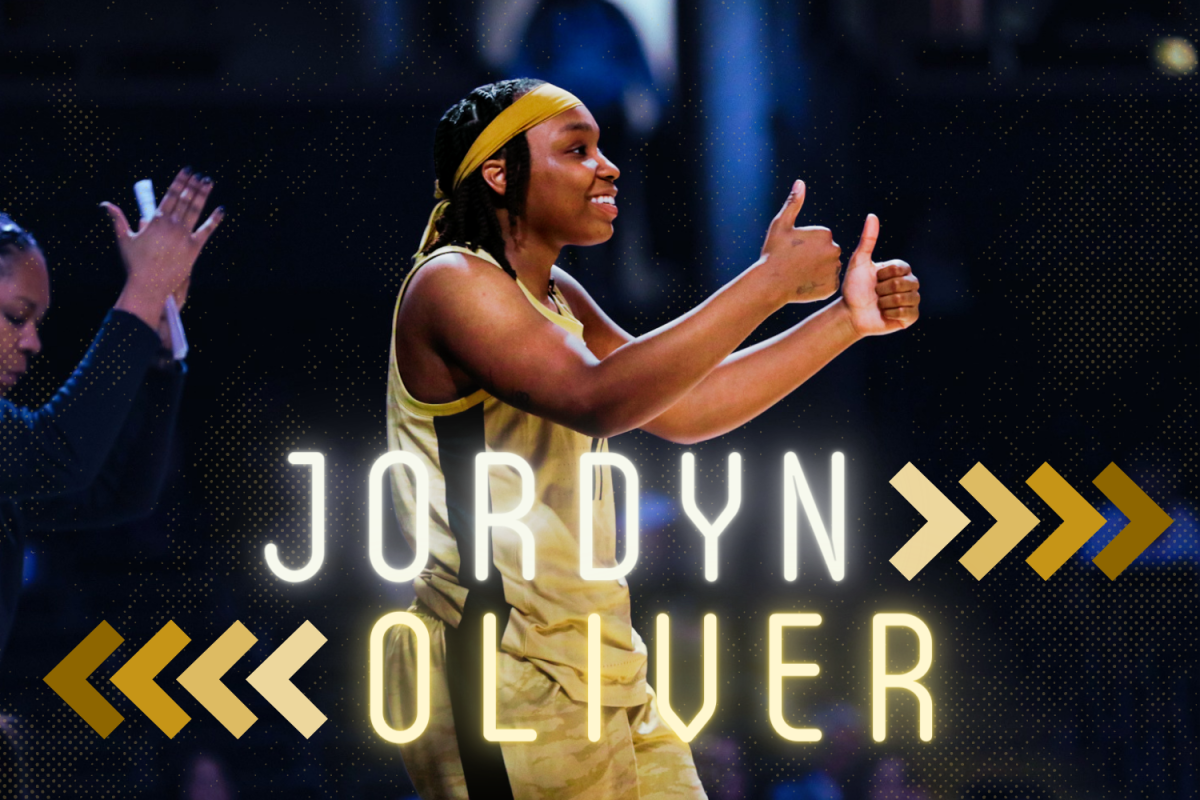


Following Vanderbilt’s first-round loss to Oregon in the 2025 NCAA Tournament, Jordyn Oliver was sitting at the podium, still in uniform, reflecting on what Vanderbilt had meant to her.
“I love Vanderbilt. Between coach [Shea] Ralph, Dr. [Candice Storey] Lee — the diversity here is just amazing,” Oliver said. “They accept us for who we are. They love us for us; they love JO for JO.”
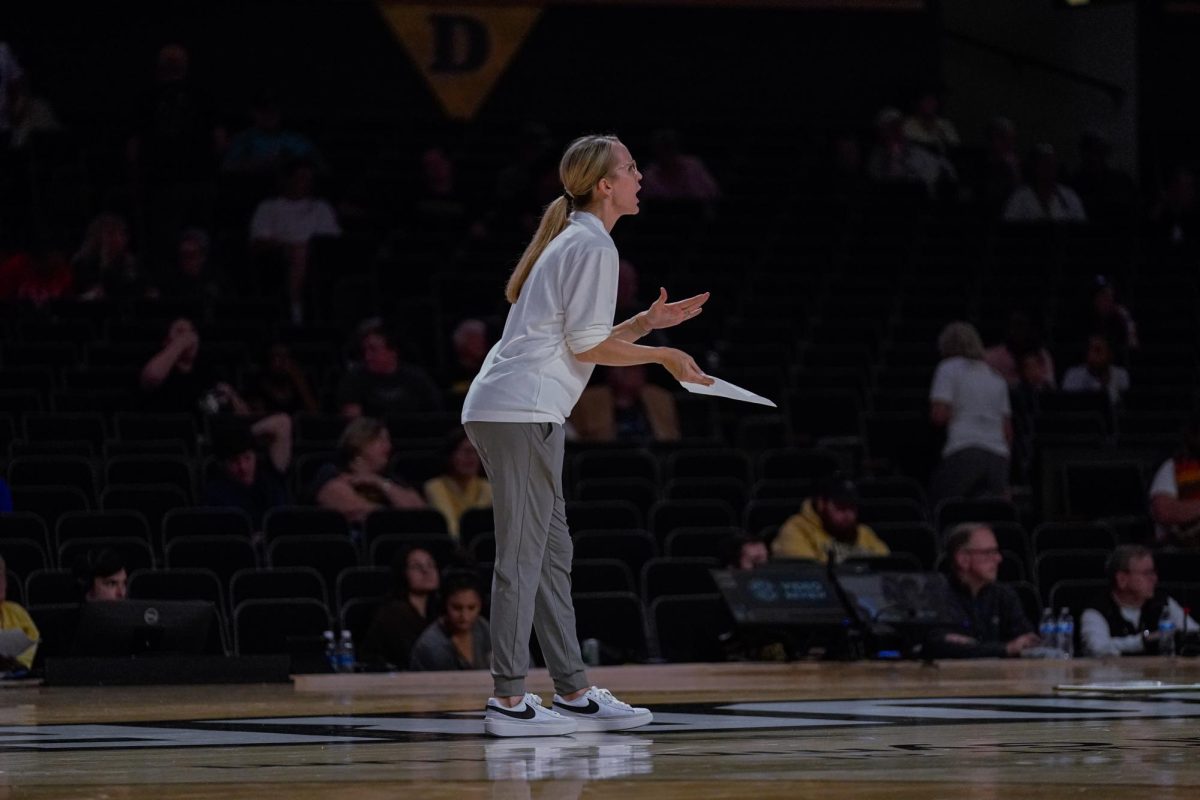
That’s when head coach Shea Ralph cut in.
“Yeah,” Ralph said with a smile. “She wants a job.”
The comment drew laughs in the room, but a few hours later at the team’s hotel, it became reality. Sitting with her parents, Oliver listened as Ralph told her she wanted Oliver to stay in Nashville and remain with the program, this time as director of player development. For Oliver, it was an automatic yes; as someone who had been a part of three different programs, there was no other place she wanted to return to more than West End.
“My career ended at 8 p.m. and at 9 p.m. I had a job,” Oliver said.
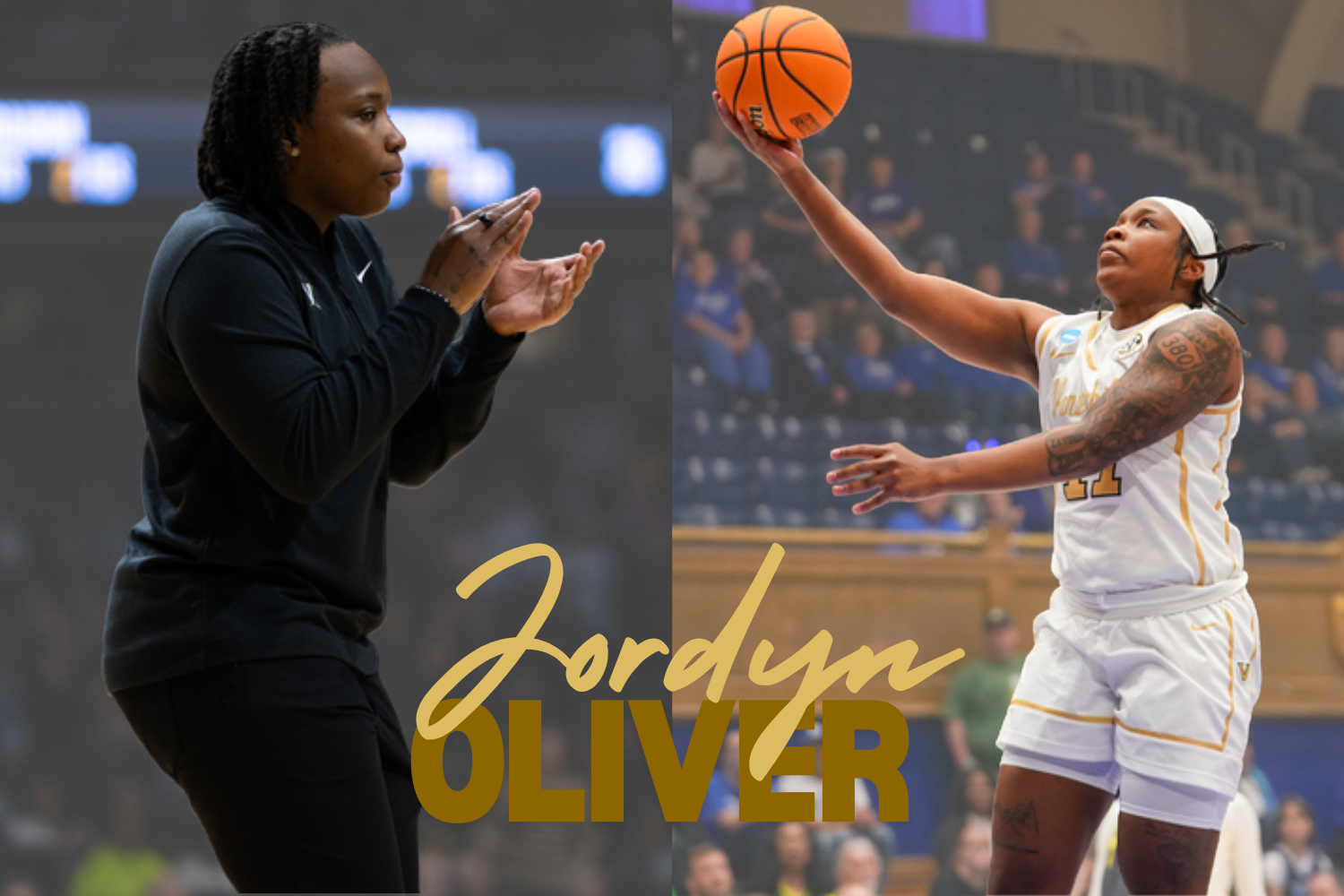
Oliver began her college career at Baylor in 2019. After two years with the Bears, she transferred to Duke in 2022 where she played one season and then spent her last two seasons at Vanderbilt. In her final year with the Commodores, she started all 33 contests, averaging 4.1 points, 4.5 rebounds, 3.6 assists and 1.7 steals per game. While these numbers might not jump off the page, Oliver brought leadership and intangibles that were critical to Vanderbilt’s back-to-back NCAA Tournament appearances after an 11-year drought.
Coming out of high school, Oliver did not think she had professional basketball aspirations, but she also did not know which career field to pursue. In her final year at Vanderbilt, her lingering injuries put professional basketball permanently out of reach. She became a leader on the team, and Ralph leaned on her to help manage the team. Now pursuing that goal in a different role, she still takes a sense of pride in the success of the program because she helped build it.
“I came here when we weren’t that good, and then we went to two [NCAA] Tournaments,” Oliver said. “So, it’s in me now to keep that tradition alive, because it’s a tradition that I feel like me and everybody else started.”
In the transition from player to coach, Oliver’s goals remain the same: to help Vanderbilt Women’s Basketball see success at the highest level.
“I want to do anything in my power to make sure that the girls are succeeding, coach Ralph is succeeding, everybody’s succeeding in the program, because I left the footprint here,” Oliver said.
The job
Fulfilling a role that touches nearly every corner of the program, Oliver has further embraced life as a behind-the-scenes utility piece: handling expense reports, helping with recruiting and stepping in wherever she’s needed. She calls it a “year of learning,” one focused on easing others’ workloads while understanding what it takes to coach at the collegiate level. That learning curve has been especially rewarding through scouting — an area Oliver has gravitated toward since stepping into her new role.
“I’ll stay up all night watching film. I love to get the film in,” Oliver said. “As an athlete, you only see the scout when it’s finished. You don’t see the process of the scout. So, [I’ve been] falling in love with how you have to watch four or five games to get a feel of a team. We didn’t do that when I played. We [would] sit down, watch the 10-minute clip and that’s it. So just being a part of that is so cool, it’s way better seeing how everything works.”
Oliver’s graduate degree in Leadership & Organizational Performance has shaped how she approaches her new role, teaching her to think about the program beyond the court. Viewing Vanderbilt Women’s Basketball almost like a business, she’s become more aware of the systems and details that keep everything running. That shift in perspective has made the transition from player to staff especially eye-opening.
“As a player, the managers take the bags off — food just randomly appears places. Now I’m like, ‘Oh, I have to put it there,’ so it randomly appears for the players,” Oliver said. “I’m used to going to team dinner and the food’s there. You never thought as a player, how did the food get here? And now I know somebody put it there.”
Since joining the staff midway through the summer, Oliver has been learning the recruiting process by observing evaluations and joining coaches on the road. Watching high school basketball for the first time since her own playing days, she’s had to recalibrate how she assesses talent. She is learning to focus on long-term potential rather than polished college-level performance — with guidance from assistant coach Kaili McLaren, whom she credits as a mentor.
“Being able to decipher [whether] this kid is good and she’s just being lazy or she’s having a bad day, but also not holding it against them, because I was so used to seeing college kids,” Oliver said. “I’m so used to seeing people that are like Mikayla [Blakes] and Sacha [Washington] and Justine [Pissott]. People that are already playing at the high level. So, trying to figure out how to see their abilities even though they’re 16.”
Leading friends
For Oliver, one of the most difficult adjustments has been shifting from teammate to coach on a roster that still includes many of the players she once played alongside. With only four newcomers, navigating relationships and learning when to step back — or speak up — has been a learning curve. Oliver described how presenting a scout in front of longtime friends can still be nerve-wracking. She recalled her first scout against Western Kentucky, when her old teammates turned around and clapped, leaving her both flattered and anxious.
“It’s hard, because you have best friends on a team and now you can’t really hang out with them anymore,” Oliver said. “Sacha is one of my best friends; she’s going to be in my wedding. I don’t really say things to her because it comes off like best friend-ish or harsh. Sometimes, just picking and choosing when maybe somebody else should probably say something, just because [the player] might take it a little bit more personal because we are friends.”
However, on the other side of that challenge is a sense of relatedness unique to Oliver’s position. She remembers how much outside stress — whether arguing with a friend or significant other or struggling in school — can affect a player’s performance. That perspective allows her to provide coaches with context for why a player might be struggling, helping bridge the gap between players and staff.
“As kids, it feels like the world is on your shoulders. When you’re playing, everybody is asking for a lot from you; it’s like your world is going at 100 miles per hour,” Oliver said. “So just giving coaches that perspective of [if] a player has a bad practice, that doesn’t mean that they don’t care, or anything like that. Just giving that perspective of things that adults sometimes forget.”
NIL lessons
While Oliver is involved in many aspects of the program, she steers clear of NIL discussions specific to how much the team is making. She prefers to stay focused on coaching and supporting the players without knowing the details of their financial deals.
“I don’t really sit in on NIL conversations. I also don’t really want to, because a lot of them are my friends, and I don’t need to know how much my friends are making,” Oliver said. “So, I’m like, ‘Hey, whatever y’all need from me. Y’all need to ask me a question, that’s fine.’ But other than that, I don’t really want to know how much my best friends are making.”
When Oliver began playing college basketball in 2019, NIL laws were not enacted. She’s seen firsthand how the landscape has changed for players since her first-year. Looking back, she felt she didn’t fully take advantage of the opportunities available to her and sometimes made impulsive choices with her earnings. Now, she uses her experience to guide younger players, emphasizing the importance of responsibility and preparation for life beyond basketball.
“I try to tell the players now [that] the real world is coming. Life is coming, and you need to prepare for that. You need to save your money,” Oliver said. “It seems cool right now to go buy a diamond chain. I promise you’re not [going to] be wearing your diamond chain to your corporate job, so it doesn’t really matter.”
Looking ahead
In the future, Oliver hopes to eventually grow into an assistant coach role, with recruiting coordination and greater leadership responsibilities coming over time. But she is careful not to rush the process. For now, Oliver is content playing her part on a staff she believes is already strong, prioritizing her personal growth, adaptability and impact.
That perspective is reflected in how she views leadership at the highest level. Drawing on the longtime dynamic between UConn head coach Geno Auriemma and associate head coach Chris Dailey — often cited as one of the most successful coaching partnerships in women’s basketball — Oliver sees herself thriving in a complementary role.
“I always tell coach Ralph, I want to be the CD to her Geno,” Oliver said. “I don’t know if I’m ready to be a head coach. She looks stressed most days, and I don’t want to be stressed. I’m not a stressful person, so I think I’ll let her be stressed and I’ll just be in the background.”
Oliver does not know exactly what her future holds, but she does know one thing: wherever Ralph is, that is where Oliver wants to be.
“I don’t really have a vision for my future. I am one of those people that lives life day-by-day, but coach Ralph is the person that I want to learn from, the person I want to grow from,” Oliver said. “So, if she’s at Vanderbilt, nine times out of 10 you’ll see JO somewhere near.”
As Vanderbilt heads deeper into the SEC season, the Commodores will continue to benefit from Oliver’s leadership and her recent experience on the court, guiding the next generation of players both on and off the floor.