

Art is more accessible now than ever before. Internet users can access millions of artworks online, and the rise of generative artificial intelligence allows anyone to create art within seconds.
Art museums, meanwhile, are famously inaccessible. On social media, users frequently mock “modern” or contemporary works found in museums, lamenting their supposed aimlessness and simplicity. Museums also carry a reputation for pretentiousness.
While I won’t necessarily dispute those claims, I disagree with the implications. In some ways, art museums can be more accessible than any other form of presentation, digital or otherwise. When you examine a piece in an art museum, be it a painting, sculpture or some other medium, you forge a connection with the artist in a way that digital media cannot replicate. Viewing the work in person, you see the product of the artist’s time and dedication, created by hand: every sketch line, every glob of residual paint, every mark and imperfection, every subtle detail, every patch of light. All these minuscule details serve a purpose, coming together as parts of a greater whole.
In an exhibit, an art piece on display isn’t a digital replica or printed dorm room poster — it’s the original, created with the artist’s fullest intentions. For a fleeting moment, the barrier between artist and viewer dissolves, transcending time and space. Gaze at a cave wall painting, and suddenly, you are watching your ancient ancestors rub pigment between their fingers, spending precious time on ritual as they fight to survive in a brutal world. Examine Van Gogh’s “Starry Night” and wonder how he felt while lying in his asylum bed and gazing at the boundless night sky. Trace his process as he painstakingly layered yellow whorls over blue to capture the wonders he saw. He knew his work was an insufficient depiction, and that no painting could truly come close to encapsulating what he experienced; still, he tried his best.
Of course, everything I just described is fantasy. I have no way of knowing how those artists actually felt during the act of creation. But isn’t imagination itself part of the immersion?
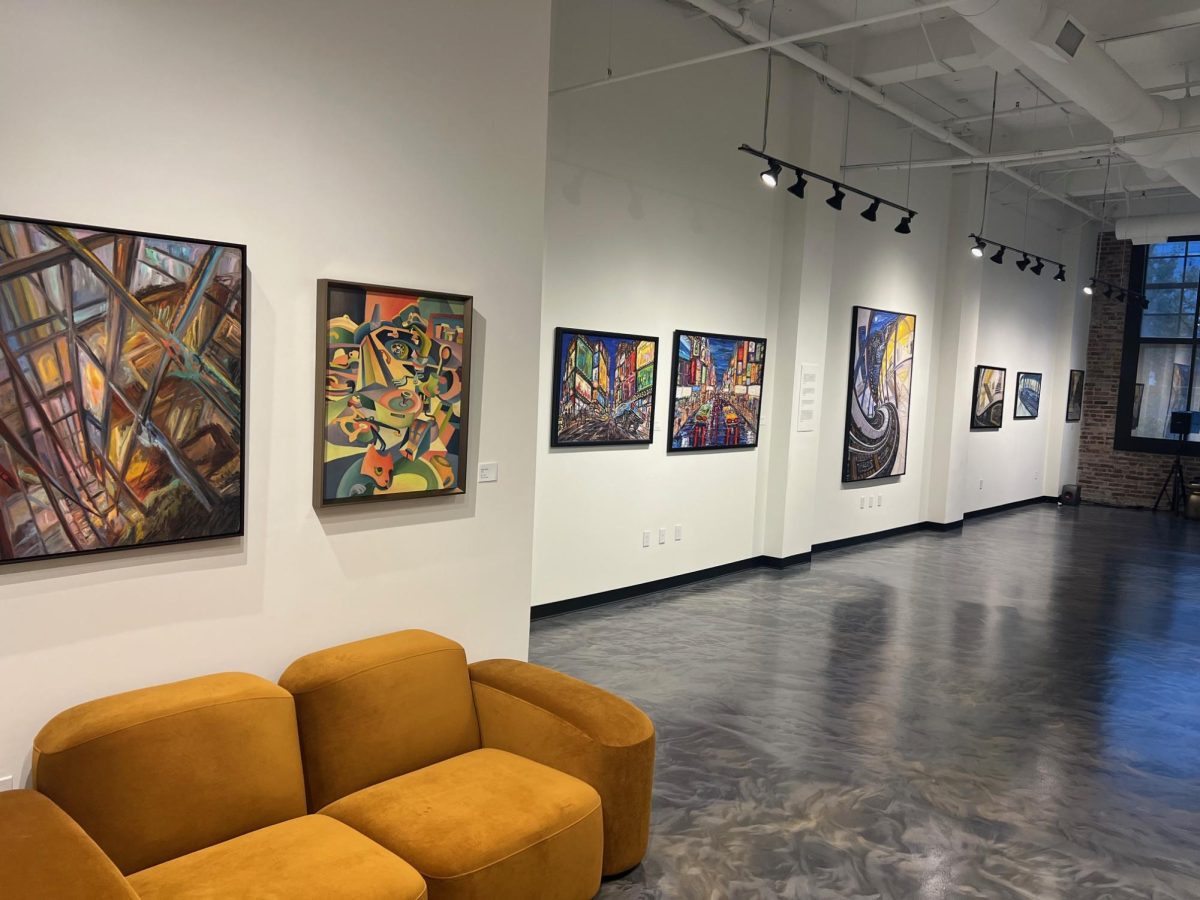
Beyond the artworks, there’s the allure of the gallery itself. With its winding hallways, white walls and relative uniformity, the gallery is a liminal space. It is a place that exists between realities, somewhere between public and private life. Each piece invites a unique connection with the viewer, forming a world that’s both infinite and intimate, one that outsiders cannot access. There is no time limit to how long the viewer can inhabit that world; galleries, by design, invite slow contemplation. You can spend as much time as you want analyzing displayed works and reading accompanying placards, all carefully curated to present a larger narrative. In an extreme example, a Harvard professor asks her students to observe a single artwork for three hours of uninterrupted time, a practice she calls “immersive attention.” The New York Times runs an ongoing feature series that recreates the “immersive attention” exercise, only for 10 minutes instead of 3 hours. I encourage Vanderbilt students to try it out with their free NYT subscription.
“Immersive attention” seems almost radical in today’s world of deadlines, TikTok videos, fleeting trends and the mantra that efficiency trumps all. At Vanderbilt, this frenetic mindset often dominates our lives, leaving little space for deceleration. We choke down the next gulp of Celsius and continue tormenting ourselves over our grades, our extracurriculars and our resumes for the merest glimpse of a “successful” future, whatever that may be. It’s exhausting.
I’m exhausted too, but it helps to focus on something else. Earlier this semester, I visited the Frist Art Museum’s “Fabric of a Nation” exhibition, which featured a variety of American quilts. I’d never particularly thought about quilts as an art form before, but I ended up pondering each stitch, marveling at the bright colors and detailed patterns. Many had connections to significant historical moments, ranging from the Civil War to the Japanese internment camps. Time seemed to slow down; my brain emptied, thinking only of the quilts and the stories underlying them. Taking time to view art can thus help us breathe during an overwhelmingly fast-paced era.
Finally, art museums are important because society is increasingly devaluing art. The arts are often dismissed as impractical, and students feel pressured to pursue more “lucrative” degrees. Meanwhile, brainless AI-generated images (“AI slop”) flood the internet, created to be consumed in one second and then discarded, replaced immediately by the next image that’s recommended by the algorithm. Especially with the advent of AI, art as a product is valued more than art as a process.
But art was never meant to be a disposable commodity or a one-way exchange between artists and audiences. Art should be a continuous, mutual dialogue comprising an eternal thread that connects and unifies. By visiting art exhibits, viewers consciously participate in that conversation. Even when they dislike or fail to understand a piece, their reactions become part of the dialogue.
In contrast, AI cannot engage in this dialogue, because it is removed from humanity. It only copies by rote what came before. Consequently, no AI art is original. Human-made artworks, and art museums by extension, will always have a place in the world.
I encourage everyone to visit an art exhibit. As Vanderbilt students, we have countless opportunities right at our doorstep. The on-campus Vanderbilt Museum of Art offers free admission, and the Frist Art Museum provides discounted $16 tickets for college students. Even if one doesn’t have enough time or can’t visit in-person, they can still visit websites like Google Arts and Culture or the Metropolitan Museum of Art’s online collection to view art (note that many museums have online collections). Although the experience wouldn’t be the same, it’s still an endeavor worth pursuing.
Viewing art at a museum creates an embodied experience, one that allows us to momentarily escape our solitary realities. In today’s frenetic culture, it’s worth considering a visit.